BRICS around the neck of the proletariat
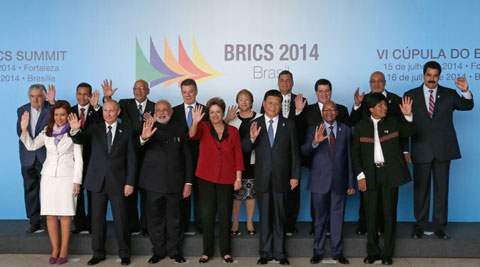
The Sixth BRICS Summit meeting held in Brazil was held in July. The occasion was one of wheeling and dealing between the two big BRICS bloc leaders and their Latin American supporters looking to set up an alternative to the traditional US dominance of the continent and an alternative to US global financial hegemony. The leaders also took time out to test the loyalty of US allies in the EU facing US-dictated sanctions on Russia that will cost the EU economies $billions. Putin used the FIFA World Cup to meet Merkel and discuss Ukraine. No doubt Russia is motivated to strengthen its push into Latin America as a reprisal to the US determination to push NATO right up against its borders. Not content to put pressure on the US bloc in Europe and Asia, Putin’s deal to write off most of Cuba’s debt and reopen a former Soviet spy base at Lourdes rubs the National Security Agency (NSA’s) nose in its own business. The rise of BRICS is regarded by many on the left today as a dynamic ‘anti-imperialist’ bloc challenging US imperialist hegemony. We challenge this view and show that BRICS may be a rival bloc but is neither ‘progressive’ nor ‘anti-imperialist’, because it is led by the emerging imperialist powers, Russia and China. We argue that the mounting inter-imperialist rivalry between the two blocs means we can only advance the world revolution by opposing and defeating both blocs.
The rise of BRICS is taking place in the context of the global crisis of capitalism. The post-Soviet, post capitalist-restorationist China, world of capitalism in decay is shaping up to look much like the world of a century ago, with inter-imperialist rivalry leading inexorably to another imperialist war. The emerging imperialist powers of China and Russia are positioning themselves as a bloc of BRICS against the traditional NATO bloc, with the United States as the dominant imperialist power since World War II.
As recent moves have shown, the declining United States is bent on maintaining this dominant position through preventing BRICS re-division of the world or re-dividing it for their benefit. The Pacific Pivot and the TPPA is directly aimed at China’s growing power in the Pacific, as was the sabre-rattling against North Korea, which was not only targeting the remaining gains of the collectivized property of the deformed workers state (DWS), but also served as a warning to capitalist China that they would call the shots in the region. Japan, an imperialist ally of the United States, has provoked China over the Senkaku islands.
Now the China-led BRICS nations have formed the BRICS Development Bank as a counter to the Bretton Woods IMF/World Bank. Although starting with a relatively meager $50 billion fund, the goal is to reach a financing capacity of $350 billion in a few years and eventually rival the World Bank, particularly with extra capital funding from China and Russia. Recently BRICS representatives were courting Latin American countries, a direct challenge to the United States. It is obvious that BRICS is wielding increasing influence, but as what? Is BRICS now beginning to pose a challenge to US hegemony as an anti-imperialist bloc or a bloc led by emerging imperialist powers, Russia and China?
Four Class Perspectives on BRICS
It is useful to breakdown the different views of BRICS by their ideological basis in one or other social class. Otherwise we have the spectacle of free-floating standpoints that reduce to national cultures, national geography, ‘blood, race or nation’, or ‘great leaders’ – ultimately, biology or genetics. The bourgeois class ideology of sovereign individuals in the free market is the default ideology of capitalism. This is the fetishised form that unequal production relations take as equal exchange relations. Value, rather than representing the labour time of workers, becomes the value of commodities as determined by the market. Individuals cease to be workers, capitalists or landlords and become sovereign individuals as buyers and sellers of commodities in the market and citizens with equal political rights. Capitalism is the best of all possible worlds provided individual freedoms in the market and nation state are not limited by other individuals and states. Today, bourgeois ideology takes three main forms –‘neoliberal’, ‘liberal’ and ‘radical’.
(A) Neoliberals
Neoliberals are neither new nor liberal. They claim to be liberal in the sense of 18th Century liberalism of free market capitalism. However, such liberalism (now neo-liberalism) never represented the reality of capitalism. The arrival and survival of capitalism since its beginning has required massive state intervention. Moreover, since the late 19th century state intervention developed into its highest form as capitalism had to move from competitive capitalism to state monopoly capitalism to deal with increasingly frequent and serious crises. (Lenin, Imperialism)
Neoliberals are apologists for state monopoly capitalism destroying organised labour and buying votes in order to dominate the ‘free market’. Neoliberalism was born out of the end of the post-war boom and onset of structural crisis in the early 1970s and announced its presence in the Chilean military coup with the overthrow of the populist president Salvador Allende to maintain US domination of the economy. Neoliberals don’t have any doubt that China, allied to Russia, leading the BRICS bloc poses a threat to US hegemony calling forth a New Cold War. Cynically the U.S. is presented as the bastion of the free market, individual rights and democracy rather than the dominant state monopoly imperialist power. Its mission is to defend these ‘values’ against those who would destroy them with superior state monopoly power, e.g., Russia and China. For neoliberals it’s as if the Soviets have come back from the dead and the cold war never ended. That is why they back date to 1949 the White House policy of expanding NATO and rallying the Pacific allies of RIMPAC to militarily box in Russia and China from making a transition from ‘regional powers’ to global powers.
The Liberal critique of neoliberalism recognises the hypocrisy of the ‘free market’ that was never free and always manipulated by power elites. Neoliberalism is defined as the specific period of US global hegemony that arose in the last 40 years, often referred to as the ‘Washington Consensus,’ under the leadership of the so-called ‘neo-conservatives,’ i.e. the subset of neoliberals who try to disguise the realpolitik of monopoly of state power behind ‘traditional’ bourgeois cultural values of family, nation and god. Liberals therefore share the neo-liberals assumption that the problem is not the imperialist epoch of state monopoly capitalism, but rather the monopoly of power held by the wrong class, the imperialist elite. Therefore the liberal trick is to replace the imperialist elite with the power of the people! Enter the BRICS.
(B) Liberals
Against this official ‘neo-liberal-con’ view of the old (now revived) cold war where confrontation and war are necessary means to prop up U.S. state monopoly capitalism, the bourgeois liberal ideologues see the rising economic power of BRICS as a ‘counter-balance’ to the ‘Washington Consensus’ that can lead to ‘multipolarity’. There are some like Tom Engelhardt who discount multipolarity in the face of an overwhelming US global power that dominates geopolitics. Others like neo-Stalinist F William Engdahl see multipolarity arising like a phoenix as Russia and China challenge US economic and financial hegemony:
“Taken as a totality, along with other measures by Russia’s Putin to deepen political, economic and military ties with China and the other nations of Eurasia, the latest energy agreements have the potential to transform the global geopolitical map, something Washington’s war faction will not greet willingly. The world, as I’ve noted before, is in the midst of one of a fundamental transformation, such as occurs only every few centuries. An epoch is ending. The once-unchallenged global hegemony of the Atlantic alliance countries of the USA and EU is crumbling rapidly.”
Today’s liberals are more the descendants of Adam Smith than the neoliberals because they agree that the equal exchange in the market has been distorted by the concentration of power in the hands of ruling elites. Smith believed that the market was rational and that competition and ‘comparative advantage’ was sufficient to organise the economy and the ‘wealth of nations’. Comparative Advantage was based on the exchange of commodities at their labour value. The ‘hidden hand’ rewarded each person according to the amount of labour they could command in the market. Equal exchange would result unless nation states intervened to manipulate or monopolise the market. We can now see how liberals today see the distribution of power as determining the distribution of income and the need for a liberal state to regulate power relations in the marketplace. This is clear in the history of liberal reforms that attempt to balance the power of organised labour and capital.
‘Multipolarity’ is therefore the 21st century liberal road back to the utopia of Adam Smith, where the ‘rebalancing’ of excessive state power, allows the ‘free market’ to become the guarantor of the ‘commonwealth’ of citizens. The main tools of ‘multipolarity’ focus on the destruction of monopoly power to control production, distribution and exchange of value on the world market. For liberals who are fixated on the fetish of the market and the symbol of the market, money, this means breaking the dominance of the US ‘juggernaut’ over the “international finance system” – the U.S. Dollar as the global reserve currency–by setting up rivals to the World Bank and IMF.
Pepe Escobar, at the Asia Times, writes:
“ It’s been a long and winding road since Yekaterinburg in 2009, at their first summit, up to the BRICS’s long-awaited counterpunch against the Bretton Woods consensus – the IMF and the World Bank – as well as the Japan-dominated (but largely responding to US priorities) Asian Development Bank (ADB). The BRICS Development Bank – with an initial US$50 billion in capital – will be not only BRICS-oriented, but invest in infrastructure projects and sustainable development on a global scale. The model is the Brazilian BNDES (Brazilian Development Bank ed.), which supports Brazilian companies investing across Latin America. In a few years, it will reach a financing capacity of up to $350 billion. With extra funding especially from Beijing and Moscow, the new institution could leave the World Bank in the dust. Compare access to real capital savings to US government’s printed green paper with no collateral.
And then there’s the agreement establishing a $100 billion pool of reserve currencies – the Contingent Reserve Arrangement (CRA), described by Russian Finance Minister Anton Siluanov as “a kind of mini-IMF”. That’s a non-Washington consensus mechanism to counterpunch capital flight. For the pool, China will contribute with $41 billion, Brazil, India and Russia with $18 billion each, and South Africa with $5 billion. The development bank should be headquartered in Shanghai – although Mumbai has forcefully tried to make its case (for an Indian take on the BRICS strategy, see here ).
Way beyond economy and finance, this is essentially about geopolitics – as in emerging powers offering an alternative to the failed Washington consensus. Or, as consensus apologists say, the BRICS may be able to “alleviate challenges” they face from the “international financial system”. The strategy also happens to be one of the key nodes of the progressively solidified China-Russia alliance recently featured via the gas “deal of the century” and at the St. Petersburg economic forum.”
Using such tools, multipolarity will result in a rebalancing of the share of global power among the big powers, as a means of both increasing and redistributing economic wealth. But the utopia of the liberal bourgeoisie won’t work unless the working class and other oppressed people are won to it by reformist political parties and trades unions. Thus the working masses must be convinced that the BRICS bloc can reform global capitalism and reverse the massive social inequalities by redistributing global wealth. This liberal perspective is the basis of Hardt and Negri’s Empire, published in 2000 that promoted the liberal left utopia of a world where imperialism was outmoded and the Empire was being ‘civilised’ by the ‘multitude’ now led by the a new middle class of ‘immaterial workers’. Empire was immediately confounded by 9/11 and the onset of the ‘war on terror’ and the Argentinazo. U.S. imperialism re-asserted its hegemonic power in invasions and wars in Afghanistan and Iraq and the liberal utopia was rudely dashed by the rampant neo-cons. The rise of BRICS – the so-called ‘emerging markets’ – since 2000 however, has given the liberal standpoint renewed hope in the form of ‘multipolarity’.
One of the ways that Russia and China are presented as ‘progressive’ leaders of BRICS is the claim that they represent the former or present forms of ‘socialism’ that facilitate the transition from capitalism to 21st century socialism. Where they lack credibility as models of 21st century socialism for the masses, then at least they can be pushed in that direction by the example of the ALBA (Bolivarian Alliance for the Peoples of our America) states, namely; Venezuela, Brazil and South Africa that all have popular front Governments with strong mass support. This is also the case in Cuba, which in our view has restored capitalism under the influence of China and has now become the ideological cheer-leader linking BRICS to Bolivarian socialism that is promoted by the World Social Forum (WSF) as embodying the phoenix that rises out of the ashes of the ex-Soviet world. These popular front regimes are the models for a global popular front. Under the control of the governmental and corporate elites, BRICS continue business as usual exploiting the masses and polluting the planet. Yet mass pressure from below can force the BRICS to implement a popular socialist program. The strongest expression of this liberal populism was that of the “Brics from Below” conference held in South Africa during the 5th BRICS summit in 2013.
This theme was also taken up in the 6th Summit in Brasilia and Fortaleza, notably by Russia with its emphasis on political and military cooperation with Latin American countries, especially Venezuela and Cuba. Andrew Korybko writing in “Russia and the Latin American Leap to Multipolarity” argues that Russia’s resurgence from collapsed Soviet state to ‘Great Power’ status means it is attempting to recover its old spheres of influence. Latin America figures strongly in this recovery:
“Russia has restored its Soviet-era global reach under Vladimir Putin, extending its influence all across the world. Because it fulfils the role of a strategic balancer, relationships with Russia are now more prized than ever as the world moves towards multipolarity. Certain contextual backgrounds make Latin America overly receptive to multipolarity and Russia’s grand foreign policy goals in this regard. Over the past decade, Moscow has spun a complex web of relationships to directly and indirectly extend its influence in the Caribbean and along both coasts of the South American continent. This strategy is not without risks, however, since all of Russia’s partners are vulnerable to various US-sponsored destabilizations. If managed properly, however, Russia’s return to Latin America can be a godsend for multipolarity, and it can even reverse the Pentagon’s strategic initiative and for once place the US on the defensive within its own natural sphere of interest…[a]round this time [around 2000], Russia was rising from the ashes of the Soviet collapse and finally returning to its Great Power status. It thus felt the need to expand its sway back into areas which it once held influence, and this of course included Latin America. Mutual visits, weapons deals, and energy contracts flourished between Russia and Venezuela since 2000, and both countries were already deep strategic partners by the time of Putin’s 2010 trip to Caracas. Military cooperation in the naval and aerial fields solidified the relationship and showed both sides’ commitment to one another. All of this influenced and has been in line with Russia’s 2013 Foreign Policy Concept, where the pursuit of multipolarity is taken as an assumed granted (having first been stated as an official foreign policy goal in 2000) and increased interaction with Latin America is emphasized.”
Cuba and Venezuela are the bridgeheads for Russia’s return to Latin America, just as they have been for China. The ALBA states have established ‘strategic’ relations with both major BRICS powers. Bolivarian socialism or 21st Century Socialism has seized on Russia and China as non-imperialist, if not ‘socialist’, powers that can rescue them from U.S. imperialist subjugation and bring about the self-determination of the underdeveloped and ‘emerging’ nations globally. “Win-Win” deals will enable all partners in the BRICS to prosper together in harmony. Thus the rise of the BRICS represents a re-balancing of the global situation where U.S. imperialist hegemony is reigned in and power is more evenly distributed among a number of ‘great powers’.
Not surprisingly, the 20th century socialism of Lenin and Trotsky is replaced by the 21st century utopia of multipolarity as the BRICS reform global capitalism, which once rid of the aberration of financial parasitism, realises a Smithian equilibrium of non-exploitative social relations among all nations. This liberal utopia is translated via the labour bureaucracy in the unions and politics adopting a more ‘left’, even ‘Marxist’ language. The debt to Kautsky, Menshevism and Stalinism is obvious in the potential of all these global powers to arrive at a policy of ‘peaceful coexistence’. This marks the death of Lenin’s theory that in the epoch of imperialism the major imperialist powers must fight for supremacy, or go into decline. Imperialism for Lenin might have been the highest stage of capitalism, but that is now passé as it is peacefully passing over into 21st century socialism.
So, it is no irony that 21st century ‘Bolivarian socialism’ replicates the patriotic fronts of 20th century Stalinism, which advocated that the international working class form political alliances, or popular fronts, with the ‘democratic’ bourgeoisies against fascism. Only the language has changed. In the new millennium, these popular fronts are between workers and the populist capitalist regimes posing as “market socialist,” striking an anti-imperialist posture against the US ‘evil’ empire. The model for this is Latin America where national populism is an historical response to the domination of the US Empire and its direct intervention in regime change from 1896 in Cuba to 2009 in Salvador. Russia’s late return and China’s recent arrival in Latin America are as the ‘saviours’ of such populist regimes. China has bankrolled Cuba’s restoration of capitalism while Russia now steps in to forgive Cuba’s debts and boost its military defence. However, as we have pointed out in Beware Falling BRICS, the idea that all the BRICS partners, even when pushed from ‘below’ by unions, NGOs and populist movements, can share equitably in a new ‘multipolar’ world, is a bourgeois utopia. Russia and China are emerging imperialist powers and their relations with the other BRIC partners are far from ‘equitable’!
(C) Radical Left
The Radical Left rejects the liberal reformist view of ‘peaceful coexistence’ between great powers and the potential for capitalism to be transformed into socialism without workers revolutions. The issue then becomes how is the socialist revolution to be won in the 21st century? The role of the Radical Left is to convince workers that capitalist exploitation can be eliminated by mobilising the working class behind the leadership of the petty bourgeoisie to equalise exchange. Imperialism therefore is no longer conceived as the ultimate stage of crisis ridden-capitalism where imperialist powers go to war to re-divide the world. Lenin’s concept of imperialism as anarchic state monopoly capital, adopted by the Bolsheviks, must be replaced by the Menshevik view of imperialism as political policy of the ruling class that can be replaced by a proletarian policy of socialist revolution as ‘peaceful coexistence’ between classes. So while the radical left has to accept that Russia and China are emerging ‘super powers’ they must argue that they cannot be new imperialist powers. Rather they are reduced to relatively minor powers subordinated to the existing U.S.-led imperialist bloc and for that reason have a ‘progressive’, ‘anti-imperialist’ character that can counter US hegemony and bring ‘peaceful coexistence’ between capitalist nations. We argue here that those who deny that Russia and China are imperialist do so having decided in advance that this is not possible because the U.S. is hegemonic. All sorts of labels are fixed to these subordinate powers – sub-imperialist, regional imperialist, capitalist semi-colony, or even Deformed Workers States!
We will prove that these are the empiricist impressions of petty bourgeois radicals. At the heart of their impressionism is their fetishised concept of finance capital. They break from Lenin who defined finance capital as the fusion between banking capital and productive capital. Imperialism is the epoch of monopoly where banks and large enterprises are jointly owned and collaborate closely to finance the accumulation process. When banking (money capital) is separated from productive capital because of a crisis of overproduction, excess money capital outside the circuit of production cannot create new value and money begins to lose value. Speculating in existing values does not maintain the value of money since the claim of money on existing value leads to its devaluation until such time as it can be turned into money capital productive of value.
That is why much of the U.S. banking capital and the U.S. dollar in particular is increasingly fictitious capital that does not represent real wealth. The U.S. massive national debt reflects that its U.S. rising dollar wealth cannot be exchanged for declining U.S. owned production of value, and the debt is only sustainable by printing U.S. dollars. Instead of uncontrollable price inflation that would normally result, the U.S. dollar value is kept artificially high because it is in demand as the world currency that has to be purchased to exchange for the value of commodities, in particular oil. Therefore the argument that the U.S. is the world hegemonic power because of its control of global finance capital does not follow. On the contrary, the overproduction of capital due to the Tendency of the Rate of Profit to Fall, means that U.S. imperialism must undergo the huge destruction of its surplus capital. The spark will be the bursting of the debt bubble and collapse of the value of the U.S. dollar.
The hegemony of U.S. imperialism is therefore as fragile as the agreement of U.S. rivals to pay for commodities in U.S. dollars! We will prove that petty bourgeois ‘Marxists’ who fail to understand this reality overestimate the capacity of the U.S. to dominate its imperialist rivals financially, and thus underestimate the capacity of those rivals to accumulate their own genuinely finance capital based on the fusion of banking capital and productive capital. And this is of course a fatal mistake when it comes to understanding the current rise of Russia and China. The fact that Russia and China are over-accumulating capital and at the same time overproducing capital as fictitious capital that will have to be destroyed, is conclusive evidence that they are not subordinated to U.S. finance capital, but have developed their own finance capital.
- Regional Imperialist (United Secretariat of the Fourth International hereafter USec)
The regional imperialist view is held by the USec, the official ‘Pabloite’ international that claims falsely to represent Trotsky’s Fourth International, but ends up junking Lenin on imperialism and rehabilitating Kautsky’s ultra-imperialist position that the period we are living in is no longer one of inter-imperialist war!
“Today, capitalism is a global intertwined and integrated system under US hegemony in a way which it was not in 1914. The two world wars of the 20th century were mainly wars of inter-imperialist rivalry to gain or maintain control of areas of the world. The outcome of these wars was the establishment of the USA by far and away as the major power in the world, ruling the capitalist system through its massive economic and even greater military power, and through institutions such as the World Bank, the IMF and NATO. This global capitalist system has further expanded with the restoration of capitalism in Russia and China, but this does not mean that inter-imperialist rivalries and the threat of regional wars are no longer on the agenda.
The form of US hegemony in operation today means that weaker states are allowed to pursue their own imperialist ambitions and regional geo-strategic interests, including through military interventions conditional on them at least not challenging the main thrust of US interests; something which is delicate to achieve as the imperialist ambitions of Russia and China have to a certain extent be at the expense of US imperialism. If they step out of line, they become “rogue” states that have to be subdued militarily as in the case of Iraq, or sanctions imposed such as for Iran and now Russia. To maintain weaker states within the framework of US imperialism, the latter has to carry out a lot of sabre-rattling. This is a dangerous game, as any incident such as the accidental downing of MH17 in Ukraine, or of the Iran Air plane by the US navy in 1988 killing 269 people, can rapidly escalate into a full military confrontation, the dynamics of which may no longer be in the hands of US imperialism and its allies. But sabre-rattling should not be confused with a dynamic towards inter-imperialist war like that leading to the two world wars. This is not the nature of the period today.
As long as Russia remains within its regional geo-strategic sphere, Western imperialism (i.e. the USA and NATO) is not greatly concerned by Russia’s annexation of Crimea. The few sanctions against Russia announced are so far symbolic – mainly against individuals – and there are deep divisions on extending them because of arms and gas deals, and because of the globalisation of the capitalist system. Sanctions that hurt Russian capitalism also affect Western capitalism.”
Claiming Leninist orthodoxy, the USec says that Russia and China are unable to become more than ‘regional’ powers and that they are tolerated by the U.S. unless they challenge US global hegemony. The U.S. remains the global power dominating its imperialist rivals without the need for major war. This is a as throw back to Kautsky’s “ultra-imperialism,” where the U.S. can impose its dominance across the globe with impunity. While the left must oppose Russia’s ‘regional’ imperialist designs such as in Ukraine, there can be no war between the U.S. and Russia because that would backfire and damage U.S. imperialism. This means that the left is disoriented and disarmed when it fails to recognise the decline of the U.S. bloc and the rise of the Russia China bloc which express their inter-imperialist rivalry in regional disputes and proxy wars. And where these proxy wars inevitably blow up into direct military confrontations between the two blocs, the left is faced with the pressure to defend the regional imperialist powers, Russia and China, against the world hegemonic power, the U.S. The fallacies of this neo-Kautskyism can be shown simply by going back to Lenin’s own critique of Kautsky:
“…the best reply that one can make to the lifeless abstractions of “ultra-imperialism” is to contrast them with the concrete economic realities of the present-day world economy…Compare this reality –the vast diversity of economic and political conditions, the extreme disparity in the rate of development of the various countries, etc., and the violent struggles among the imperialist states –with Kautsky’s silly little fable about “peaceful” ultra-imperialism…an example of the division and the re-division of the world…The question is: what means other than war could there be under capitalism to overcome the disparity between the development of the productive forces and the accumulation of capital on the one side, and the division of colonies and spheres of influence for finance capital on the other?
Below we will prove that this theory is all the more applicable today to explain the rise of Russia and China as new imperialist powers driven by the necessity to re-divide the world by means of war.
- Sub-imperialist (Socialist Fight)
Gerry Downing in Socialist Fight has a similar view to the USec. He attempts to establish a firmer Leninist theoretical explanation of the difference between the dominant U.S. imperialism and the rise of Russia and China as rivals rather than regional geography. Socialists should side with Russia and China against the U.S. not because they are mere ‘regional’ or minor imperialisms, but because they are not imperialist, i.e., ‘sub-imperialist’. Gerry Downing is not the only one who adopts the concept of ‘sub-imperialism.’ It originated in Brazil to characterize that country’s role in the world. It means that such states are intermediary between semi-colonies and imperialist nations. They fall short of imperialism on the grounds that while they collaborate in the imperialist super-exploitation of semi-colonies, they remain semi-colonies and are exploited by the US dominated international finance capital. There is no suggestion that ‘sub-imperialist’ states can become imperialist.
Downing uses the term to acknowledge Russia has ‘imperialist’ characteristics, but is prevented from developing into a full imperialism by U.S. financial hegemony. The barrier is not productivity since the “sub-imperialist” corporations are competitive with US corporations, but political and military. Downing claims the U.S. is in decline (he implies that this is a decline of manufacturing competitiveness) and must increasingly go to war to stop Russia and China emerging as global rivals. Therefore the solution is for the international working class to defend Russia (and China) from U.S. warmongering and in the process trigger the defeat of U.S. imperialism.
The false premise in this theory is the ability of U.S. finance capital to subordinate Russian and Chinese imperialism in the same way it does other “sub-imperialist” nations (e.g., Brazil, India or South Africa) through control of global finance capital. Downing points out, that ‘finance capital’ is universal yet the U.S. is able to impose its hegemony because it owns the biggest banks including the IMF and World Bank. So no matter how competitive Russian and Chinese corporations are in the global market, U.S.-owned banks always take the lion’s share of the super-profits extracted from the semi-colonial world. But to work, this must mean that the U.S. can monopolise finance capital and its accumulation in Russia or China. As we have shown elsewhere, this is not the case. Joint ventures with U.S. (and EU) capital in Russia and China allow value to be expropriated on the basis of low wages and low rents, but both Russia and China accumulate a major part of the value produced. The U.S. may have the biggest banks but these cannot monopolise the production of value in Russia or China, and hence cannot trap these countries in “sub-imperialism”.
This is the same trap that Sam Williams falls into when he reduces finance capital to money capital in search of surplus value. This is the “decisive factor” in determining if a country is imperialist or not. But finance capital is separated from ‘industrial’ capital for Williams, while for Marx and Lenin finance capital is the fusion of bank and industrial capital. So for Williams finance capital makes a claim on surplus value; it does not have to be invested in the production of surplus value. By equating finance capital with money in banks, Williams reduces imperialism to “big banks.” We reject this non-Marxist method and follow Lenin’s criteria of ‘export of finance capital’ as measured today by Outward Foreign Direct Investment (OFDI) ‘directly invested’ in producing surplus value. It means that Williams like Downing overestimates the power of U.S. banks to prevent Russia and China from accumulating value. In fact, Williams draws the conclusion that both Russia and China are semi-colonies of the US (see below). However both Downing and Williams over-estimate the capacity of the U.S. to accumulate value, since the U.S. dollar cannot be a repository of value, and the vast bulk of its money capital value is fictitious capital. U.S. banks are technically insolvent because without the Fed printing of U.S. dollars they would be bankrupt. This explains why far from being hegemonic, U.S. imperialism is in decline and must go to war to plunder raw materials and labour power as the sources of more value. Here they face the emergence not of sub-imperialist powers, but of new rival imperialist powers that accumulate more real value than the U.S. and seek to replace the U.S.-dominated banking system with a rival system.
To fit their preconception that Russia and China cannot be imperialist, petty bourgeois Marxists look for empirical “facts” to validate their theory. Fictional pseudo-Marxist concepts like ‘sub-imperialism’ and ‘regional imperialism’ then reflect the fetishisation of the capacity of the U.S. economy to monopolise the production of value on the basis of fictitious value, and the ‘de-valuing’ of the production of real value by the Chinese and Russian economies.
Logically, this leads to a reformist program that is no different essentially than 21st century liberal ‘multipolarity’ at the fetishised level of exchange relations. The radical concept of ‘sub-imperialism’ arises out of Underdevelopment Theory associated with Baran and Sweezy, in which exploitation occurs at the level of exchange leading to ‘unequal exchange’. As a result the international class struggle, specifically a Bolivarian-type popular front with Russia and/or China, or ‘BRICS from below’, led by modern Mensheviks, can create a BRICS Development Bank and other mechanisms (e.g., a rival Society for Worldwide Interbank Financial Telecommunication –SWIFT) to challenge U.S. dollar domination of international finance capital over ‘sub-imperialist’ states, bringing about an ‘equalisation of exchange’, a redistribution of money as value, and a peaceful global socialist utopia.
- Capitalist Semi-colony (International Leninist Trotskist Fraction – FLTI)
Carlos Munzer of the FLTI argues that Russia and China are semi-colonies. This is because as former workers states when they restored capitalism they were slotted back into the global capitalist division-of-labour as semi-colonies super-exploited by imperialism, in particular U.S. imperialism. Munzer’s main argument against Russia and China as imperialist is that imperialist partition of the globe was completed by WW1 and therefore the oppressed countries recognised by Lenin at that time as colonies, semi-colonies or ‘independent’ countries, could not make the transition to imperialism. Munzer explains the role of Russia and China as that of semi-colonies serving the interests of U.S. imperialism. He explains their rapid economic growth and increased outward foreign direct investment (OFDI) as the provision of cheap raw materials and cheap labour as inputs into U.S. multi-nationals’ production in China. Therefore, China cannot profit from its growth and accumulate capital in its own right, as it has to pass the lion’s share of the surplus value on to U.S. imperialism.
As we have pointed out in a number of articles on this question, this is the other side of the coin of Pabloist empiricism. Empiricism fits the “facts” to preconceptions without investigating the essence of reality. Pablo was the main leader of the post WWII Fourth International, who argued that Stalinism was a progressive force allied to democracy to smash fascism and so would power on into the future dragging the working class along with it. That is, he fitted the “facts” that Stalinism was historically progressive into a preconceived Menshevik schema that capitalism would peacefully evolve into socialism without a Bolshevik revolution! The reverse side of this position is to state one’s preconceptions as dogma and ignore all facts that don’t fit the dogma. Thus Munzer ignores the need to explain the surface appearances of a ‘superpower’ and takes the dogmatic position that, since Lenin excluded the rise of new imperialist powers, the economic expansion of Russia and China must be to serve existing imperialism. Hence Munzer made a propaganda bloc with the JRCP (Japan Revolutionary Communist Party-Koroda) in Japan which recognises Russia and China as ‘super-powers’ while simultaneously rejecting Lenin’s theory of imperialism as no longer relevant!
All these radical left positions on Russia and China today seek to apply sundry revisions of Lenin’s theory of imperialism to prove their preconception that they are NOT imperialist powers. Williams’ is perhaps the most blatant revision of Lenin’s concept of ‘finance capital’ as the merger of banking and industrial capital, to mean money in banks that has a claim on surplus value. This conflates capital productive of surplus value directly invested to realise super-profits, as a response to the Tendency of the Rate of the Profit to Fall (TRPF), with fictitious capital speculating in existing values, as a symptom of the TRPF, i.e. the overproduction of money capital. As we have argued elsewhere, this fails to grasp the essentials of Lenin’s theory based on his dialectic method. The Bolshevik Revolution broke the reality that the whole world was partitioned among imperialist powers. They spent the next 70 years invading or blockading Russia and China in the attempt to collapse the Soviet bloc but only succeeded around 1990. The assumption that history then jumped back to 1917 and the imperialists simply squabbled over who would get the spoils of the ex-soviet world cannot explain the reality that Russia and China, unlike the other smaller members of the Soviet bloc – Vietnam, Cuba etc.,– did not become mere semi-colonies of one or another imperialism, but emerged as new imperialist powers.
Thus both the empiricist and dogmatic deviations from Marx, Lenin and Trotsky’s dialectics fail to resolve the dilemma that the obvious appearance of new ‘super-powers’ cannot be explained by other than the rise of new imperialisms. The answer to this dilemma is provided by revolutionary Marxists who understand and apply materialist dialectics to all questions.
(D) Revolutionary Marxist
For Marxists this dilemma can only be resolved by recognising the reality that emerging ‘super powers’ must be imperialist. ‘Multipolarity’ therefore is no master plan for peaceful coexistence but rather a Kautskyite-Stalinist-Menshevik ‘smokescreen, thrown up to disguise the rapid escalation of inter-imperialist rivalry between two major imperialist blocs.
As we have argued, Lenin’s theory was based on materialist dialectics which can be developed to explain the rise of imperialist Russia and China out of the ashes of the former workers states. The partition of the world by the imperialist powers was broken by the Bolshevik Revolution which began the process of forming a Soviet bloc which was independent of imperialist domination and oppression. This national independence from imperialism (the overthrow of the national bourgeoisie and defeat of imperialist invasions) created the conditions for the development of the forces of production beyond that possible in a capitalist semi-colony.
If follows that we draw political conclusions from dialectics. Theory and practice are united in the class struggle in which Marxists participate. Unlike the neo-liberal ruling class who preach cold war between nations, and their liberal ideologues who take sides according to which nation is judged as ‘oppressive’, ‘rogue’ or ‘terrorist’ in its use of power against the people, or the radical left that subcontracts the defence of ‘oppressed’ countries to populist leaders, we take Lenin’s position and declare that the working class is the only revolutionary class and that our main enemy is the ruling class of our own country or the imperialist power(s) that oppress it. It is the first duty of workers in the imperialist countries to defeat their oppressors at home.
The Marxist view is that Russia and China are developing as imperialist rivals to the U.S. led bloc of powers. Each annual BRICS meeting hosted by one or other member, shows that it is becoming a new power bloc seriously threatening the U.S. led bloc. This is not just evident from the fact that both Russia and China clearly display the features of imperialism, in particular crises of overproduction and export of capital, but that through their BRICS partners, Brazil, India and South Africa, they have strong partners in extending their influence in Eurasia, Middle East and North Africa (MENA), Asia, Africa and South America.
In our view only Russia and China are imperialist members of BRICS while the others are subordinated as semi-colonies. This is evident from their trade, production and finance deals as we will show. The semi-colonial BRICS serve as dutiful allies in the expansion of the China-led imperialist bloc into their respective South Asian, Latin American and African spheres of influence. Those who argue that all or some of the BRICS are either regional- or sub-imperialist are empiricists basing their arguments on criteria that owe nothing to Marxism. Patrick Bond, writing in Links, defines sub-imperialism as enabling neo-liberal imperialism to further its policy of ‘accumulation by dispossession’. This is a definition of imperialism at the level of exchange which means that all the BRICS act as ‘sub-imperialist’ cronies or agents of U.S. and EU imperialist powers. However, as we will prove, Russia and China extract imperialist super profits from their BRICS semi-colonies in their own right, and far from serving US and EU imperialism, are the basis of the emergence of the rival China/Russia spheres of influence.
What this dynamic reflects is that the conditions that allowed Russia and China to escape semi-colonial subservience to the US bloc of powers also enable them to follow the same classic road of rising imperialisms competing with existing imperialisms. This means exporting capital to the semi-colonial world, and then as super-profits accrue, draining this world of surplus value, and setting limits on the semi-colonies capacity for their own capital accumulation. So we can document in Eurasia, Africa and Latin America, Russia and China acting on the basis of the laws of capitalist accumulation. Russian and Chinese Foreign Direct Investment (FDI) becomes the basis for vertical integration and monopoly control of production, distribution and exchange. As we shall see, Russia and China are expanding their OFDI into the semi-colonial BRICS (not all at the same rate) through loans in exchange for oil, and mergers and acquisitions in mining, agriculture, construction and manufacturing, etc., all of which is designed to create a monopoly of production from raw materials to finished products shipped to market. The essence of this is the rapidly rising share of surplus going to Russia and China, and the much smaller rise in the share going to India, Brazil and South Africa.
Table 1 below shows that from a weak start in 1995 when capitalism was barely restored in Russia and China, all the BRICS had modest levels of FDI. Since then both FDI and OFDI has increased markedly. But we can see that the trajectory is different for Russia and China on the one hand and India, Brazil and South Africa on the other. First, the magnitude of both FDI and OFDI is much greater in the case of Russia and China. Second, while OFDI is 55% of FDI averaged over India, Brazil and SA in 2013, for the same year, OFDI averages 80% of FDI for Russia and China. This is a snap shot of a dynamic process however, and flows of OFDI exceeded flows of FDI in Russia after 2010 while China is expected to become a net exporter of FDI in 2014. On the other hand we would expect the rise of OFDI in the semi-colonies to stagnate and even decline as the ownership of the Multi National Corporations that engage in export of capital succumbs to imperialist ownership and control.
| BRICS | FDI Stock in $billions | OFDI Stock in$billions | FDI Stock in$billions | OFDI Stock in $billions | FDI Stock in$billions | OFDI Stock in$billions | FDI flow over OFDI flow |
| 1995 | 1995 | 2010 | 2010 | 2013 | 2013 | 2013 | |
| Russia | 6 | 3 | 490 | 366 | 576 | 501 | 79/95 |
| China | 101 | 18 | 588 | 317 | 957 | 614 | 124/101 |
| India | 6 | 0.5 | 206 | 97 | 227 | 120 | 28/2 |
| Brazil | 48 | 45 | 682 | 191 | 735 | 293 | 64/-4 |
| S Africa | 15 | 23 | 180 | 83 | 140 | 96 | 8/6 |
Table 1 Based on UNCTAD World Investment Report – Country Fact Sheets
That the BRICS semi-colonial partners serve the interests of Russia and China is also evident from the fact that this is recognised as such and is provoking a retaliatory response on the part of the U.S. led bloc. It is this response that confirms that BRICS is not merely an association of ‘emerging markets’, ‘regional powers’, or the rise of a ‘multipolar’ system that replaces the US ‘unipolarity’. Rather, it is perceived by the U.S. as a rising imperialist bloc that has created a core sphere of influence as BRICS based on production, trade, finance and political agreements that can onlyored sphere of influence as BRICS advance at the cost of U.S. decline. Currently while the two power blocs are facing each other in MENA, Africa and Latin America, it is in Eurasia where the stakes are highest. Here we can see the growing inter-imperialist rivalry escalating from trade wars to military confrontation and local wars, accompanied by rising threats and nuclear sabre rattling.
What is missing on the revolutionary left is a coherent critique of the role of BRICS as a new brand of “social imperialism from below” promoted by the World Social Forum (WSF) and fusing the neo-Stalinist and fake Trotskyist left into a new batch of Mensheviks, diverting the workers into a global popular front and tying their hands in the face of the escalating economic, political and military wars between the two imperialist blocs. In the absence of such a revolutionary theory there is no program to unite the international working class behind a revolutionary party and a revolutionary communist international.
- EURASIA
The stakes are highest in Eurasia because here the heartlands of the two power blocs confront each other directly from Europe to the Pacific Ocean. The NATO powers confront Russia directly over the Ukraine. The U.S. and its ally Japan confront China directly over the territorial waters of the East and South China seas. These hotspots are therefore the most convincing test of the liberal ‘multipolarity’, radical ‘regional’ / ‘sub’ imperialism, and Marxist inter-imperialist rivalry theories. Already we see the liberal and radical theories bankrupted by events. In the Ukraine, the U.S. bloc is using NATO not to ‘negotiate’ the containment of Russia to prove that its global hegemony remains intact, but to impose economic and military sanctions to weaken Russia and challenge its regional power in Eurasia.
The result is not a victory for the U.S. bloc, but the consolidation of the China/Russia bloc and the weakening of the links tying the European powers to the U.S. bloc, as the two blocs exchange political, economic and military threats.
This is evident as Russia looks to China in building trade relations and joint ventures to counter sanctions. Most notable is the huge deal over gas. This deal ignores the U.S., dollar showing the petroyuan is on the way. A 21st century Silk Road is being driven from China into Europe and by sea from China into the Middle East. In meeting financial sanctions we have seen how BRICS is attempting to set up a rival development bank to counter the World Bank and IMF. Russia and China are now responding to U.S.-driven financial sanctions against Russia by advancing talks to set up a rival SWIFT bank of international settlement that will further undermine dollar hegemony. This will integrate the Russia-China bloc’s competitive advantage in production of energy and manufacturing with a banking system that challenges U.S. dollar hegemony.
The current weakening of the EU is the outcome of the so-called Global Financial Crisis (GFC) of 2008. The U.S. downloaded its profit crisis onto the EU and forced the weakest states into bankruptcy. Greece and Italy had crisis regimes run by former employees of the U.S. finance broker Goldman Sachs, to ensure that austerity measures imposed on the working class make it pay for the U.S. crisis. The debt burden of the weakest states impacts heavily on Germany and France. Germany is attempting to produce its way out of the risk of default rather than print money and is now heavily economically interdependent on Russia and increasingly China for economic inputs and markets:
“Merkel will be under pressure to prioritise the economic relationship even more than before because of the slowdown in Germany” says Hans Kundnani at the European Council on Foreign Relations, a foreign policy think-tank based in London. “The EU is China’s largest trading partner, with Germany accounting for about one-third of total Sino-EU trade.”
Other European states are being torn between the two blocs. Armenia is to join the Eurasian Economic Union (EEU). Turkey is to consider joining the EEU. Bulgaria is dependent on Russian Gas. Serbia proposes an FTA with Russia and sides with Russia on the South Stream pipeline. This strengthens the Russia/China bloc position with the EU as growing tension within the EU over alignment to the rival blocs is reflected in the strong popular opposition to the U.S.-driven trade war with Russia that will cost jobs and profits. The U.S. is trying to counter the powerful pull of Eurasia with its Transatlantic Trade and Investment Partnership deal, the TTIP. There is widespread opposition to this partnership as advantaging U.S. corporations at the expense of the sovereign rights and powers of EU states.
Does this amount to an emerging ‘multipolarity’? Not as the liberals conceive it, since the EU states are being pulled in two directions by the two big blocs. Nor as the radicals conceive it because every move that attempts to break the EU away from Russia-China is pulling the EU apart and strengthening the China/Russia bloc. The US is in decline and to survive it has to impose costs on its EU partners. US wealth in turn is propped up by a hugely overvalued dollar pegged to oil prices. The China/Russia bloc is on the rise and offers benefits to the EU which the U.S. cannot match. Moreover these countries are not doing oil deals in their own currencies rather than the U.S. dollar. This dynamic tug of war over Europe between a declining bloc and a rising bloc invalidates the dogmatism that U.S. dollar hegemony prevents Russia and China from becoming more than regional powers.
To sum up, Germany is drawing closer to the China/Russia bloc as a weakening of solidarity inside the U.S. bloc allows Russia and China to make inroads. This is a tale of two blocs not of multipolarity. The win-win liberalism is a mirage as the zero-sum nature of the ‘Great Game’ unfolds.
If we go to the other side of the Eurasian land mass, the Asia-Pacific Rim, we see that the U.S. bloc is ramping up hostility to China’s attempts to stake claims to oil and other resources in the East and South China Seas. It has yet to reach the level of crisis that is evident in the direct military confrontation in Ukraine. But there is no doubt this is not a negotiated settlement between equals. This is a display of U.S. power to deter China from stepping beyond its regional limits, because the U.S. fears China’s global expansion at U.S. expense. Thus the U.S. is pushing its Trans Pacific Partnership Agreement (TPPA) to a quick completion, ahead of China’s rival multilateral deal, so that the TPPA will allow U.S. corporations to make further inroads into China. U.S. investors in countries like Australia, NZ, Chile, ASEAN members, etc., that already have FTAs with China will be able to maintain their leverage in China. And just as the TPPA is the Pacific partner to the Atlantic TTIP, the U.S. military alliance RIMPAC in the Pacific is the beginnings of an equivalent of NATO in Europe, which so far allows China to participate. Now this may seem odd for rivals to participate in joint military exercises, but this is a temporary quid pro quo in return for China’s participation in the anti-piracy flotilla off east Africa and guarding access to Middle East oil.
In South Asia, India is the BRICS partner that dominates that region. However it is not an imperialist power and is dominated by the U.K., Japan and U.S. imperialism. Nor in our view is India a ‘regional’ or ‘sub-imperialist’ power. A comparison of Chinese and Indian OFDI shows that the accumulation of surplus capital leading to capital export in India is relatively small and not rising significantly in relation to FDI. The drivers of OFDI are not primarily the need for raw materials or new technology but the more liberal regulatory regime in India which allowed OFDI into larger developed markets for services and manufactures. What this shows is that India’s OFDI is not primarily the result of the export of capital to counter the tendency for the rate of profit to fall by sourcing cheaper raw materials, land and labour power. India’s OFDI is much smaller than its FDI and targeted at developed markets.
This indicates that its place in the global division of labour is as a semi-colonial source of super-profits more than the ‘colonial’ super-exploitation of ‘developing’ markets. This supports our argument that longstanding semi-colonies like India cannot break free of imperialist super-exploitation to become new imperialist powers. It also means that India as a member of BRICS is now being integrated into the China/Russia bloc as a semi-colonial source of super-profits rather than an emerging imperialist power, in the same way that Brazil and South Africa are. This is confirmed by the vulnerability of these three BRICS to the ‘great recession’ of 2008 which saw their growth rates lag compared to those of Russia and China.
Let’s look at the evidence. Is India becoming a semi-colony of Russia-China rather than U.S. and EU imperialism? Not yet. China is India’s main trading partner with two-way trade reaching $70 billion in 2013. Its trade deficit with China was $40 billion. The comparative figure for U.S.-India trade is $64 billion while the US has a trade deficit of $20 billion. But beyond trade China has yet to get begin seriously investing in India. US FDI stock since 2000 is $12.2 bn compared with China’s miniscule $0.4 bn in the same period. It remains to be seen if China uses BRICS to strengthen economic and political relations and overtake the US, Japan and U.K. as the main imperialist investors in India. President Xi Jinping’s promise of a loan of $20bn during his recent visit to India fell well short of Prime Minister Modi’s expectations:
“During his [election] campaign, Modi was wagering that India would increase its economic might and strengthen its position in the world, and he was looking to economic cooperation with China as a way to achieve that goal. Modi gives China credit for its economic buildup, and he is striving to transfer its experience to benefit India’s industrial growth. He is primarily pinning his hopes on Chinese direct investment, which in the last 14 years has not exceeded $400 million because of previous policy restrictions.”
Given China’s recent emergence as an imperialist power, and the long-standing domination of India by U.K., Japan and the U.S., China’s relationship is still mainly about exporting cheap manufactures to India. Yet the trajectory of its dynamic relationship will probably follow the same pattern as Brazil and South Africa where it has developed FDI from resource extraction to include infrastructure and/or setting up branch factories producing home appliances, autos, etc. Bi-lateral relations between India and Russia point in the same direction with deals in the areas of defence, space and nuclear energy.
- MENA
The Middle East is once again proven to be an ongoing site of inter-imperialist rivalry via proxy wars. No sooner had Israel’s latest bombardment of Gaza ended in a fragile ceasefire, than the ISIS began its campaign in Iraq and Syria. The rise of ISIS challenged the pact between the two rival blocs. The relative stalemate between the imperialist powers in Iraq and Syria as part of the containment of the Arab Revolution broke down again as Obama launched another war in these countries. Everywhere we can see the evidence of the latent rivalry between the rising bloc against the declining bloc. The Arab Revolution had not been contained by the NATO powers and by Israel without the rise of Islamic militancy filling the vacuum left by the relative weakness of the secular left. To counter this threat, the US has chosen to compromise with the BRICS (Russia, China and their client Iran and possibly Egypt) so long as this does not threaten its power base in MENA. The US initially looked to Iran, backed by China and Russia to re-stabilise Iraq. However, after its collaboration in replacing Maliki with another Shia head of government, the U.S. and Iran have not reached agreement on the latter’s participation in the coalition against IS. Thus the rival interests of the two blocs are revealed by the direct return of the US to military intervention in MENA.
Obama’s new turn to war on the Islamic State (formerly ISIS) is being sold as a continuation of the ‘war on terror’ but its real target is to contain China and the BRICS influence in MENA. Under the pretext of a war on IS ‘terror’, the U.S. keeps a military presence in MENA to counter China’s growing influence on the Arab states. The war against IS will be a long war and inevitably lead to the partition of Iraq into (1) an Islamic State tolerated by Assad, Russia and Turkey as a barrier to the Arab and Kurd social revolutions; (2) a Kurdish state in Iraq backed by the U.S. against the Kurd social revolution; and (3) a Shia state in the south backed by Iran and China, each staking out rival oil claims. But none of these militarised states will in the long run be able to suppress the masses by invoking sectarian or religious terror.
Syria and Libya will also be drawn into the war on the Islamic State creating rival national bourgeois factions backed by the China and U.S. blocs against the masses and radical Islam. NATO intervention in Libya was unpopular in Africa and MENA, with China and South Africa backing Gadaffi. Yet neither side was able to disarm the rebels and the re-opening of civil war will see both blocs try to control the outcome with BRICS backing the armed rebels against the NATO backed regime. If the revolutionary international forces do not intervene to support the Arab revolution, the rival blocs will continue to fight proxy wars to defend their interests at the expense of the Arab Revolution.
Syria today also reflects a stalemate where the BRICS power Russia backs Assad while the U.S. and its Saudi and Gulf allies back their factions in the opposition. Turkey is balanced between the two blocs since its main concern is to stop the Kurdish social revolution in Rojava from destabilising the Turkish state. So far neither side is able to win but given the failure of the world revolutionary left to decisively intervene on the side of the revolutionary masses, a prolonged stalemate is likely.
While there is no clear outcome yet in MENA, it is obvious that the U.S. and China led blocs are staking out their oil holdings, not as partners but as rivals. However MENA is repartitioned, this is clearly not a process in which Russia and China are mere regional powers, nor are they engaged in a negotiated re-balancing of U.S. ‘unipolarity’ as ‘multipolarity.’ Imperialism is a zero-sum game. While the power blocs may cooperate to suppress the masses, in the end it is the masses that will pay for their crises and wars unless an independent workers movement throws out both imperialism and their mercenary regimes.
(3) Africa
Nick Turse claims that Washington’s ‘Pivot’ to Africa now involves Africom in 49 of 54 countries. Its objective is to checkmate China’s reach into Africa. If we want a test case that proves the point that Russia and China are neither sub-imperialist nor ‘regional imperialisms’ we only need to look at the war in South Sudan. Here, there is a brutal proxy war that proves beyond doubt that the US and China are deadly rivals in the war for oil. Nick Turse writes that South Sudan is second only to Liberia as a state that the U.S. has propped up in the hope of creating a ‘democratic’ bridgehead in Africa. But after pumping many billions of dollars to break the South away from the North, the experiment has failed. It is China that has stolen the march and controls most of the oil and is bankrolling the new regime. The war that is now raging is a proxy war between the regime armed by China and a rebel army backed by Uganda and the U.S.
China presents itself in Africa as an “equal partner” in development, making “win-win” deals which creates “double-happiness.” Against this propaganda, Howard French, in his recent book “China’s Second Continent”, recounts one of many cases in which Chinese investment in Africa exploits African labour and natural resources. The Chambishi Copper Mine in Zambia reveals a record of labour abuse and violence against protesting workers. It is obvious that Chinese firms will try to pay starvation wages ($100 a month versus a $700 subsistence cost of living) and unsafe working conditions, when it can get away with it. After a decade of super-exploitation at Chambishi under a succession of pro-China regimes a change of government in 2011 almost overnight forced a wage increase of 85%. Deputy Minister of Labour in the new Michael Sata government, a former mining workers’ union President interviewed by French stated that in Zambia, China treats workers unfairly, was corrupting politics, and was not developing Zambia to share in the wealth of its natural resources.
But it is South Africa (SA) that proves beyond doubt how BRICS serves Russian and Chinese imperialism in Africa. SA is the BRICS member that is the intermediary between Russia and China and the whole African continent. The African National Congress (ANC) dominated by the South African Communist Party (SACP) leadership takes a similar line to the Bolivarian left in Latin America. The movement to counterpose a “BRICS from Below” to the business interests of the BRICS corporations has its origins at the 2013 BRICS meeting in SA. The ANC has a strategic relationship with China and Russia to develop Africa as the ‘socialist’ alternative to U.S. and EU imperialism. In particular it has opened the door to China to use SA as a launching pad to produce and assemble Chinese made goods for the African market. The BRICS meeting in SA included a proposal for a new Development Bank, symbolic because small and funded by equal shares. But in reality China already has investments in Africa via the China Export-Import bank which are bigger than the World Bank. And bilateral finance follows trade deals, and other loans are targeted at specific development projects. BRICS has been attacked as a back door for Russian and Chinese ‘colonial’ exploitation of Africa, and as having no regard for climate change. Bond calls this “co-dependence on Eco-Financial imperialism”. If we want an especially brutal example of “eco-financial imperialism” , China’s bankrolling of the Mugabe’s regime in Zimbabwe to plunder its rich minerals and diamonds destroys the livelihoods of indigenous miners and lays waste to the environment.
If we need convincing proof of Lenin’s charge that inter-imperialist rivalry must lead to war:
“…the best reply that one can make to the lifeless abstractions of “ultra-imperialism” is to contrast them with the concrete economic realities of the present-day world economy…” (Imperialism, the Highest Stage of Capitalism)
Clearly, in opposition to Lenin, the ANC Stalinist view of African development in which the African states share in “win-win” deals with Chinese and Russian investment, is a popular front with imperialism no less than its long-term relationship with British and U.S. imperialism. And as the rival blocs scramble to plunder Africa to extract super-profits and maintain their capital accumulation, this rivalry is already leading to local proxy wars. The military build up of AFRICOM means that the U.S. recognises that China and Russia are not ‘sub-imperialist’ nor ‘regional imperialist’ powers but deadly rivals. Those on the left who hold the BRICS to be a ‘progressive’ alternative to imperialism are the enemy of the proletariat and poor peasants.
- Latin America
The BRICS as ‘alternative to imperialism’ propaganda is most advanced in Latin America for the reasons outlined above. Brazil as the only Latin American BRICS partner plays a key role. Some of the Brazilian Trotskyist left regards Brazil as sub-imperialist. However, it is clear to us that this is not the case. Ana Garcia’s ‘Building BRICS from below’ provides evidence of the “concrete economic realities” proving that Brazil is a semi-colony in the global popular front with Russia and China, doing corporate doing deals, and its unions and NGOs are attempting to negotiate terms on ‘labour’s share’, sustainability, climate change, etc. Garcia lists all the ‘organisations’ which participate ‘from below’ in this popular front in Brazil. On the far left of this popular front, ostensibly revolutionary organisations such as Coletivo Lenin advocate a vote for the PT popular front with the BRICS against the right-wing threat of a coup. So it is in Latin America that the Trotskyist left is most strongly hooked on the illusion that China and Russia are ‘anti-imperialist’ partners in development as the alternative to Yankee Imperialism! Here we will follow Lenin’s lead again and put the “ultra-imperialist” abstractions to the test of reality of “concrete economic realities”.
We have written at length elsewhere on how Cuba has joined Venezuela as semi-colonies of China. We now have to add the role of Russia in Cuba. Here we want to concentrate on Argentina and Peru as special cases where Russia and China are making inroads, sometimes using Brazil as semi-colonial intermediary, in expanding their ‘sphere of interest’. In doing so we are critiquing particularly the FLTI and the COR in Argentina and the NRCI in Peru. The BRICS invited Argentina to the 6th summit as a prospective member. Here is Pepe Escobar’s take on Argentina:
“This Russia-China commercial/diplomatic offensive fits the concerted push towards a multipolar world – side by side with political/economic South American leaders. Argentina is a sterling example. While Buenos Aires, already mired in recession, fights American vulture funds – the epitome of financial speculation – in New York courthouses, Putin and Xi come offering investment in everything from railways to the energy industry.”
Escobar is here claiming that Argentina is a fit case to join the BRICS ‘multipolar’ world to escape from the predatory, ‘scavenging’ US imperialism. Will China bail out a bankrupt Argentina? Is the currency swap between Argentina and China part of the BRICs policy of ‘de-dollarization’? Can the West keep Putin’s hands off Argentina’s oil or the nuclear industry? Will Argentina join the BRICS and participate in the ‘multipolar’ utopia? This is the hopeful view shared by the Bolivarian left for which Russia and China are ‘anti-imperialist’ if not ‘socialist’ powers that can be pushed to the left (“BRICS from Below”) to share in a “win-win” economic and social development in Latin America.
A more cynical Trotskyist left such as the FLTI and COR rejects this benign view and damn the BRICs as the agents of hegemonic U.S. finance capital. Our differences with the FLTI are well known in our literature, and we have summarised them above, so we will not repeat them. Here, we will take up the position of the COR on the BRICS and subject it so Lenin’s dialectics. For the COR of Argentina:
“The6thBRICSsummitheld inBrazil is theintent of thesemi-capitalist “Emerging”andBonapartismChineseand Russianrestorationiststo showdecadent capitalismstill has afuture under thealleged newopportunity for growththat a”multipolar world would give.”This reactionaryfictionresonates with allbourgeois and petty bourgeoischarlatansnot only inthe “periphery”, but alsoin the financial centersof New York,London,Frankfurtand Paris.Thisis not surprising to anyone,as thismotleygrouping of “emergingcapitalisms” called “BRICS” was an inventionofthe financial institutions such asGoldmanSachs,seeking toprovide a solutionforspeculative capitalafter thecrisis of 2000-2001.”
For the COR the BRICS are semi-colonies and Russia and China are restoring capitalism as Bonapartist states oppressed by the U.S. and EU. This is a conspiracy of Wall Street to download the crisis onto the BRICS and fool the masses into believing that this is an ‘anti-imperialist’ alternative to U.S. imperialism. This puts the COR into the same dogmatic ultraleft camp as the FLTI in denying that Russia and China form a new imperialist bloc which includes the BRICS, with increasing influence in Latin America. The dogmatic rejection of reality depicting BRICS as U.S. agents is the reverse side of the opportunist “BRICS from Below” coin. It is a weak explanation for the increasing direct involvement of Russia and China, which like in Eurasia, MENA, and Africa, is obviously antagonistic to U.S. imperialist interests. The dogmatic position is therefore unable to counter the opportunism of the Bolivarian left popular front with BRICS. Both disarm the masses in the face of the development of inter-imperialist rivalry between the two blocs.
The NRCI is a recent split from the FLTI based in Peru. As far as we know, the NRCI shares the FLTI view of Russia and China as ‘independent’ capitalist states subordinated to hegemonic U.S. imperialism. Yet Peru of all Latin American nations has been subjected to direct Chinese investment in mining that has faced militant mass resistance for more than 10 years. Let’s check out these ‘concrete economic realities’.
Bolivarian opportunists like Morales claim that Chinese investment in Latin America is somehow more “progressive” than U.S. investment. This would mean extracting lower profits than the U.S., and certainly not ‘super-profits’ from mining. The dogmatists also argue that China has to extract lower super-profits as a ‘proxy’ of U.S. imperialism; not because it is “progressive” or “anti-imperialist” but because it is subsidising the raw material and labour costs of US-owned corporations, such as Apple producing electronics in China. We argue elsewhere that there is no evidence that China subsidises the inputs of foreign investors in China. To be able to do that and accumulate capital at the rate it is doing, it would have to gain access to very cheap labour and raw materials to extract huge super profits so as to be able to share part of its surplus value with U.S. imperialism.
What we find in Peru however, is that when the historical anomalies are accounted for, Chinese and non-Chinese mining corporations operate in much the same way. The first Chinese mine acquired in Latin America in 1992, Shougang Hierro Peru, has a 20 year old legacy of labour problems due to its failure to modernize. This mine operates with outdated machinery and has a tough labour regime to extract super-profits by intensive exploitation. Yet allowing for its outdated machinery, when Shougang Hierro Peru is compared with a more modern U.S. metals mine dating from 1997, Doe Run Peru, the rate of exploitation, labour and environmental conditions are not significantly different. This is an important finding and it is confirmed by the comparison of more recent Chinese FDI in mining in Peru with non-Chinese FDI.[i] Using Irwin and Gallagher’s data, we argue that more recent Chinese mining investment, as with US and other mines, follows a similar pattern.
While all take advantage of the relatively lax enforcement of labour and environmental regulations to drive down wages by employing contract labour, there is no firm evidence to show that China behaves any differently than non-Chinese investment in mining in Peru. There is a clear trend from intensive labour exploitation at Shougang Hierro Peru, dating from 1992 (at which point China was restoring capitalism), towards rising labour productivity in more modern, efficient mines that are operated in much the same way as non-Chinese mines. Therefore China is no more or less exploitative than its FDI rivals when cost of raw materials, level of technology and labour and environmental regulation are taken into account. The opportunist belief that China is a “progressive” non-imperialist alternative to US and other imperialist powers in mining in Peru is false. Equally false is the dogma that China acts as the ‘agent’ of US imperialism (FLTI and NRCI) or “Wall Street” (COR Argentina).
The liberal and radical ideology of BRICS as a ‘multipolar’ grouping of ‘emerging markets’ or ‘sub-imperialists’ that are a global counter-force to U.S. hegemony has no basis in the truth in the mines in Peru. We would say that this must also be the case from Cuba to Patagonia. The workers of Latin America and every continent where BRICS operates are no less exploited by the rise of Russia and China as emerging imperialist powers than they are by U.S., EU and Japanese imperialist powers.[ii]
Conclusion
There is nothing ‘progressive’ or ‘anti-imperialist’ about BRICS. BRICS are not all the same. They are not all ‘emerging markets’, not ‘developing’ countries, not ‘sub-imperialist’ nations subservient to U.S. and EU imperialism. Such false impressionistic conceptions allow their bourgeoisies to masquerade as the ‘multipolar’ alternative to U.S. imperialism, capable of redistributing global wealth. And on this basis the labour bureaucracy, reformists and centrists, present popular front governments as ‘anti-imperialist’ and ‘progressive’. That is why Evo Morales can claim that the recent electoral victory of the MAS popular front party was a victory for ‘anti-imperialism’. This is just another instance of states that subscribe to the Bolivarian, Castroist, ANC and World Social Forum global popular front with China and Russia. But BRICS are not equal, and we have shown that they cannot make ‘win-win’ deals. Even if the bourgeoisies of South Africa, Brazil and India get a share of the super-profits, it is the workers and poor peasants that will lose both their livelihoods and their lives.
This is because the BRICS are all capitalist countries subject to the laws of motion of capitalism in its imperialist epoch. This means that they are either semi-colonies of existing imperialisms, or become semi-colonies of new imperialisms. The new BRICS Development Bank is no better than the World Bank or the IMF. It is finance capital concentrated in the two imperialist powers that enters into the circuit of production to produce super profits in the semi-colonial world including India, South Africa and Brazil as well as any prospective members such as Argentina and Egypt. It thus competes with finance capital of the U.S. bloc to plunder the world’s resources to the point of climate chaos and human extinction.
We have explained why Russia and China have emerged as new imperialist powers. They escaped semi-colonial oppression when their national revolutions expropriated the capitalist ruling classes. Such independence could only be sustained by isolation from global capitalism which enabled these states to escape the fate of semi-colonies. Capitalist restoration allowed these states to jump straight into highly centralised state monopoly capitalism and emerge as new imperialist powers. Those BRICS which never expropriated their national bourgeoisies could not and cannot escape the trap of semi-colonialism within BRICS itself. Their membership of BRICS cannot protect them from the laws of motion of the imperialist epoch. BRICS is governed by these laws as much as the semi-colonies of U.S. and EU imperialism. That is why SA, Brazil and India (and prospective members of BRICS) look to Russia and China to rescue them from U.S. hegemony. They think that Russia and China have succeeded in ‘breaking these laws’, in part attributing it to their history as Deformed Workers States but also to their capacity to out-produce the declining U.S. bloc.
But there is no escaping the laws of motion of capitalism in its imperialist epoch. Capitalism can only survive by increasing the rate of exploitation of workers and peasants. And in the epoch of imperialism, capitalist crisis drives the imperialist powers to send their workers to war to re-partition the world and grab what is left of nature to destroy. For humanity and nature to survive the working class as the only revolutionary class must overthrow its ruling class. This is as true of Russia and China as of the U.S. and EU imperialist powers. BRICS cannot rise from soviet ashes to put an end to capitalism, only the revolutionary proletariat led by the revolutionary Marxist party and program can make the socialist revolution.
REFERENCES
Building a BRICS wall http://rt.com/op-edge/172624-brics-putin-arab-spring/
http://orientalreview.org/2014/08/23/russia-and-the-latin-american-leap-to-multipolarity/
FI http://internationalviewpoint.org/spip.php?article3529
Putin in Cuba http://rt.com/news/173092-russia-sigint-facility-cuba/
Walden Bello http://zcomm.org/znetarticle/the-brics-challengers-to-the-global-status-quo/
Patrick Bond http://www.telesurtv.net/english/opinion/The-BRICS-Remix-Climate-Damage-and-Corporate-Collusion-20140830-0003.html
Patrick Bond Brics ‘Anti-imperialist or Sub-imperialist?’ http://links.org.au/node/3265
Patrick Bond South Africa ‘BRICS from below’ http://links.org.au/node/3260
Cuba Sold Out http://cwgusa.wordpress.com/2013/06/30/cuba-sold/
Castro NATO as SS http://rt.com/news/184340-castro-compares-nato-nazi/
http://www.thecommunists.net/theory/china-russia-as-imperialist-powers/
Douglas Kellner on Adam Smith and Karl Marx http://bit.ly/1tEfpqk
Vince Scappatura, ‘The US Pivot to Asia, the China Spectre and Australian-American Alliance.’ http://japanfocus.org/-Vince-Scappatura/4178?utm_source=September+8%2C+2014&utm_campaign=China%27s+Connectivity+Revolution&utm_medium=email
Imperialism: Policy Option or Death Drive http://trotskyistinspain.wordpress.com/2010/01/06/imperialism-policy-option-or-death-drive/
COR Argentina El Impresso #51 August 2014 http://www.cor-digital.org/el%20impreso.html
Argentina restructures debt with China’s backing. http://www.theguardian.com/world/2014/sep/12/argentina-law-restructuring-government-debt-default
Silk Road Economic Belt http://www.ecns.cn/2014/06-10/118279.shtml
China/Arab states cooperation http://www.ecns.cn/2014/06-05/117662.shtml
China in Ethiopia http://www.bloomberg.com/news/2014-07-22/ethiopia-becomes-china-s-china-in-search-for-cheap-labor.html
China and India comparison http://www.theguardian.com/news/datablog/2014/sep/16/china-and-india-13-charts-that-show-how-the-countries-compare
China India trade deals http://www.theguardian.com/world/2014/sep/18/india-china-trade-deals-xi-delhi
China Africa Project http://www.chinaafricaproject.com/?utm_source=ChinaFile+Newsletter&utm_campaign=4107219c8e-Weekly_Email&utm_medium=email&utm_term=0_dc6c65f0c6-4107219c8e-336149401&ct=t%28Weekly_Email%29
Washington’s Pivot to Africa Nick Turse http://www.tomdispatch.com/post/175899/tomgram%3A_nick_turse%2C_american_%22success%22_and_the_rise_of_west_african_piracy/
China and India http://journal-neo.org/2014/10/02/rus-vizit-si-tszin-pina-v-indiyu/
Breaking dollar hegemony http://journal-neo.org/2014/10/10/russia-in-negotiation-with-china-for-alternative-swift-bank-system/
Engdahl Geopolitical tectonic shift http://journal-neo.org/2014/09/28/china-and-russia-in-new-strategic-energy-deals/
Turkey to join the EEU? http://journal-neo.org/2014/08/23/turkey-s-erdogan-comes-closer-to-russia/
Kurd social revolution http://roarmag.org/2014/07/rojava-autonomy-syrian-kurds/
Turkey support for IS http://roarmag.org/2014/10/kurdistan-kobane-turkey-isis/
EU debt burden http://www.zerohedge.com/news/2012-11-20/world-wide-web-debt
The petroyuan comethn http://www.zerohedge.com/news/2014-09-21/petroyuan-cometh-china-docks-navy-destroyer-irans-strait-hormuz-port
Merkel looks to China to help with Russia http://www.ft.com/intl/cms/s/0/3bef76b6-4fb3-11e4-a0a4-00144feab7de.html#axzz3FtAJXgnm
Coletivo Lenin http://coletivolenin.blogspot.com.br/2014/10/votar-em-dilma-para-derrotar-aecio.html
Egypt to join BRICS? http://www.larouchepub.com/other/2014/4133egypt_new_course.html
Morales claims victory for ‘anti-imperialism’ http://telesurtv.net/english/news/Morales-This-Is-a-Victory-of-the-Anti-Imperialists-20141012-0036.html
Silk Road http://www.ecns.cn/2014/06-10/118279.shtml
China into Middle East http://www.washingtoninstitute.org/policy-analysis/view/the-new-silk-road-chinas-energy-strategy-in-the-greater-middle-east
China/US Rivalry in the Pacific http://cwgusa.wordpress.com/2012/11/03/chinaus-rivalry-asia-pacific/
TPPA: the NAFTA from Hell http://redrave.blogspot.co.nz/2013/01/tppa-nafta-from-hell_3.html
http://cwgusa.wordpress.com/2014/01/11/defend-south-korean-rail-workers/
http://en.wikipedia.org/wiki/New_Development_Bank
Imperialism: the Concentration of production and Monopolies http://http://www.marxists.org/archive/lenin/works/1916/imp-hsc/ch01.htm
Pilling on Marx political economy https://www.marxists.org/archive/pilling/works/capital/geoff1.htm
Commodity Fetishism http://en.wikipedia.org/wiki/Commodity_fetishism
Petras is wrong on …Latin America https://livingmarxism.wordpress.com/2008/07/02/petras-wrong-on-the-resurgent-right-in-latin-america/
Ann Garcia Building BRICS from Below? http://www.socialistproject.ca/bullet/1018.php
Trotsky on the Lessons of Spain https://www.marxists.org/archive/trotsky/1937/xx/spain01.htm
http://redrave.blogspot.co.nz/2014/06/why-are-russia-and-china-imperialist.html
Howard French book Million migrants in Afica http://www.economist.com/news/books-and-arts/21613162-mass-immigration-chinese-people-africa-almost-entirely-driven-money
Howard French in NYTs http://www.nytimes.com/2014/05/17/opinion/into-africa-chinas-wild-rush.html?_r=0
Capitalist agriculture in Africa http://www.chinaafricarealstory.com/2014/10/praise-for-faostat-3-great-interface.html
China extracts LIBOR plus 1.5% in Africa http://www.chinaafricarealstory.com/2012/01/chinas-foreign-aid-economist-still.html
China ‘industry par’ http://www.chinaafricarealstory.com/2014/08/china-in-zambia-on-par-with-industry.html
Great academic resource on China Africa http://explore.tandfonline.com/page/bes/economics-in-africa/china-in-africa
Win-Win in Africa http://explore.tandfonline.com/page/bes/economics-in-africa/china-in-africa
China beating US in Africa http://nationalinterest.org/feature/five-reasons-why-the-united-states-can%E2%80%99t-beat-china-africa-11094
Howard French on Win Win vs imperialist power http://www.aljazeera.com/indepth/opinion/2014/09/china-africa-cooperation-win-w-2014924202811161705.html
Zambia: Chinese imperialism reverses the logic of China’s growth in Africa. African states are not able to put conditions on China FDI such as technology transfer; limit penetration of banks etc. http://www.newyorker.com/news/news-desk/china-in-africa-the-new-imperialists
State subsidies allows China to pay more for minerals http://resourceinvestingnews.com/41702-china-africa-mining-sector-investing-barrick-gold.html
Investments in mining on increase http://www.ft.com/intl/cms/s/0/7c2c6478-8f42-11e3-be85-00144feab7de.html#axzz3Gzass8Vb
China partnering with State firms risks patronage and competitiveness: China and competitiveness of SA mining http://www.saiia.org.za/policy-briefings/nationalism-with-chinese-characteristics-how-does-it-affect-the-competitiveness-of-south-africas-mining-industry
China’s wild rush into Africa. http://www.nytimes.com/2014/05/17/opinion/into-africa-chinas-wild-rush.html?_r=0
Tufts Working Group/Excellent updated resource on China investment etc in LA http://www.ase.tufts.edu/gdae/policy_research/ChinaLatinAmerica.html
China OFDI soon to exceed FDI http://www.ft.com/intl/cms/s/0/28f6b8d4-59cd-11e4-9787-00144feab7de.html#axzz3Gzass8Vb
Risk to LA of China slowing down. This is the context for China Russia entry of finance capital to ensure that LA can pay off debt and remain as stable suppliers. Motive is extraction of value and not win/win. http://www.brookings.edu/research/opinions/2014/06/06-risks-china-latin-america-talvi
Good recent overview: China the new hegemony in LA? http://www.coha.org/the-dragon-in-uncle-sams-backyard-china-in-latin-america/
China has reinforced LA as raw material suppliers (de-industrialisation) http://www.economist.com/news/americas/21600686-china-lends-disproportionately-countries-lack-other-options-flexible-friends
http://www.modernghana.com/news/561217/1/russias-investment-in-africa-new-challenges-and-pr.html
Breakdown of US/UK/France and BRICS investment in Africa http://online.wsj.com/articles/SB10001424052702304422704579571363402013176
[i] “Peru has been the recipient of the latest Chinese investment — the purchase of Las Bambas mine, in southern-central Peru, from Swiss-based company Glencore Xstrata PLC (LON:GLEN), announced on Monday. Chinese consortium MMG Ltd. (HKG:1208) bought the mine for $5.8 billion, the largest transaction for a mining site in the history of Peru.”
[ii] The Tufts Working Group pdf shows that LA supplies raw materials to China which are subject to price fluctuations typical of semi-colonies. “Over half of LAC exports to China are in four major commodity groups. Table 1 shows that each of these four groups (refined copper, copper ores and concentrates, iron ore and concentrates, and soybeans and other oilseeds) saw substantial growth in 2012 between six and 37 percent by weight. Considered as a single group, they grew by 11.4 percent: nearly identical to their average annual growth rate over the five-‐year period of 2007-‐2012, of 11.7 percent. But the revenue from their sale grew by much less than the quantity exported, and actually declined for iron and copper ores and concentrates. Export revenue for all four groups combined was essentially flat, growing only 1.8 percent. This is a huge drop from the 18.9 percent average annual growth rate over the last five years. Behind the increase in export quantity and flat export revenue is a drop in the price of each kilogram exported. Three of the four groups saw a price decline, and together they fell by nearly 11 percent. In effect, LAC exporters were running in place in 2012: selling more goods but not seeing more revenue from the sales.4”
Why are Russia and China imperialist powers and not capitalist semi-colonies?
Developing Lenin and Trotsky on post-soviet Russia and China
There are big debates going on about whether Russia and China are imperialist powers today. This arises when it becomes obvious that the major local and regional wars around the globe, such as in Ukraine, are in reality proxy wars between the established imperialist powers led by the US, and the upstarts, Russia and China. With the rapid rise of inter-imperialist rivalry between the US and China led blocs this question has become urgent since it involves a policy of defeat for both sides if they are imperialist or the defence of Russia and/or China if they are not. Unlike much of the left that thinks that the old debates of the workers states are no longer important today, we argue here that the fundamental differences that arose over the workers states nearly a century ago carry over into the 21st century revisionist politics of new batches of Mensheviks who substitute the petty bourgeois for the revolutionary agency of the proletariat.
The usual approach of Leninist-Trotskyists is to apply Lenin’s criteria from Imperialism, the highest stage of capitalism, which essentially reduces to the overproduction of capital in the great powers which requires capital export to colonies and semi-colonies to raise the rate of profit at home. The argument goes back to Marx’s Capital to establish the foundations of the theory, and forward to see if the theory applies to Russia and China today. The problem is therefore framed in terms of whether Russia and China today are imperialist on Lenin’s criteria. A second important question that flows from this approach, however, is not just “if” this is the case, but “how”. This is because to be consistent with Lenin’s theory, more needs explaining than the theory underpinning capital export and whether Russia and China qualify in these terms. Lenin as well as explaining the rise of imperialism also argued that the world had been divided among the imperialist powers. Some have taken this mean that there is no room for new imperialist powers to emerge, not least former workers’ states!
In summary, Lenin’s theory draws on Marx Capital to posit imperialism as a necessary stage of finance capital that arises out of its inherent crisis tendencies. Driven by crises of over-production of capital at home to export capital to get access to cheap raw materials and labor, the competing imperialist powers carve up the world market among them. From that point on the world market can be re-divided among these powers only by means of trade, political and military wars until such time as wars produce revolutions capable of defeating imperialism and making the transition from capitalism to socialism.
Therefore it follows that there is no provision in the theory for the emergence of new imperialist powers escaping colonial or semi-colonial servitude. They lack the pre-condition for such a transition – that is, they lack genuine political and economic independence from imperialism. They are oppressed states and as such will remain oppressed by one or other imperialist power. So not only must Lenin’s theory be developed to explain the emergence of Russia and China as imperialist, we must prove “how” this is possible. In the process we can demolish all the rival theories that arrive at false conclusions based on a non-Marxist, non-dialectical method, that is, a bourgeois eclectic, empiricist method.
We must first show that Lenin’s theory, because it is grounded in Marxist method, is powerful enough to explain why Russia and China can emerge as imperialist nations late in the imperialist epoch. That is, far from being ‘exceptions’ to the rule, they prove the rule; that, in the epoch of imperialism, only nation states that have made successful national revolutions and become independent of imperialism, are capable of making the transition to imperialism. The measure of ‘independence’ is not the ‘political independence’ of neo-colonialism, but economic independence won by the expropriation of imperialist property, and the property of comprador national bourgeoisie that act as agents of imperialism.
The Imperialist Epoch
We can illustrate this briefly by reviewing the history of those imperialist states that existed at the time Lenin wrote Imperialism: the highest stage of capitalism. Imperialist states by his definition are oppressor states that extract super-profits from oppressed states. Here we will show that those that became imperialist, like Spain, Italy, Britain, Japan, Russia and the USA, inherited pre-capitalist territories and expanded through wars of independence or conquest. All these countries were imperialist by 1914. They divided the world market among them and since then no colony or semi-colony that won their ‘political independence’ has succeeded in breaking free from imperialism, unless that revolution went further than the bourgeois democratic revolution and expropriated the bourgeoisie. Russia is the classic case of a workers revolution where the bourgeoisie were expropriated. Less clear are the post-ww2 national revolutions in China, Vietnam and Cuba, that ended up expropriating the bourgeoisie only because the bourgeoisie refused to make peace with a predominantly peasant-based government.
Those colonies and semi-colonies that underwent national revolutions that fell short of expropriating capitalist and imperialist property have remained oppressed countries failing to break free from imperialism. Since some of these are considered by many to be imperialist (or sub-imperialist), it is important to demonstrate why that cannot be the case. This question has arisen mainly in relation to the BRICS –that is, the grouping of Brazil, Russia, India, China and South Africa. These states are grouped together because they appear to be similar on the surface. They are large developing or emerging countries that exercise some regional economic influence and export some capital. For this reason not only do Russia and China appear to have both semi-colonial and imperialist features, so too do India, Brazil and even South Africa. Yet by Lenin’s criteria only Russia and China make the grade because they alone have a history of national liberation struggles that expropriated the bourgeoisie. India, Brazil and South Africa never completed their national revolutions and so never achieved the level of independence from the existing imperialist powers to make possible their own transition to imperialism. That is, the accumulation of capital in those countries was largely expropriated by the imperialist countries leaving them incapable of developing their productive forces to the point of causing crises of overproduction leading to capital export.
Russia and China are different
In stark contrast, Russia and China did complete their national revolutions to break from imperialism to a point sufficient to develop the forces of production beyond that possible in a capitalist semi-colony. The only possible explanation for the economic growth of Russia and China outside the global capitalist economy is that they were post-capitalist planned economies that accumulated a social surplus produce. What makes Russia and China different from the rest of the BRICS is their independence as post-capitalist economies, outside the sphere of interest of any existing capitalist power, allowing these degenerated workers states to develop independently of the law of value. Yet at the same time their almost complete isolation from the global capitalist market forced them to backslide into economic stagnation as the parasitic bureaucracy consumed the surplus as its privileged income at the expense of the further development of the forces of production. While this isolation and stagnation ultimately led the restoration of capitalism, their independence from imperialism allowed them to escape semi-colonial oppression when they re-entered the global capitalist system and to make the transition to imperialism.
This analysis allows us to develop Lenin’s theory to the new situation of restored former workers states. We do this by integrating Lenin’s theory with Trotsky’s theory of the degenerated workers states. These are not the same as the classic ‘limits to growth’ faced by capitalist semi-colonies promoted by development theorists like Walt Rostow. As Trotsky had predicted, if the working class was unable to mount a political revolution to resist the growing distributional inequalities resulting from the stagnation of the plan, the bureaucracy could to overturn workers property and restore the law of value to stimulate economic growth and convert itself into a new capitalist class. The gradual step by step bureaucratic reintroduction of the Law of Value (LOV) became a total transformation in the class character of the state between ‘89-‘92 in Russia and China, when the bureaucracy decided to restore capital and, given the laws of motion of capital, created the pre-conditions for the necessary emergence of imperialism.
We will see how a range of empiricist non-Marxist theories fail to explain this concrete reality in Russia and China today. We exclude from this analysis the Stalinist Communist Parties and their associated currents. They defended the Soviet Union (SU) uncritically and many still see the SU and China as ‘socialist’ (in Stalin’s language) despite the inroads of global capitalism. We limit the analysis here to those self-described Trotskyists in the tradition of the 4th International. We target these groups to demonstrate that Lenin’s theory of imperialism and Trotsky’s theory of the workers state are both necessary in the case of Russia and China today to prove that alternate empiricist theories based on impressions, or appearances, of the concrete reality, fail to provide a guide to revolutionary practice. The programmatic consequence of such a bourgeois anti-Marxist method is a bourgeois program directed against the revolutionary program of the proletariat.
As we argue here, this empiricist method leads to the theory/practice of a refusal to defend workers states or to fight for the political revolution. In both cases this liquidation of the Trotskyist program contributed to the defeat of the workers states. Some recognise this as an historical defeat, others as a victory over Stalinism, but neither owns up to their rotten role in liquidating the Trotskyist program of world revolution in defence of the workers states. In the recent debates over the role of imperialism in a number of conflicts across the globe, the big majority of reformist and ‘centrist’ currents reject Marxist dialectics for an empiricist and eclectic method of Menshevism. This rejects the Bolshevik party as the proletarian vanguard and turns the socialist revolution into an evolutionary process a la Kautsky or Stalin in which the petty bourgeois substitutes itself for the revolutionary agency of the proletariat. As Trotsky argued in In Defence of Marxism (IDOM), empiricism is the hallmark method of the petty bourgeois intellectuals who select facts in isolation to promote their interests as a class or caste that acts as the labour agents of capital.
Empiricism versus Dialectics
Empiricism is the method of the bourgeoisie because it corresponds to capitalism at the level of exchange where the exploitative relations of production appear in a fetishised form as relations of exchange. When the petty bourgeois empiricists ‘select facts’ they are those facts that accord with this fetishised view of capitalism, in which they play a mediating role in the market between employers and workers. Petty bourgeois intellectuals along with the labor bureaucracy therefore act as the agents of the bourgeoisie subordinating the working class to its rule. The class struggle is a constant battle between revolutionary Marxists who represent the general and historical interests of the proletariat, and the petty bourgeois reformists, who attempt at every turn to subordinate the proletariat to the bourgeoisie. The Russian Revolution succeeded because the revolutionary Bolshevik party prevailed over the reformists and Mensheviks and led the workers and poor peasants to victory. The degeneration of the Russian revolution and the failure of the German revolution resulted from the failure of workers to form Bolshevik parties and break from the petty bourgeois currents in the labour movement outside the SU and the rise of the Stalinist bureaucracy inside the SU.
The Russian revolution is the pivotal event in the history of the proletariat. It was the single event that proved the Bolsheviks superior to the Mensheviks. Acting as the agents of the bourgeoisie, the petty bourgeoisie in general rejected the revolution as premature. For example, the Mensheviks and Kautskyites did not think the pre-conditions for socialist revolution were present in Tsarist Russia. First there had to be a bourgeois revolution. Hence the Bolshevik revolution was regarded as a coup rather than a genuine revolution because it skipped over the bourgeois revolution. The Bolsheviks broke from the Mensheviks to overthrow the bourgeoisie and make a socialist revolution and the Mensheviks wanted their revenge. They regarded themselves as vindicated by history and rewound events in their heads to start again. Either the bureaucracy became the agents of the bourgeoisie in preparing the ground for socialism, or they became a new bourgeoisie to create a new or more advanced version of capitalism.
These Mensheviks fell into two camps, pro-Stalinist and anti-Stalinist depending on their attitude towards the historic role of the Stalinist bureaucracy. Both camps objectify the proletariat in order to eliminate its subjective role in the revolutionary process substituting the petty bourgeoisie as the subjective agency of history. Thus one identifies with the Stalinist bureaucracy as progressive in this process and so credits the bureaucracy with the subjective revolutionary agency of the proletariat. The other reverses the signs and attributes to the Stalinist bureaucracy the subjective agency of a bourgeoisie or a new ruling class. The both mask their conservative role in collaborating with the bourgeoisie by blaming the working class as unprepared for the historic tasks. Both represent a degeneration of Trotsky’s dialectics that puts the revolutionary agency of the proletariat, and in particular the proletarian revolutionary party, at the heart of its program and characterises the Stalinist bureaucracy as a counter-revolutionary ‘caste’ inside the working class which is dependent on workers property for its privileges.
(1) The Pro-Stalinists
By crediting the Stalinist bureaucracy with an independent progressive role in the transition to socialism, the pro-Stalinists liquidate the revolutionary party and program. Usually they are identified as Pabloites after the leader of the FI in the immediate post-war period. The Pabloites paid lip-service to the defence of the SU but in reality betrayed the revolution by liquidating the revolutionary party capable of leading the revolution. They responded to the restoration of capitalism in the SU and EU, as well as China in the 1990s, by recognising it as a counter-revolution but without taking any responsibility for it in their liquidating of Trotskyism into neo-Stalinism!
A recent example of this is Barry Sheppard’s apologetics for Pabloism. Sheppard admits that the official United Secretariat of the Fourth International (USFI) went soft on Stalinism and began to see the political revolution as an objective process. But he doesn’t think that it had any responsibility for the counter-revolution in the SU. He claims that the USFI always defended the SU despite Stalinism and did not capitulate like the ‘third camp’. Of course this is formally true; the SU was not capitalist, nor imperialist. But this does not absolve the Pabloites from any blame for the collapse of the SU. If you liquidate the party by underestimating the counter-revolutionary role of the bureaucratic caste, you are relying on objective forces outside the revolutionary party to defend workers property. In some ways this submission to evolutionary socialism is worse than the ‘third camp” since it defaults the task of political revolution to the Stalinist bureaucracy. Sheppard exposes his unreconstructed Pabloism by justifying the Socialist Workers Party (SWP-US) liquidation into the Cuban bureaucracy on the basis of its mass support and break from ‘Stalinism’. Since Cuba was a healthy workers state (however limited by its size and isolation) it did not need a political revolution. Not surprisingly, by such criteria Cuba remains a workers’ state today.
Most Pabloists see restoration as a transformation of Degenerate Workers States (DWS) into new capitalist semi-colonies. So facing the current global crisis and intensification of inter-imperialist rivalry they defend Russia and China from imperialism. We wrote a detailed critique of this when we were in the FLTI. The latest attempt to dredge up theoretical excuses against Russia as imperialist is that of Sam Williams at the Critique of Crisis Theory Blog. The author seems to be in the Pabloite tradition. He is orthodox on Tendency for the Rate of Profit to Fall (TRPF) etc but shows he has no grasp of Marx’s method. His concept of capitalist crisis is flawed by his failure to understand that Lenin developed Marx’s concept of finance capital by graspingits fusion of banking and productive capital at the concrete level of state monopoly capital. No surprise then to find that Williams substitutes for Lenin’s concept of imperialism an eclectic empiricist fact book. For him finance capital is banking capital. So Russia cannot be imperialist because it has no major private banks. Already 100 years ago Lenin had defined Russia as a special hybrid case of imperialism in fusing its capitalist state banks with the Tsarist Empire as an example of state monopoly capital. Never mind, William’s empiricist litmus test is banking capital above per capita $100,000. So NZ is imperialist! Yet Russia and China is below the cut-off point so they cannot be imperialist. William’s second main criterion of imperialism is a military machine. Russia lacks a military machine? Such a method is a caricature of Marxism and Leninism.
Other pro-Stalinists, refusing to recognise the reality of capitalist restoration, deny that a counter-revolution has taken place, still looking for some progressive faction in the bureaucracy that will rescue the workers states from capitalist restoration. For some, Russia has undergone restoration while China has not. What accounts for the restoration of one and not the other is the empiricist ‘selection of facts’ according to some historic schema. In Russia the Yeltsin counter-revolutionary coup led to the outlawing of the Communist Party of the Soviet Union (CPSU), whereas in China the Communist Party (CPC) remains in power. This ‘fact’ is sufficient, backed by selected Trotsky quotes, to account for restoration in the SU but not in China. But by equating restoration with the defeat of the Communist Party, these pro-Stalinists confess to their bankruptcy in crediting the Communist Party with the ability to stop restoration and develop the forces of production as a historically progressive petty bourgeois caste.
(2) The Anti-Stalinists
Anti-Stalinists are of two sorts. First there are those Trotskyists who see the Stalinist bureaucracy as totally counter-revolutionary. The bureaucracy is a caste dependent for its privileges on workers property and it does this by usurping workers power and administering the plan on bourgeois norms. In this respect the Stalinist bureaucracy is seen as the class equivalent of the bourgeoisie. For anti-Stalinists there can be no political bloc with the Stalinists even to defend workers’ property.
The second group of anti-Stalinists are those who saw the Stalinists not merely substitute for the bourgeoisie but actually convert into a bourgeoisie in the 1920s or 1930s restoring capitalism and imperialism.
Both comprise the ‘third camp’ which Trotsky subjected to a cutting class analysis:
“…this new anti-Marxist grouping which appears under the label of the ‘Third Camp’. What is this animal? There is the camp of capitalism; there is the camp of the proletariat. But is there perhaps a ‘third camp’ –a petty bourgeois sanctuary? In the nature of things, it is nothing else.”
We will give most space to our critique of the ‘third camp’ since it was the major break from Lenin and Trotsky on the Workers State, and the concept of a new class state in the SU led to the first major revision in Lenin’s theory of imperialism. Moreover, Trotsky was quick to see the implications of the method underlying this concept of the USSR as ‘imperialist’.
‘Third camp’ vs Trotsky
For the ‘third camp’ in general, the object was to re-define the SU as not-a-workers-state since the Stalinists and not the proletariat ruled the state. Whatever ‘new society’ they arrived at it involved a major revision of Marx’s Capital so we have to retrace our steps somewhat to uncover the origins of the ‘third camp’ and why it survives today. In short the ‘third camp’ arose out of the Socialist Workers Party (SWP-US) in the late 1930’s under pressure of liberal public opinion opposed to Stalinist ‘totalitarianism’. Against Trotsky who argued that workers must defend the Soviet Union unconditionally, despite the counter-revolutionary bureaucracy, the ‘third camp’ equated the Soviet Union with its Stalinist regime. When that regime joined forces with fascism and invaded Finland, such was the liberal outrage that the ‘third camp’ had to look for a new theory of the workers state to justify refusal to defend it. What followed was an attempt to rewrite Marx theory of capitalism, so that capitalism could exist without a market, nor any of the laws of motion that capitalism is notorious for, like booms and slumps, crises and wars.
The ‘third camp’ in the SWP-US began their retreat from unconditional defence of the USSR by identifying the workers’ state with its bureaucratic regime. First they falsified the unconditional defence slogan they recently shared. Instead of defence of workers property relations despite the bureaucracy, it became defence of the bureaucracy. Then as the bourgeoisie saw the bureaucracy’s foreign policy as no different to that of Hitler, the petty bourgeois opposition agreed and Stalin’s foreign policy became ‘imperialist’. “Disagreeing among themselves on the class nature of the Soviet state, the leaders of the opposition agree on this, that the foreign policy of the Kremlin must be labelled ‘imperialist’ and that the USSR cannot be supported ‘unconditionally’. (IDOM, 99). “Our innovators cover the holes in their position with violent phrases. They label the policy of the USSR ‘imperialist’. Vast enrichment of the sciences! Beginning from now on both the foreign policy of finance-capital and the policy of exterminating finance-capital will be called imperialism. This will help significantly in the class education of the workers! (p. 75) It is necessary to add that the stretching of the concept of ‘imperialism’ lacks even the attraction of novelty. At present not only the ‘democrats’ but also the bourgeoisie of the democratic countries describe Soviet policy as imperialist. The aim of the bourgeoisie is transparent –to erase the social contradictions between capitalist and Soviet expansion, to hide the problem of property, and in this way to help genuine imperialism.” (p. 76.)
Here is Trotsky destroying the credibility of petty bourgeois intellectuals and their empiricist apologetics for refusing to unconditionally defend the workers’ states:
“Throughout the vacillations and convulsions of the opposition, contradictory though they may be, two general features run like a guiding thread from the pinnacles of theory down to the most trifling political episodes. The first general feature is the absence of a unified conception. The opposition split sociology from dialectic materialism. They split politics from sociology. In the sphere of politics they split our tasks in Poland from our experience in Spain –0ur tasks in Finland from our position on Poland. History becomes transformed into a series of exceptional incidents; politics becomes transformed into a series of improvisations. We have here, in the full sense of the term, the disintegration of Marxism, the disintegration of theoretical thought, the disintegration of politics into its constituent elements. Empiricism and its foster-brother, impressionism, dominate from top to bottom…Throughout the vacillations and convulsions of the opposition, there is a second general feature intimately bound with the first, namely, a tendency to refrain from active participation, a tendency to self-elimination, to abstentionism, naturally under cover of ultra-radical phrases. You are in favour of overthrowing Hitler and Stalin in Poland; Stalin and Mannerheim in Finland. And until then you reject both sides equally, in other words, you withdraw from the struggle, including the civil war.” (IDOM, 114-115)
Trotsky labels the opposition’s position on the USSR “conjunctural defeatism:
“Let us now check up on how Shachtman, aided by a theoretical vacuum, operates with the ‘realities of living events’ in an especially vital question. He writes: “We have never supported the Kremlin’s international policy…but what is war? War is a continuation of politics by other means. Then why should we support a war which is the continuation of the international which we did not and do not support? The completeness of this argument cannot be denied; in the shape of a naked syllogism we are presented here with a rounded-out theory of defeatism…Since we never supported the Kremlin’s international policy, therefore we ought never to support the USSR…Since we are against Stalin we must therefore be against the USSR too. Stalin has long held this opinion. Shachtman has arrived at it only recently. From this rejection of the Kremlin’s politics flows a complete and indivisible defeatism. Then why no say so?”
The reason Shachtman and the opposition do not recognise this as defeatism is their empiricist method of splitting the function of war from the organ of class rule, the state:
“Shachtman hold it possible that a function, namely, war, can be studied ‘concretely’ independently of the organ to which it pertains, i.e., the state. Isn’t this monstrous? This fundamental error is supplemented by another equally glaring. After splitting function away from organ, Shachtman in studying the function itself, contrary to all his promises, proceeds not from the abstract to the concrete but on the contrary dissolves the concrete in the abstract. Imperialist war is one of the functions of finance capital, i.e., the bourgeoisie at a certain stage of development resting upon capitalism of a specific structure, namely monopoly capital. This definition is sufficiently concrete for our basic political conclusions. But by extending the term imperialist war to cover the Soviet state too, Shachtman cuts the ground away from under his own feet. In order to reach even a superficial justification for applying one and the same designation to the expansion of finance capital and the expansion of the workers’ state, Shachtman is compelled to detach himself from the social structure of both states altogether by proclaiming it to be –an abstraction. Thus playing hide and seek with Marxism, Shachtman labels the concrete as abstract and palms off the abstract as concrete! This outrageous toying with theory is not accidental. Every petty-bourgeois in the US without exception is ready to call every seizure of territory ‘imperialist’, especially today with the US does not happen to be occupied with acquiring territories.” IDOM, 162-3)
Trotsky sums up the petty bourgeois opposition as a whole just after the split in the SWP (US) in April 1940 in his article, ‘Petty-Bourgeois Moralists and the Proletarian Party’:
“The petty-bourgeois minority of the SWP split from the proletarian majority on the basis of a struggle against revolutionary Marxism. Burnham proclaimed dialectical materialism to be incompatible with his moth-eaten ‘science’. Shachtman proclaimed revolutionary Marxism to be of no moment from the standpoint of ‘practical tasks’. Abern hastened to hook up his little booth with the anti-Marxism bloc…Only the other day Shachtman referred to himself in the press as a ‘Trotskyist’. If this be Trotskyism then I at least am no Trotskyist. With the present ideas of Shachtman, not to mention Burnham, I have nothing in common…As for their ‘organisational methods’ and political ‘morality’ I have nothing but contempt. Had the conscious agents of the class enemy operated through Shachtman, they could not have advised him to do anything different from what he himself has perpetrated. He united with anti-Marxists to wage a struggle against Marxism. He helped fuse together a petty-bourgeois faction against the workers. He refrained from utilising internal party democracy and from making an honest effort to convince the proletarian majority. He engineered a split under the conditions of a world war. To crown it all, he threw over the split the veil of a petty and dirty scandal, which seems especially designed to provide our enemies with ammunition. Such are these ‘democrats’, such are their ‘morals’’!
Bureaucratic Collectivism
Trotsky’s damning verdict on the petty-bourgeois “third camp” exposed the theoretical fraud of determining the character of the workers state from the ‘concrete’ foreign policy of its Stalinist regime. This means defining social relations or production in terms of its political relations, or economics by power relations. This reduces Marxism to common liberalism. Agreement on the Soviet Union as ‘imperialist’ left the problem of what form of class society is engaged in such ‘imperialist’ expansion. Under the heat of Trotsky’s ridicule, a new theory of the class character of the Soviet Union was needed to account for Stalin’s ‘imperialism’. Max Shachtman, ever the eclectic according to Trotsky, abandoned his abstract ‘workers state’ (i.e. isolated from class relations) for a version of the theory of ‘bureaucratic collectivism’ and rise of the bureaucracy as a ‘new class’.
Trotsky critiqued the theory of ‘bureaucratic collectivism’ in ‘The USSR and War’. For Bruno R: “…the new bureaucracy is a class, its relation to the toilers is collective exploitation, the proletarians are transformed into the slaves of totalitarian exploiters…Bruno has caught on to the fact that tendency of collectivisation assumes as a result of the political prostration of the working class, the form of bureaucratic collectivism. The phenomenon itself is incontestable. But what are its limits, and what is its historical weight? What we accept as a deformity of a transitional period, the result of the unequal development of multiple factors in the social process, is taken by Bruno R for an independent social formation in which the bureaucracy is the ruling class.” [Our emphasis]
Bruno R equates the regimes of Stalinism with fascism and the ‘New Deal’. He abstracts this form of collectivist regime from two specific social formations, capitalism and a new social formation. But he produces no analysis in support of a new bureaucratic collectivist social formation in which a new class of bureaucrats exploits workers as slaves. Shachtman attempts to adapt Bruno R’s concept. He says that in 1939 Stalin became “Hitler’s agent” in an “aggressive military alliance.” This means that Stalinism is an “imperialism” peculiar to the Stalinist bureaucracy in its present stage of degeneration”. The basis of this imperialism is ‘bureaucratic collectivism’:
“Now to summarize our position: What then exists in Russia? We call it a bureaucratic collectivist state – anti-proletarian and anti-socialist, but also anti-capitalist. The ruling class is a bureaucracy. The possibility of such a bureaucracy was foreseen by Marx. I’ve already published without challenge that the leader next to Trotsky of the Russian opposition said in 1931 that in Russia there is a unique ruling class. Bukharin said that in degeneration a peculiar ruling class could emerge. Trotsky allowed for its possibility and concluded therefore that if it occurred Marxism would have proved to be a utopia. I don’t agree with his conclusions but nevertheless he allowed for the theoretical possibility. Our theory arose from our analysis of the developments in Russia. It is impossible for the working class to maintain power indefinitely in one country and it is impossible to create socialism in one country. We thought that the capitalists would be restored but the Russian bourgeoisie proved to be too weak to retake power. Capitalism can come to Russia primarily from the outside. But world capitalism didn’t and couldn’t do it because it was too weak and too torn by its own internal contradictions. In the midst of this mutual impotence, to maintain the revolution or to re-establish bourgeoisie rule, the unique ruling class brilliantly foreseen by Bukharin came to pass by smashing both the working class and the remnants of the bourgeoisie in Russia. The bureaucracy came to power and expanded production – not socialist production or capitalist production, as the international capitalists know it. The working class does not exist in its capitalist form or in its workers’ state form. Even less does the old bourgeoisie exist.”
Shachtman develops Bruno R to characterise Stalinism as imperialism to justify rejection of unconditional defence of the SU. This is the eclectic/empiricist method in full view. On the one hand he quotes Lenin to say that imperialism always existed. “Every war in which two belligerent camps are fighting to oppress foreign countries or peoples and for the division of booty must be called imperialist”. On the other hand, Stalinism is a ‘peculiar’ form specific to a degenerated ‘bureaucratic collectivism’. The SU does not live up to Shachtman’s definition of capitalism or socialism as neither a property owning bourgeoisie exists, nor does the proletariat control state power, so he must invent a new society. He never developed this theory beyond an outline sketch of a new society to fill in the blank page in his blueprint. Meanwhile, the ‘third camp’ had already largely abandoned ‘bureaucratic collectivism’ for the theory/practice of ‘state capitalism’. Note that we are using ‘third camp’ here in Trotsky’s class sense as the ‘sanctuary’ of the petty bourgeoisie.
State Capitalism vs Trotsky
(1) Dunayevskaya vs Trotsky
Dunayevskaya was Trotsky’s secretary in Mexico but resigned in 1939 when Stalin signed a pact with Hitler. She was a prominent member of the opposition in the SWP (US) that rejected unconditional support of the SU. After the split in SWP the opposition formed the Workers Party. Dunayevskaya was the first to develop the state capitalist theory within the 4th International against Shachtman’s ‘bureaucratic collectivism’ theory. Despite his blueprint approach to reality, Shachtman was correct to reject the state capitalist position as misrepresenting the LOV under capitalism. The LOV cannot operate under capitalism unless commodities are produced for sale in the market. Value is thus only realised or valorised by means of exchange. Dunayevskaya abstracts from the market and quotes Marx to say that the LOV does not require a market to be produced and valorised. She argues Marx theoretically anticipated the concentration and centralisation of capital to the point of a single state capitalist. This is a general tendency within capitalism globally so the SU is not an isolated case. But while the tendency has not yet under fascism or the New Deal reached the point of a fully developed state capitalism, in the case of the SU there are no theoretical grounds against such a development where a single ‘collective’ capitalist in the form of the state can both produce and exchange value in terms of the LOV.
Unfortunately for Dunayevskaya, Marx used the term state as ‘collective capitalist’ as an abstraction. The state is derived from production relations where capitalists compete at the level of the firm, at the level of monopoly, and at the level of the nation state to destroy their rivals! In the workers state the LOV as managed by state planning and exchanging of value according to administrative prices is no longer the form of the LOV that defines capitalism, any more than it is the LOV under feudalism or an imagined ‘bureaucratic collectivism’. It is the ‘collective labourer’ in the form of the dictatorship of the proletariat. Marx’s theoretical projections are at a level of abstraction that only bear fruit when the capitalist laws of motion are concretised by experience and observation as the ‘many determinations’ that manifest at the level of everyday society.
Lenin and Trotsky applied Marx’s method through the theory and practice of an organised revolutionary international party to both ‘interpret’ and ‘change’ the course of events of the ‘uneven and combined development’ of global capitalism in all of its everyday reality. They took the TRPF that Marx theorised in the mid 19th century to show how this produced periodic crises of overproduction that gave rise to the epoch of imperialism and monopoly state capitalism which determined the historically specific struggle between classes and nations. A long time before Marx’s theoretical ‘collective capitalist’ could become a reality then, capitalist crises, wars and revolutions would bring about the revolution and the transition to socialism.
Far from the SU becoming the first case of the realisation of the ‘collective capitalist’, it was the result of capitalist crisis exploding imperialism at its ‘weakest link’ where workers rose up to expropriate the bourgeoisie and build a workers’ state. Compared with Dunayevskaya’s attempt to cut and paste Marx’s abstraction of ‘collective capital’ to the concrete, complex, reality of a specific, isolated and backward workers’ state, Lenin and Trotsky applied Marx’s dialectics to the practical problem of making and defending the revolution from the ongoing counter-revolution. The qualitative point at which the revolution would turn into a counter-revolution would be reached when the LOV was re-established in its capitalist form. That is, whatever the level of centralisation or ‘statification’ of the economy, when the LOV is no longer expressed by administered prices, but determined by the market.
(2) Cliff vs Trotsky
The next move was made by Tony Cliff. After the war Trotskyists tried to explain the expansion of Stalinism into Eastern Europe, and Cliff succumbed to anti-Stalinist liberal public opinion that saw this expansion as that of a ‘communist empire’. To overcome the logical fantasy of a ‘new class society’ that mysteriously appears between capitalism and socialism Cliff takes the easy way out and invents a new theory of state capitalism dating back to 1929. Cliff said that capitalism was restored at precisely the time that Stalin smashed the limited market of the New Economic Policy (NEP) and collectivised agriculture. Capitalism arose with Stalin’s ruthless suppression of the law of value. In this respect Cliff was closer to Marx than Dunayevskaya. It is obvious that the LOV under capitalism requires exchange value and therefore a market. Since it was not operating inside the SU, Cliff tried to rescue his version of state capitalism by claiming that the LOV was introduced into the SU through its foreign trade. It was enough for the SU to compete on the world market to be dominated by the LOV! This is Cliff’s claim to fame. Yet obviously, state monopoly of foreign trade negated the LOV and its effects inside the SU. So there is no way that the sale of military goods on the international market was a transmission belt to mean that the capitalist LOV operated in the SU. Cliff’s ‘innovation’ was to junk Marx.
As Paul Morris points out, far from the SU foreign trade (largely in military goods) transmitting exchange value into the SU internal economy, its trade and foreign relations were designed to reproduce ‘use-values’ inside the SU. That is, even though the SU had to ‘compete’ on the global market it did this on the basis of bureaucratic price setting at the expense of the workers’ wages:
“… Cliff concedes that Russia’s [SU] military competition with the West forced it to produce useful weapons and not accumulate large sums of value. In the end, therefore, the whole argument hinges on the following assertion: ‘Because international competition takes mainly a military form the law of value expresses itself in its opposite, viz. a striving for use values’. Cliff gives the example of a capitalist society in war subordinating the production of butter to the production of guns, introducing technical innovations which in peacetime are prevented by the profit making needs of cartels. Is this an example o the law of value expressing itself through its opposite? Only if we consider why the capitalist state goes to war, namely to expand its sphere of extraction of surplus value, to expand its sphere of capital accumulation.”ibid
In other words, only if the SU is competing globally to expand its sphere of capital accumulation, rather than expand its production of use-values domestically, could it be seen as capitalist and imperialist. Capitalist imperialism negates the LOV in the production of military use-values for destruction as a means of defending, reproducing and expanding the accumulation of exchange values. But the SU does not suppress the LOV in its military competition since it is defending a system of producing use-values. “It is producing use-values to defend the production of use-values”. ibid
This is important because it completely knocks out any attempt to claim that the SU was ‘imperialist’ in reproducing the LOV and super-exploiting its ‘colonies’ like capitalist imperialism. If the LOV had actually operated in the SU it would have led to the super-exploitation of its labor power to, and its colonial servitude by, imperialism. But the SU was neither a capitalist imperialism nor were its ‘satellites’ capitalist semi-colonies. The form of ‘exploitation’ that took place inside the SU and within its satellites was based on administrative price fixing.
Thus all the other questions that arise about the nature of the SU as state capitalist: are its workers exploited capitalistically? Is the bureaucracy a new ruling class? Is state capitalism the highest stage of capitalism? Does the SU exhibit the capitalist laws of motion, in particular crises of overproduction, etc., and how to explain the collapse of Stalinism etc., become nonsensical in the absence of the LOV. Labour power is not a commodity; the bureaucracy does not collectively own the means of production; state capitalism does not replace state monopoly capitalism as the highest stage; crisis in the SU is not the overproduction of commodities but stagnation in the production of use-values; and the collapse of Stalinism exposes the myth that the LOV existed in the SU and that it reproduced it as a ‘soviet imperialism’. ibid
Today the Cliffites continue to claim continuity with Marx and Lenin to explain the existence of Russian imperialism and the its role in conflicts such as the breakup of the Ukraine. They say the cold war was an inter-imperialist struggle between two imperialist super-powers. ‘Soviet imperialism’ was defeated in 1990s by US imperialism only to see imperialism return as a revived Great Russian imperialism mounting a challenge to US hegemony? This is a dizzy switchback ride for the Cliffites and any workers who unfortunately fall for them.
(3) Daum vs Trotsky
Neither the wartime ‘third camp’ nor the post-war Cliffites could provide a convincing alternative to Trotsky’s theory/practice of the Degenerated Workers State (DWS). Not until the collapse of the SU in 1991 did another ‘innovation’ appear on the stage. This was Walter Daum’s ‘Life and Death of Stalinism’.Much of what follows is drawn from the critical review of Daum’s book by the LRCI in 1994. Daum recognised that earlier attempts to ‘improve’ on Trotsky while he was alive ran into the problem of Trotsky’s powerful Marxist method. Trotsky had ridiculed both ‘bureaucratic collectivist’ and ‘state capitalism’ theories. Neither Shachtman nor Dunayevskaya had been able to prevail against Trotsky’s theory of the ‘workers state’ and his polemics against the ‘petty bourgeois opposition’. Cliff revived ‘state capitalism’ after the war but in doing so was seen to be breaking from Trotsky in the process. Daum revived the theory of state capitalism at a time when Trotskyism was facing the historic defeat of the SU. He claimed that state capitalism had existed since the ‘counter-revolution’ in 1939, and what is more, the theory of state capitalism, corrected elaborated, was in true continuity of Marx’s method and the tradition of Lenin and Trotsky.
His theory was not new. It was a development of that of Dunayevskaya. First, Daum had to argue that the LOV existed under the workers state. He did this by re-defining the workers state in transition to socialism as a stage of capitalism. This rests on the fact that the workers state is the ‘dictatorship of the proletariat’. Since the proletariat still exists (but as the ruling class) then so did wage-labor and wage exploitation. What constitutes an advance over earlier stages of capitalism, however, is that the workers who are now in power decide how their surplus-value is distributed on the basis from each according to the work, and to each according to the labor; i.e. bourgeois norms of distribution. However, when that power is gradually hijacked by the Stalinist bureaucracy after 1924 it leads to bourgeois norms of distribution being transformed into capitalist property relations in the form of state capitalism. In Daum’s view the qualitative turning point in restoration of capitalism was Stalin’s elimination of all proletarian opposition to the bureaucratic dictatorship in 1939.
However Daum’s claim to improve on Trotsky falls at the first hurdle by misrepresenting Marx’s concept of the capital-labor relation at the level of production. The proletariat certainly survived in the SU as the ruling class. After all the ‘dictatorship of the proletariat’ is another name for a workers’ state. But this is not a proletariat defined by the labor-capital relation. The labor- capital relation was obliterated except for exceptional forms where capitalist firms were allowed to survive or the NEP which encouraged peasants to produce food to sell on the market. But such exceptions proved the rule that the labor-capital relation was subordinated to administrative prices under the proletarian dictatorship. Second, Daum rewrites Marx at the level of exchange. The LOV can only operate by means of market exchange. Value is not realised as value unless it is exchanged on the market. Hence even where exceptional forms of capitalist production survived, subordinated to the plan in the SU, the LOV did not set the prices in the whole economy. When Lenin talked of a ‘bourgeois state’ without the bourgeoisie, he was faithfully developing Marxism. The workers were in power but under the conditions of an isolated, backward economy, the workers state was forced to use of bourgeois methods of production and distribution norms, subordinated to and directed at creating the pre-conditions for socialist production.
Conclusion
We can conclude that post-war Trotskyism contributed to the defeat of the legacy of the Bolshevik revolution by abandoning the proletariat as the revolutionary class, and liquidating the Bolshevik-Leninist-Trotskyist party. In its place the main currents of post-war Trotskyism degenerated into a petty-bourgeois Menshevism, worshipping the objective development of the revolution under the subjective leadership of Stalinism and the labor bureaucracy; the conservative, indeed reactionary, layers of the working class that acted as the agents of the bourgeoisie in the labor movement. One camp of pro-Stalinists, the Pabloists, worshipped Stalinism as a progressive force in the labor movement. Another camp of anti-Stalinists, the ‘third camp’, turned the SU into a capitalist imperialism between 1929 and 1939; their intent was to paint the SU as imperialist so that it did not need to be defended. Fortunately, the vast majority of the world’s workers did not equate the SU under Stalinism with fascism and willingly defended the SU against fascism. As we have seen such was the role of Stalinism in defeating fascism that it was widely seen as ‘progressive’ even by a large section of the Fourth International.
The original ‘third camp’ inside the Workers Party (US) had no great influence during the war as it merely mirrored one current of petty bourgeois opinion, and its adherents soon abandoned Trotskyism. Dunayevskaya and Cliff revived the ‘third camp’ however, as forms of state capitalism and ‘soviet imperialism’, abandoning the defence of the SU and appealing to workers to take no side during the Cold War. Daum arrived only at the funeral of the SU, perhaps to assuage the guilt of those who did not defend the SU over the previous 50 years, and today justifying this betrayal as a qualification for leading the class struggle against Russian (but not yet Chinese) imperialism! The Daumites are unique in the ‘third camp’ since they can claim a spurious unbroken continuity with Marx since for them Russian imperialism today is a continuation of Tsarist and Soviet imperialism! Hypocritically, they refuse to take any responsibility for the betrayal of the DWSs and their world historic defeat at the hands of capitalist imperialism, and yet claim credit for the world historic defeat of Stalinism.
Other anti-Stalinists, who ‘defended’ the SU despite the Stalinists, like the International Committee under Gerry Healy, substituted for the hated Stalinists, ‘progressive’ nationalist petty bourgeois leaders like Paz Estenssoro in Bolivia and Gaddafi in Libya who betrayed the colonial revolutions with their popular fronts with imperialism. In other words they were fake Trotskyists who substituted for Stalinists to bloc with the national bourgeois and imperialism in popular fronts for ‘national roads to socialism’. While they did not abandon the SU, they propped up the Western imperialists against the SU, rather than defend it by Leninist-Trotskyist means – making the world revolution! They were not alone. The pro-Stalinist Pabloists also abandoned the proletariat and the Leninist Party for petty bourgeois social movements, propping up imperialism while handing over by default the leadership of the political revolution to the Stalinists for centuries.
We stick with Trotsky. We defended the SU, China, Vietnam and Cuba until their defeat at the hands of the counter-revolutions of the imperialist powers, aided and abetted by the petty bourgeois renegades of Trotskyism. These renegades have no credibility as Marxists, Leninists or Trotskyists, having abandoned the unconditional defence of the SU they attempt to take credit for explaining imperialism in Russia and China today, junking Marxism, Leninism and Trotskyism. The theory of state capitalism cannot sustain the notion of ‘Stalinist imperialism’ or ‘Maoist imperialism’. There is no continuity between ‘soviet imperialism’ and Russian and Chinese imperialism today. It is their history as degenerated Workers States that explains why both Russia and China have re-emerged as imperialist powers today.
That is why we insist that the question of Russian and Chinese imperialism is at the heart of the transitional program today. We arrive at our analysis using Trotsky’s dialectics to demonstrate that the qualitative transformation of Russia and China from DWSs into new imperialist states accounts for the fundamental reality today. It is a betrayal of one’s revolutionary duty to turn ones back on the current terminal crisis of capitalism in which two imperialist blocs led by the US and China battle each other to re-divide the world in the struggle for survival. All concrete political and social questions posed today are in the last analysis determined by this inter-imperialist rivalry. To fail to understand this is to fail to build a new world party of socialism on Trotsky’s transitional method, and to doom the international proletariat, and with it humanity, to destruction, and almost inevitably, extinction.
Selected References
Dunayevskaya and Shachtman on the Russian Questionhttp://thecommune.co.uk/ideas/state-capitalism-or-bureaucratic-collectivism-the-debate-on-the-russian-question-in-the-workers-party/
Tony Cliff http://www.marxists.org/archive/cliff/works/1955/statecap/
Paul Morris, The Crisis of Stalinism and state capitalist theory http://www.fifthinternational.org/content/review-walter-daum-%E2%80%93-life-and-death-stalinism
Imperialism & the anti-capitalist Left: Ukraine in Context http://left-flank.org/2014/05/21/imperialism-anti-capitalist-left/#sthash.Qjp8HWOv.mIcMMXxi.dpbs
Walter Daum ‘Life and Death of Stalinism’ http://www.scribd.com/doc/185446840/The-Life-and-Death-of-Stalinism-A-Resurrection-of-Marxist-Theory-Walter-Daum
Review of Life and Death of Stalinism by Walter Daum, http://www.permanentrevolution.net/entry/1475
Barry Sheppard Three Theories of the USSR http://links.org.au/node/3901
Sam Williams ‘Is Russia Imperialist’http://critiqueofcrisistheory.wordpress.com/is-russia-imperialist/
Roger Annis, ‘Discussion: The ‘Russia is Imperialist’ thesis is wrong.’ http://links.org.au/node/3916
Trotsky, Petty Bourgeois Moralists and the Proletarian Party. https://www.marxists.org/archive/trotsky/idom/dm/30-pbmoral.htm
Trotsky, In Defence of Marxism. http://www.marxists.org/archive/trotsky/idom/dm/
Brazil! Stop the World Cup! Break the Popular Front!

This is the workers big fight against the capitalist crisis in Brazil!
Down with the popular front of the PSTU etc. with the PT and the bourgeoisie!
Build Working class councils and militias to defend the class from the state forces!
For the General Strike to unite the proletariat and to fight for a Workers and Peasants Government!

Since the opening of the new world crisis in 2007 Brazil experienced a big hit to its economic growth shared by all the other BRICS except China and Russia which are rising imperialist powers and making the other BRICS semi-colonies. Facing the crisis the workers began to fight against paying for the crisis with loss of their wages and mass sackings. All workers began to see the need for unity, but how would that happen? Fearing that workers would unite from below, the reformist and centrist left parties and left bureaucrats…
View original post 2,120 more words
Cuba Sold Out

Then Vice-President Xi Jinping and Raul Castro, Havana, June 5, 2011 (photo: Forbes)
In April 2011 in “Cuba for Sale” we reviewed the situation in Cuba following the 6th Congress of the CPC and the Guidelines which it adopted. We concluded that Raul Castro was taking Cuba down the ‘China Road’ to state capitalism. We did not think then that Cuba had reached the point of restoring capitalism. We were wrong. We predicted that Cuba was moving towards ‘market socialism’ and on the way meeting Venezuelan ‘state capitalism’. Today looking back after two years we think Cuba had already reached the point of restoring capitalism. We missed the significance of the 6th Congress in committing Cuba to a state capitalist ‘strategic partnership’ with Chinese imperialism. Cuba’s fate has always hinged on the revolution in Latin America. In the last decade the revolution has been strangled by the Bolivarian popular front with China. While the Castroist and Bolivarian regimes have made a great show of their opposition to US imperialism, in reality they have been increasingly subordinated to Chinese imperialism. We think that the intervention of imperialist China has played a key role in strangling the Latin American revolution and that as a result Cuba has gone capitalist. This means that a new Catroist bourgeoisie has emerged alongside the Bolivarian bourgeoisie as the main comprador agents of Chinese imperialist plunder of Latin American workers. A socialist revolution is necessary to overthrow that bourgeoisie and bring about a Socialist United States of Latin America!
So is Chinese investment an alternative to imperialist super-exploitation? Is China different to the Western Powers? Can it sustain the world economy and in particular the BRICS. Will South Africa be able to attract more trade and investment out of China, and also increase its share of the rent from mineral extraction? And will he Chinese model of development reproduce in SA an increase in added value based on transfer of technology and knowledge?
- For the right to freedom of expression, assembly, and the media!
- For a Free Press for the working class!
- Free all political prisoners! For a Workers Court to penalise corruption!
- Throw the bureaucracy and new bourgeoisie out of the PCC!
- For the right of all anti-restorationist tendencies to form parties!
- For the formation of democratic Workers, poor Farmers and Soldiers councils!
- For an emergency Congress of Revolutionary Councils to make an Emergency Plan!
- Disband the State army and Police and for the formation of a Workers’ Militia!
- For a Workers’ and poor Farmers’ Government based on the Revolutionary Councils!
For the Socialist Plan!
The task of revolutionaries in the DWS was to defend against counter-revolution, resist bureaucratic privileges and growth of bourgeois consumption appetites and the consciousness that goes with it. These appetites are the sea bed of capitalist restoration. The collapse of the Soviet Union left the Castroist bureaucracy with a massive cut in their privileges. Venezuelan oil proved a stopgap but the bureaucracy found in China a new source of privilege, this time not as a bureaucracy but as a new Castroist bourgeoisie. When the bureaucrats put their own desires first this led directly to the destruction of the monopoly of foreign trade, first illegal and then with open private business; the circumvention of the plan and later the abandonment of the plan via its conversion into its opposite the 5 year Cuba-Chinese Cooperation Plan. To do this the party leadership had to refashion itself as a bourgeoisie-in-fact and further separate its decision making further away from the eyes of the masses into a high-level state institution to implement China’s imperialist plan for Cuba. The task of revolutionaries today is to fight for a Workers Government to expropriate the workers property that has been converted to capitalist property and create an Emergency Socialist Plan!
- Jobs for All! All unemployed and self-employed provided with productive work! Reward necessary labour with a living wage! Down with the labour market!
- For independent trades unions and workplace councils!
- For Wage and Price committees that report to workers councils! For a sliding scale of wages that stops inflation of wages and prices to pay for the capitalist crisis!
- Open the Books of the State, the SEOs and all Joint Ventures!
- For an Emergency Socialist Plan!
- Expropriate imperialist property and the property of the Cuban bourgeoisie!
- A single State Bank under council control!
- For the socialisation of private land! State aid to farmers’ cooperatives and collectives!
- For the monopoly of Foreign Trade!
For Revolutionary Foreign Policy!
As a Deformed Workers State, Cuba’s foreign policy was Stalinist so that while workers property was an inspiration and support for the LA revolution, its Stalinist regime locked the working classes on the sub-continent into popular fronts which suppressed the LA revolution. Thus under the Castroist regime Cuba in Latin America backed populist regimes against arming the workers (Chile ‘73, Central America ‘80s). Today the bourgeois regime in Cuba and its CBL fake left cover acts as an agent of US and Chinese imperialism in CEPAC and ALBA to make the Latin American working class and poor farmers pay for the global capitalist crisis, and drawing them into imperialist wars. A new Cuban Revolution is necessary to overthrow the regime that provides the left cover for the popular front with China, strangling the workers revolution. A Revolutionary Cuba will lead the Latin American revolution by the example of its revolutionary foreign policy. It will also impel the US and Chinese revolutions as workers refuse to go to war and turn their guns on their respective imperialist ruling classes. For Cuban revolutionaries this means the export of revolution by any means necessary. For example, instead of providing cover for the Bolivarian popular front with China, it will expose this front and break from it by setting the example of repudiating imperialism and expropriating its property. Most important, the new Cuban Bolshevik/Leninist Party and its revolutionary program will inspire the world’s workers in the same way the Bolsheviks inspired them in 1917 with the real prospect of socialist revolution today. It will lead by example to build a new revolutionary international, a new World Party of Revolution, based on the program of the 4th international of 1938 and incorporating the revolutionary tradition of the Communist movement!
- Open the books to all secret treaties! Repudiate all treaties with imperialist powers!
- Down with China’s imperialist agreements to plunder Cuba!
- Down with the Castroist foreign policy of support for bourgeois regimes! For Revolutionary Cuban aid to revolutionary movements in the Bolivarian states!
- Down with the Bolivarian bourgeoisies in the ALBA countries who tie the workers to the popular front with China!
- Down with the fake Trotskyists and their ‘anti-imperialist united fronts’ that subordinate the workers and oppressed masses to imperialist China!
- For socialist revolution and Workers’ and Poor Peasants Governments in Latin America!
- For a United Socialist States of all the Americas!
- For a New World Party of Socialist Revolution!
Liaison Committee of Communists, June 30, 2013.
References
Beware Falling BRICS: South Africa and China http://redrave.blogspot.co.nz/2012/10/beware-falling-brics-south-africa-and.html
Carmela Mesa-Lago, 2005 The Cuban Economy Today: Salvation or Damnation http://www.google.co.nz/url?sa=t&rct=j&q=&esrc=s&source=web&cd=1&ved=0CCsQFjAA&url=http%3A%2F%2Fpdf.usaid.gov%2Fpdf_docs%2FPNADD794.pdf&ei=yDq8UcGKGtGRiQefm4DwDA&usg=AFQjCNFXlwl39QR6MBzhBLPgwDDdNTtVVw&sig2=Wgwctp0dewZ0s_l6Xv-d_Q&bvm=bv.47883778,d.aGc
China, Cuba sign host of cooperation deals. http://www.chinadaily.com.cn/cndy/2011-06/07/content_12646298.htm
China: FLTI Minority Report on the Current World Situation. http://redrave.blogspot.co.nz/2009/12/flti-minority-report-on-current-world_25.html
China Group’s Cuban Oil Deal http://www.ft.com/intl/cms/s/0/0844c5c2-f72f-11df-9b06-00144feab49a.html#axzz2VygHCd12
China is Reaping Biggest Benefits of Iraqi Oil boom. http://www.nytimes.com/2013/06/03/world/middleeast/china-reaps-biggest-benefits-of-iraq-oil-boom.html?pagewanted=all&_r=0
China’s Policy Paper on Latin America and the Caribbean. http://news.xinhuanet.com/english/2008-11/05/content_10308117.htm Nov 2008
Chinese Technology Companies in Cuba. http://ctp.iccas.miami.edu/FOCUS_Web/Issue186.htm
China to assist Cuba in adopting Digital TV http://news.xinhuanet.com/english/china/2013-03/20/c_132247588.htm
Cuba, China to strengthen economic, trade ties. http://news.xinhuanet.com/english/china/2012-09/27/c_131876461.htm
Cuba for Sale http://redrave.blogspot.co.nz/2011/06/cuba-for-sale.html
Cuba hopes to keep Nickel output above 60,000 t http://www.chinamining.org/News/2013-03-28/1364435299d60912.html
Cuba seeks New Socialist Model http://www.greenleft.org.au/node/49852
Cuba Seeks Closer Ties with Beijing http://online.wsj.com/article/SB10001424052702303684004577508432963724246.html
Cuban Oil Exploration: the Revolution Digs Deep http://ratb.org.uk/news/cuba/204-cuban-oil-exploration
Cuban Oil hopes Sputter as Russians give up for now on well http://thecubaneconomy.com/articles/tag/petroleum/
Cuba’s Oil Quest to continues, despite deepwater disappointment http://news.nationalgeographic.com/news/energy/2012/11/121119-cuba-oil-quest/
Feinberg, Richard. (2012) “The New Cuban Economy: What Roles for Foreign Investment” http://www.brookings.edu/research/papers/2012/12/cuba-economy-feinberg
Hearn, Adrian H. (2012), ‘China, Global Governance and the Future of Cub’, in: Journal of Current Chinese Affairs, 41, 1, 155-179. http://hup.sub.uni-hamburg.de/giga/jcca/article/view/498/496
Humanist Workers for Socialism Capitalist Restoration in the Former Soviet Union and Eastern Europe. http://www.humanistsforrevolutionarysocialism.org/IT_Archive/Restoration_cover.html
Good News for Cuba, the Chinese are Coming http://www.letcubalive.org/china.html
How the Chinese are helping to transform Cuba, again. http://www.diplomaticourier.com/news/regions/brics/1465
Hugo Chavez’ Death and the way forward for Venezuelan Socialism http://redrave.blogspot.co.nz/2013/03/hugo-chavezs-death-and-way-forward-for.html
IWL-FI. Cuba: the effects of capitalism return. http://www.litci.org/en/index.php?option=com_content&view=article&id=2131
The Restoration of Capitalism in China: A Marxist critique of the process of the CCP’s counter-revolution. http://redrave.blogspot.co.nz/2013/04/the-restoration-of-capitalism-in-china_9310.html
Marc Cameron http://cubasocialistrenewal.blogspot.co.nz/
http://www.columbia.edu/~lnp3/mydocs/state_and_revolution/democracy_in_cuba.htm
Pressure building for US to remove Cuba from Terror Sponsor List. http://thecubaneconomy.com/articles/tag/petroleum/
The Bolivarian Process after Chavez http://socialistworker.org/2013/06/06/the-bolivarian-process-after-chavez
The Danger of Dependence: Cuba’s Foreign Policy after Chavez. http://ratb.org.uk/news/cuba/204-cuban-oil-exploration
The Expanding Chinese Footprint in Latin America http://www.ifri.org/?page=contribution-detail&id=7014
The Restoration of Capitalism in China: A Marxist analysis. http://cwgusa.wordpress.com/2013/04/24/the-restoration-of-capitalism-in-china-a-marxist-critique-of-the-process-of-the-ccps-counter-revolution/
Trotsky, Leon (1933) The Class Nature of the Soviet State. http://www.marxists.org/archive/trotsky/1933/10/sovstate.htm
Trotsky, Leon, (1936) The Revolution Betrayed. Chapter 9 http://www.marxists.org/archive/trotsky/1936/revbet/ch09.htm
US-Cuba Relations. Council on Foreign Relations. http://www.cfr.org/cuba/us-cuba-relations/p11113
Venezuela. http://flti-ci.org/ingles/venezuela/velezuelai_03marzo2013.html
Venezuela: New Labour Law part of “transition to socialism”. http://www.greenleft.org.au/node/54112
Why has China snubbed Cuba and Venezuela? http://www.economist.com/blogs/economist-explains/2013/06/economist-explains-3
Rebooting Lenin
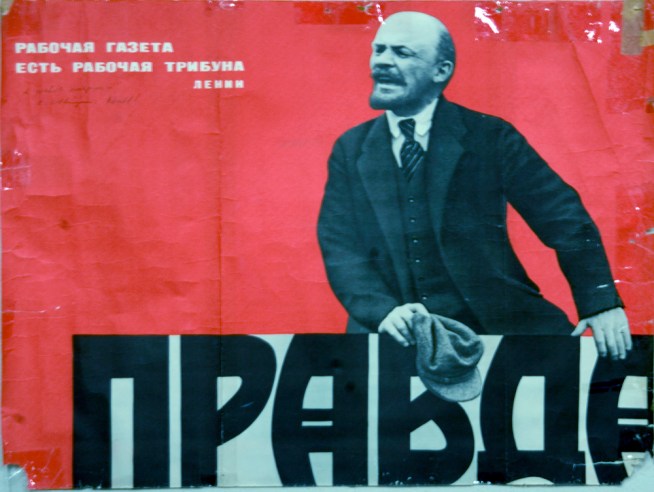
The Communists disdain to conceal their views and aims. They openly declare that their ends can be attained only by the forcible overthrow of all existing social conditions. Let the ruling classes tremble at a Communistic revolution. The proletarians have nothing to lose but their chains. They have a world to win.” Marx and Engels, Manifesto of the Communist Party.
Lenin or Kautsky?
Today we are facing a massive retreat from Leninism on the left. Under attack from the global crisis the working class and the oppressed are moving to the left in opposing its effects – austerity, ‘precarity’, mass unemployment and political repression – and launching Arab Springs, riots, occupations and armed struggles against bourgeois dictators. The masses are hungry for ideas on how to challenge and overcome capitalism. Yet there is no revolutionary mass party to turn to. The ostensible revolutionary left moves to offer this leadership. However this left is afraid to be identified with what is perceived as a failure of 20th century socialism and communism. It runs a mile from the ‘Dictatorship of the Proletariat’. To appease the radicalised masses most of the left is re-inventing its Marxism along the lines of the Chavista 21st century socialism, or the broad Marxist party of the 2nd International ‘democratic socialism’ associated with Karl Kautsky. It either renounces Bolshevism as an historic dead-end, or attempts to make the Bolsheviks and Lenin in particular, no more than Russian Kautskys. Trotsky is also a target because he renounced his conciliation with the Mensheviks and Kautsky to join Lenin and the Bolsheviks in 1917. Trotsky stands or falls with Lenin.
As we will see with bourgeois professors professing Marxism, the WSJ Roubini interview, TIME magazine cover story ‘Rethinking Marx’ , Hugo Chavez painted as ‘Marxist’ with links to Cuba and China, the left has no credibility unless its stakes a claim to the Marx franchise. So is this Marx with or without Lenin? That is the question. How do we know? Who was the real Lenin? Was he the heir of Marx and a proponent of fusing theory and practice, or was he a renegade from ‘authentic’ Marxism rather than the ‘renegade Kautsky’? Was the Marxist party a vanguard party in Marx’s sense of not being ‘separated from the working class’? Was the ‘democratic centralism’ Lenin practiced democratic or was it a precursor to Stalin’s dictatorship. Was Lenin responsible for the degeneration of today’s political sects and their isolation from the masses? It sounds confusing but it’s not really. We don’t have to ‘rediscover’ or ‘reload’ Lenin, his history is written by the Bolshevik Revolution.
Without the Bolsheviks and their undisputed leader Lenin, there would have been no Russian revolution so the left as we know it today would not exist. The history of the 20th century would be very different. Marxism would not have been kept alive in the 20th century and remain a powerful class ideology today. There would be no Marx revival, symbolic or real. But because the Bolsheviks and Lenin did exist they and he will continue to inspire the masses today in the belief that socialist revolution is not only possible but necessary. If we do not defeat the all out attack on Lenin and Bolshevism, reactionaries ranging from centrists who claim to be Marxists (the new batch of Mensheviks) to reformists and anarchists, in the name of ‘democracy’, horizontalism, of ‘not taking power’, and so on, will lead new layers or revolutionaries back into the swamp of reformism, reaction and climate catastrophe. Against all anti-Leninists our task is to Reboot Lenin. This means restoring Lenin as the leading champion of Marx (and Engels) in the 20th century.
For Marx Program came first
“The Communists are distinguished from the other working-class parties by this only: 1. In the national struggles of the proletarians of the different countries, they point out and bring to the front the common interests of the entire proletariat, independently of all nationality. 2. In the various stages of development which the struggle of the working class against the bourgeoisie has to pass through, they always and everywhere represent the interests of the movement as a whole.” Manifesto of the Communist Party
The Communist Manifesto competed in the workers movement of its time with the rival programs of the Bakuninists, Proudhonists and the Blanquists. For Marx the program was a fusion of scientific theory and socialist practice. Marx’s critique of capitalism revealed its laws of development and provided a programmatic guide to the development of the proletariat as the revolutionary class. Marx was almost alone as the drafter of Communist program and of developing that program on the basis of class struggle. In his 18th Brumaire of Louise Bonaparte written 4 years after the Manifesto, Marx revealed the class interests of the bourgeoisie which despite its factions united to maintain its class rule by concentrating state power in the figure of a Bonapartist dictator. But as the Bonaparte personified state power as ‘above classes’, he also represented its fallibility, as the state became ripe for ‘smashing’ and replacement by a proletarian state –the “Dictatorship of the Proletariat”.
This development of the Marxist program was based on Marx’s observations derived from his theory of the class nature of the state as the state of the ruling class. But as a guide to revolutionary practice it had to be tested in the class struggle with the active collaboration of the members of the party. Unless the Marxist program won the support of a majority of politically active workers there could be no revolution. Its first major test came with the Paris Commune of 1871.
Marx wrote later in a Letter to Krugelmann during the days of the Paris Commune:
If you look at the last chapter of my Eighteenth Brumaire you will find that I say that the next attempt of the French revolution will be no longer, as before, to transfer the bureaucratic-military machine from one hand to another, but to smash it, and this is essential for every real people’s revolution on the Continent. And this is what our heroic Party comrades in Paris are attempting. What elasticity, what historical initiative, what a capacity for sacrifice in these Parisians! After six months of hunger and ruin, caused rather by internal treachery than by the external enemy, they rise, beneath Prussian bayonets, as if there had never been a war between France and Germany and the enemy were not at the gates of Paris. History has no like example of a like greatness [Our emphasis]
Marx had written 20 years earlier at the conclusion of the 18th Brumaire “…when the imperial mantle finally falls on the shoulders of Louis Bonaparte, the bronze statue Napoleon will crash from the top of the Vendome Column”. This was now put into practice by the Communards as they took steps to ‘smash the state’.
As Engels puts it:
From the outset the Commune was compelled to recognize that the working class, once come to power, could not manage with the old state machine; that in order not to lose again its only just conquered supremacy, this working class must, on the one hand, do away with all the old repressive machinery previously used against it itself, and, on the other, safeguard itself against its own deputies and officials, by declaring them all, without exception, subject to recall at any moment.
Engels describes this process as the “shattering of former state power and its replacement by a new really democratic state”. (Engels, Introduction to The Civil War in France.)
The Commune was a watershed that tested the Marxist program in the throes of civil war and proved that the smashing of the state and its replacement by a workers state was necessary to complete the proletarian revolution, and to defend it from the bourgeois counter-revolution. The failure to smash the state would inevitably mean defeat. The program proved its superiority in practice over the Proudhonists, Blanquists, and the Anarchists in front of the world working class. All had a program that would lead to defeat. The Proudhonists had no conception of organising the proletariat as a class to smash the state and take power. The Blanquists organised as a conspiratorial elite separate from the proletariat. The Anarchists thought that capitalist exploitation derived from its state power and once the state was smashed the proletariat did not need a state to defend its class rule. (Engels, Introduction to The Civil War in France)
Marx found two weaknesses in the Commune in its failure to implement the Dictatorship of the Proletariat fully. Despite forming a popular militia, it failed to march on Versailles to take advantage of the enemy retreat. “They did not want to start a civil war, as if that mischievous abortion Thiers had not already started a civil war with his attempt to disarm Paris!” .“The Central Committee surrendered its power” to the Commune too soon. [Letter to Krugelman].
In The Civil War in France Marx explains that the Central Committee (made up of a Blanquist majority and Proudhonist minority) was not prepared for an insurrection and tried to compromise with the bourgeois regime. It lacked a firm Marxist leadership and did not understand the necessity to take power. That is why it failed to march on Versailles.
Lenin writing on the Commune comes to the same conclusion – the absence of a Marxist party in the leadership meant the reformists prevailed:
But two mistakes destroyed the fruits of the splendid victory. The proletariat stopped half-way: instead of setting about “expropriating the expropriators”, it allowed itself to be led astray by dreams of establishing a higher justice in the country united by a common national task; such institutions as the banks, for example, were not taken over, and Proudhonist theories about a “just exchange”, etc., still prevailed among the socialists. The second mistake was excessive magnanimity on the part of the proletariat: instead of destroying its enemies it sought to exert moral influence on them; it underestimated the significance of direct military operations in civil war, and instead of launching a resolute offensive against Versailles that would have crowned its victory in Paris, it tarried and gave the Versailles government time to gather the dark forces and prepare for the blood-soaked week of May. [Our emphasis]
Even in defeat the Commune proved the fundamental correctness of the Marxist program; only the working class organised by a Marxist vanguard was capable of smashing the state and introducing the Dictatorship of the Proletariat (the “really new democratic state”).
20 years later in his Introduction to The Civil War in France, referring to the ‘opportunism’ trend in the 2nd International, Engels concluded:
Of late, the Social Democratic philistine has once more been filled with wholesome terror at the words: Dictatorship of the Proletariat. Well and good gentlemen, do you want to know what this dictatorship looks like? Look at the Paris Commune. That was the Dictatorship of the Proletariat. [Our emphasis]
Though the Marxist program was proven correct in by the Commune, the International Workingmen’s Association (the ‘First International’) did not survive long. In the ebb in the class struggle that followed, two Marxist tendencies emerged both drawing on the Paris Commune, one to advance to revolution and the other to retreat to reformism. In the Second International the revolutionary wing came to be associated with Lenin, Trotsky and Luxemburg. The reformist wing was associated with Bernstein and Kautsky. Both trace their Marxist credentials back to the Commune and the revised Communist Manifesto. (Karl Korsch, Introduction to the Critique of the Gotha Program)
Lenin and Trotsky: Kautsky and the Paris Commune
It is no accident that both Lenin and Trotsky went back to the Paris Commune and Marx and Engels for guidance during and after the Bolshevik seizure of power. Lenin did so to get to the roots of the Kautsky’s ‘centrism’ and betrayal of revolution in Russia and Germany. Trotsky did so during the height of the civil war in response to Kautsky’s attack on the ‘Red Terror’. They both traced the ultimate split in the Marxist movement over the question of the proletariat’s ‘authority’ to impose a Dictatorship of the Proletariat back to the Paris Commune.
Engels writing in the immediate aftermath of the Commune’s defeat in 1873 put his finger on the fear that held back the proto-Mensheviks from the military seizure of power:
Have these gentlemen ever seen a revolution? A revolution is certainly the most authoritarian thing there is; it is an act whereby one part of the population imposes its will upon the other part of the population by means of rifles, bayonets and cannon, all of which are highly authoritarian means. And the victorious party must maintain its rule by means of the terror which it arms inspire in the reactionaries. Would the Paris Commune have lasted more than a day if it had not used the authority of the armed people against the bourgeoisie? Cannot we, on the contrary, blame it for having made too little use of that authority? [On Authority]
Both Lenin and Trotsky follow Marx and Engels’ view that the leaders of the Communards made “too little use of that authority” and “stopped halfway” (Lenin’s phrase) because they lacked a Marxist leadership and were still influenced by petty bourgeois socialism (Proudhon’s reforms, Blanqui’s adventurism) and Bakunin’s petty bourgeois hostility to the proletarian dictatorship. They shared the view that conditions were not ripe for revolution, but that once the armed workers were forced to defend Paris from the Prussian and French armies, it was necessary to pursue the civil war to the end. They agreed with Marx and Engels that the failure to do this was due to the absence of Marxist majority in the Central Committee of the National Guard.
In drafting The State and Revolution, Lenin traces Kautsky’s break from the Marxist program back to the Commune. While Marx and Engels amended the Manifesto to incorporate the “smashing of the state” and the “Dictatorship of the Proletariat”, Kautsky is opposed the “destruction of state power” and instead speaks of “shifting the balance of forces within state power”.
Lenin exclaims:
This is a complete wreck of Marxism!! All the lessons and teachings of Marx and Engels of 1852-1891 are forgotten and distorted. “The military-bureaucratic state machine must be smashed”, Marx and Engels taught. Not a word about this. The philistine utopia of reform struggle is substituted for the dictatorship of the proletariat. [Lenin, Marxism on the State: preparatory Material for the book The State and Revolution. 78 [Not online]
Lenin goes on to point out that the old bourgeois state has to be replaced by a new proletarian state so that the proletariat as a class can “suppress the bourgeoisie and crush their resistance.” While the Commune immediately took on the form of a proletarian state by replacing the standing army with armed workers, it could not complete its task of workers democracy (in which all officials were elective, responsible and revocable) because it failed to crush the resistance of the bourgeoisie. The Central Committee feared imposing the ‘terror’ of their class authority on the class enemy. It sought ‘compromise’ instead. As Trotsky found in Kautsky’s writings on the Commune, he agreed with the Central Committee!
Trotsky, onboard his military train in 1921 replying to Kautsky’s attack on Red Terror [the Red Army putting down counter-revolution ruthlessly], found Kautsky’s fear of the ‘authority’ of the proletarian dictatorship in Russia during the Civil War was already rooted in his fear of the ‘Red terror’ of the Civil War in France. Kautsky could easily agree with Marx that in 1871 the revolution was premature because the conditions were not ripe and the workers unprepared. Yet when facing an actual civil war, instead of following Marx and Engels into battle to defeat the non-Marxist leadership and impose a strong central military command, Kautsky would have sided with the ‘compromisers’ who hoped to do a deal with Thiers by holding an election to make the Commune ‘legal’!
As Trotsky argues, Kautsky put the ‘democracy’ of the Commune ahead of the Central Committee’s military campaign to defeat the National Assembly:
In supporting the democracy of the Commune, and at the same time accusing it of an insufficiently decisive note in its attitude to Versailles, Kautsky does not understand that the Communal elections, carried out with the ambiguous help of the “lawful” mayors and deputies, reflected the hope of a peaceful agreement with Versailles. This is the whole point. The leaders were anxious for a compromise, not for a struggle. The masses had not yet outlived their illusions.
Nor had Kautsky , whose pacifist confusion would have done nothing to help smash those illusions. Trotsky ‘gets’ Kautsky:
When one considered the execution of counter-revolutionary generals as an indelible “crime”, one could not develop energy in pursuing troops who were under the direction of counter-revolutionary generals. [The Paris Commune and Soviet Russia],
In other words Kautsky was already a ‘centrist’. He quoted Marx in theory but then drew reformist practical conclusions. He put bourgeois democracy ahead of the Dictatorship of the Proletariat, because the “workers were not prepared”. His centrism was to go unchallenged for decades by Engels and others in the 2nd International though Engels selected Bebel in his place as literary executor of Marx and Engels after the latter’s death.
Gotha Program abandons Marxist program
Four years after the defeat of the heroic C0mmunards which put the Marxist program to its first test in a revolutionary situation, Marx was forced to come to the defence of the Communist Manifesto in his Critique of the Gotha program in 1875. Having dispensed with the Proudhonists who rapidly declined, and split with Bakunin in 1873, Marx was now facing a split with the German ‘Marxists’ the Eisenarchers, who at the unity congress with the Lassalleans turn out to be more followers of Lassalle than Marx. Marx argued that the resulting United Workers Party of Germany abandoned the “Communist” program for that of Lassalle which ignored social relations, surplus-value, internationalism, and the class nature of the state, and “returned” to a reformist view of the German state redistributing ‘aid’ to workers on the basis of ‘equal right’. It was an “extremely disorganized, confused, fragmented, illogical and disreputable Programme”, and had it been perceived as such by the enemies of the proletariat, Marx and Engels stated they would have been forced to dissociate themselves from it. (cited in Korsch, Introduction to the Critique of the Gotha Program)
Marx writes in the Critique:
Since Lassalle’s death, there has asserted itself in our party the scientific understanding that wages are not what they appear to be — namely, the value, or price, of labor—but only a masked form for the value, or price, of labor power… And after this understanding has gained more and more ground in our party, some return to Lassalle’s dogma although they must have known that Lassalle did not know what wages were, but, following in the wake of the bourgeois economists, took the appearance for the essence of the matter. [Our emphasis]
Marx reveals here that against his own dialectic science, Lassalle’s theory is pre-Marxist ideology going back to Malthus and Ricardo. Wages are the price of labor (not labor power) so the basis of exploitation is the underpaying of the exchange value of labor. This is the ‘appearance’ since the ‘essence’ of capitalist social relations of production ‘appear’ (are inverted) as relations of exchange. If exploitation occurs by paying labor less than its value, then it can be rectified by ‘equalising exchange’ through state aid. However, Marx had already proven scientifically that this cannot be the case in Capital, and more popularly in Wages, Prices and Profits. Exploitation occurs when the commodity labor power is bought at its value, and yet because it is the only commodity with a use value that can produce more than its own value, the capitalist appropriates a ‘surplus-value’. Hence the state cannot become the basis of reforms that guarantee the “undiminished proceeds of labour” by means of a “fair distribution” of income based on an ideal of “equal right”. It is necessary to overthrow the state and expropriate the expropriators!
Thus, Marx makes clear that the Gotha Program is a retreat from his Marxism to the petty bourgeois reformist utopia of a ‘vulgar socialism’:
Any distribution whatever of the means of consumption is only a consequence of the distribution of the conditions of production themselves. The latter distribution, however, is a feature of the mode of production itself. The capitalist mode of production, for example, rests on the fact that the material conditions of production are in the hands of non-workers in the form of property in capital and land, while the masses are only owners of the personal condition of production, of labor power. If the elements of production are so distributed, then the present-day distribution of the means of consumption results automatically. If the material conditions of production are the co-operative property of the workers themselves, then there likewise results a distribution of the means of consumption different from the present one. Vulgar socialism (and from it in turn a section of the democrats) has taken over from the bourgeois economists the consideration and treatment of distribution as independent of the mode of production and hence the presentation of socialism as turning principally on distribution. After the real relation has long been made clear, why retrogress again? [Our emphasis]
Lenin recognised that Marx’ Critique was a powerful analysis that developed the program of the Communist Manifesto on the transition from capitalism to communism. Not only did he critique Lassalleanism as a vulgar socialism tied to the German capitalist state, he showed how the capitalist state must be overthrown and give way to a period of transition to socialism (the Dictatorship of the Proletariat) that creates the conditions for communism and the withering away of the state.
“The whole theory of Marx is the application of the theory of development – in its most consistent, complete, considered and pithy form – to modern capitalism. Naturally, Marx was faced with the problem of applying this theory both to the forthcoming collapse of capitalism and to the future development of future communism…it is possible to determine more precisely how democracy changes in the transition…” (The State and Revolution Chapter 5)
Thus Marx in his Critique, destroys all possibility of a peaceful transition from bourgeois to proletarian democracy at the very time when German Social Democracy is opportunistically vulgarising Marxism into a reformist utopian program. First, Marx shows how bourgeois democracy is a formality for the big majority (the working class) because bourgeois democracy can only be a bourgeois dictatorship of the minority over the majority. Second, to bring about proletarian democracy the Dictatorship of the Proletariat is necessary to smash the bourgeois dictatorship.
“Only in communist society, when the resistance of the capitalists has been completely crushed, when the capitalists have disappeared, when there are no classes (i.e. when there is no distinction between the members of society as regards their relations to the social means of production), only then “the state…ceases to exist” and “it becomes possible to speak of freedom”. Only then will a truly complete democracy become possible and be realised…Only then will democracy begin to wither away.” (ibid)
Korsch spells the wider reasons why Marx and Engels took their critique so seriously:
“In the middle of the 1870s, then, Marx and Engels thought it was far more possible than they had ten years earlier for the socialist and communist movement in the advanced countries to return to the ‘old audacity’ of the 1847-8 Manifesto by exhibiting a ‘declaration of principles’. In any case, they thought that the movement had developed to an extent that any retreat from what was said in 1864 must appear to be an unforgivable crime against the future of the workers’ movement. Thus Marx himself says in the note accompanying his Critique of the Gotha Programme:there was no need to make a ‘declaration of principles’ when conditions did not allow it, but when conditions had progressed so much since 1864, it was utterly impermissible to ‘demoralize’ the party with a shallow and unprincipled programme.
This illustrates some of Marx’s preoccupations when writing the Critique of the Gotha Programme. He demanded from the ‘Declaration of Principles’ of the most advanced Socialist Democratic party as a minimum the same level of principle and concrete demands as he himself had been able to insert into another declaration of principles, ten years earlier. This had been drafted under much less favourable circumstances and was designed for the common programme of the various socialist, half-socialist and quarter-socialist tendencies in Europe and America. Wherever the Gotha Programme failed to meet this minimum condition, Marx considers it to have fallen below the level already reached by the movement. Hence, even if it appeared to suit the state of the Party in Germany, it was bound to harm the future historical development of the movement.”
Yet, neither Marx’s ruthless critique nor his development of the Marxist theory of transition to communism was understood. It was ignored and the Gotha Program emerged virtually unchanged in a rising tide of opportunism. The ‘vulgar’ Marxist program that mistook exchange relations for production relations was to lead to the betrayal of 1914, was adopted. “Why retrogress”? Marx asked. Engels and Lenin provided the explanation later. The emergence of German imperialism could now afford to create a labor aristocracy bought off by rising living standards paid for by colonial super-profits. German Social Democracy was adapting to the formation of a labour aristocracy which voted for state reforms paid for by the super-exploitation of colonial workers and peasants. If the Gotha Program turned its back on the Communist Manifesto and founded German social-democracy as pre-Marxist ‘vulgar socialism’, was the Erfurt Program of 1891 any better?
Engels and Lenin critique the Centrist Erfurt Program of 1891
The Erfurt program in 1891 fails to break completely from the Gotha Program in its central aspects. It is a centrist program at best. Engels’s letter ‘On the Critique of the Social Democratic Draft Programme of 1891 (the Erfurt Programme)’ is a continuation of Marx and Engels critique of the Gotha Program. Engels was clearly prepared to continue the fight for the Communist program against the emerging opportunist German Social Democracy and its main theoretician, Karl Kautsky, while Kautsky delayed Engels critique for 10 years. He published for the first time Marx’s Critique of the Gotha Program alongside his own Introduction to Marx’s: The Civil War in France in 1891 to publicly champion the lessons of programmatic development since 1947, yet his Critique of the Erfurt program was not published by Kautsky until 1901! The substance of Engels critique, like that of Marx at Gotha, was ignored. The gulf between the Communist Manifesto and the reformist German SPD, behind the hollow Marxist phrases, was growing wider.
Engels main critique is of the “opportunism” of the political demands:
These are attempts to convince oneself and the party that “present-day society is developing towards socialism” without asking oneself whether it does not thereby just as necessarily outgrow the old social order and whether it will not have to burst this old shell by force, as a crab breaks its shell, and also whether in Germany, in addition, it will not have to smash the fetters of the still semi-absolutist, and moreover indescribably confused political order… In the long run such a policy can only lead one’s own party astray. They push general, abstract political questions into the foreground, thereby concealing the immediate concrete questions, which at the moment of the first great events, the first political crisis, automatically pose themselves. What can result from this except that at the decisive moment the party suddenly proves helpless and that uncertainty and discord on the most decisive issues reign in it because these issues have never been discussed? … This forgetting of the great, the principal considerations for the momentary interests of the day, this struggling and striving for the success of the moment regardless of later consequences, this sacrifice of the future of the movement for its present may be ‘honestly’ meant, but it is and remains opportunism, and ‘honest’ opportunism is perhaps the most dangerous of all… [Our emphasis]
Kautsky evades the critique. He claims that Engels critique was of the first draft and not of his draft which was the one adopted. Yet a comparison of the two shows that Kautsky’s version does not reflect Engels critique of the political demands. Kautsky’s book Class Struggle, an extended commentary on his Erfurt draft, was published in 1892. It becomes the popular presentation of the Erfurt Program. Do Engels criticisms still hold of Kautsky’s book?
Kautsky’s Class Struggle expounds ‘orthodox’ Marxist ‘economics’ from surplus-value to crises of overproduction which create the conditions for the transition to socialism. But there are no dialectics, only an evolutionary schema of capitalist development. The proletarian side of the class struggle is rendered ‘objective’ as the subjective agency of the proletariat is suppressed and replaced by the petty bourgeois socialist intelligentsia. Capitalist ‘development’ is expressed by Vulgar Marxist intellectuals who lecture the workers on their level of development. The transition to socialism is managed by a socialist bureaucracy that reforms the transition of the capitalist state into the socialist state.
“From the recognition of this fact is born the aim which the Socialist Party has set before it: to call the working-class to conquer the political power to the end that, with its aid, they may change the state into a self-sufficing co-operative commonwealth.” [Our emphasis]
So for Kautsky “conquering political power means “change the state”. How? There is no armed insurrection or ‘smashing of the state’ but rather a relatively peaceful transition through the gradual take-over of the state or as Marx put it the “transfer the bureaucratic-military machine from one hand to another” (18th Brumaire). Therefore the political demands of Urfurt as presented by Kautsky for the transition to socialism fall far short of the Communist Manifesto and the critical development of the program in the period 1852- 1875 spanning the Commune to Gotha.
Lenin’s recognition that the Erfurt program was centrist did not come until after the great betrayal of 1914. From that point he went back searching for the material roots of the degeneration of German social-democracy. State and Revolution and the Renegade Kautsky were the result. In this process Lenin revisits Engel’s suppressed critique of Erfurt and in the process finds that Kautsky, the German leader who bases his authority on Erfurt, actually rejects all the decisive developments in the Marxist program since 1847. Referring to Kautsky, Lenin exclaims in marginal notes in his drafting of State and Revolution “This is as a complete wreck of Marxism...a step back from 1852-91 to 1847”! [Marxism on the State: Preparatory Material for the book The State and Revolution. Not online]
Why was Lenin taken in by Kautsky’s centrism for so long? The short answer is, first centrism itself, and second, Tsarism. It is the nature of centrism that it disguises its treachery in hollow phrases. While Engels chided the German Social-Democracy as ‘opportunist’ he thought this was an aberration probably resulting from self-censorship to avoid triggering Bismarck’s anti-socialist law. However, centrist opportunism is not exposed as a counter-revolutionary retreat from Marxism until it is tested in revolutionary conditions and is exposed by its treacherous actions. So the revolutionary phrases carefully qualified by vague euphemisms such as “conquering political power” in Kautsky’s program were not put to the revolutionary test of practice in Germany until 1914.
Second, developments in the SPD were not central to the class struggle that was developing in Tsarist Russia. The SPD was a legal party with millions of members, a large official apparatus, and many elected MPs in the Reichstag. Formally, it was standing on the Erfurt program and the “conquest of political power”. In Russia however, the pressing task for the Marxists was the smashing of the Tsarist state bringing with it a whole set of challenges to the program and to the form of revolutionary party needed to overcome these challenges. The necessary debates over theory and tactics became the focus of the factional disputes and machinations in the RSDWP. This is evident in the fact that the RSDWP leaders while in exile in Europe conducted disputes in their own papers and congresses almost independently from the 2nd International parties in their host countries.
Currently a debate around whether the RSDWP was a Marxist party in the mould of the SPD of Kautsky, the ‘mother’ party in the 2nd International, or a party of a ‘new type’ as a result of Lenin winning a majority in 1902. The SPD was a ‘mass’ party but it was also a ‘broad’ party of Marxists, centrists, and reformists where the Marxist faction was marginalised by the centrists and were unable to defend the Marxist program of the dictatorship of the proletariat against the opportunists. This question was glossed over since workers were experiencing rising living standards via parliamentary reforms and the program was watered down by the reformist wing of Bernstein under the cover of Kautsky’s centrist wing. So while the reformist wing was critiqued by the centrist Kautsky at the same time he opens the door to the retreat from ‘smashing the state’.
Lenin asks: How, then, did Kautsky proceed in his most detailed refutation of Bernsteinism? He refrained from analyzing the utter distortion of Marxism by opportunism on this point. He cited the above-quoted passage from Engels’ preface to Marx’ s Civil War and said that according to Marx the working class cannot simply take over the ready-made state machinery, but that, generally speaking, it can take it over—and that was all. Kautsky did not say a word about the fact that Bernstein attributed to Marx the very opposite of Marx’ s real idea, that since 1852 Marx had formulated the task of the proletarian revolution as being to “smash” the state machine. (Lenin Chapter 6, State and Revolution)
In Russia the “task” of the RSDWP was not the working class “conquering political power” from the bourgeoisie, but that of leading all the oppressed masses in the overthrow of the Tsar. The RSDWP began as ‘broad’ party like the SPD but its Marxist faction (Bolsheviks) from 1902 dominated the opportunists (Mensheviks) and the conciliators (Centrists) in its militant defence and development of the Marxist program. The showdown between Marxist and opportunist factions came to the surface in Russia even before 1905 as theoretical differences on strategy and tactics had life or death practical consequences in combating the Tsarist autocracy.
Lenin and ‘What is to be Done?’
Unlike the SPD which could vote its representatives into Parliament, the Russian party faced a Tsarist autocracy. The immediate task was that of ‘political freedom’, that is the bourgeois revolution, in which the proletariat would be the leading class. Lenin’s conception of the party was not as a professional elite separated from the mass membership, but of both intellectuals and workers who took the Marxist program to the workers already organising against the Tsarist regime. The differences in the RSDWP didn’t arise over the program to overthrow of the Tsar but over the role of the proletariat in this revolution. For Lenin and the Bolshevik faction the proletariat must be independent of the bourgeoisie and lead all the oppressed classes. For the Mensheviks, like the centrists of the SPD including Kautsky, the proletariat was not capable of taking the place of the bourgeoisie in leading the bourgeois revolution alone.
Thus between 1902 and 1917, the main fight inside the RSDWP was between those who argued over whether that working class was ready or not to take the place of the bourgeoisie in overthrowing the Tsar. The Bolsheviks thought it was ready, the Mensheviks thought that the workers would have to ‘compromise’ with the bourgeoisie.
On the question of the nature of the vanguard party, this is determined by the Marxist program in which the proletariat is the only revolutionary class capable of fusing Marxist theory and practice as the agency of revolution. Specific national conditions are the immediate concrete workings of this historic and international class dialectic. The Tsarist regime oppressed not only workers but poor and middle peasants. It also oppressed elements of the bourgeoisie. Lenin argues that the working class will lead the revolution bringing behind it the poor and middle peasants. The rich peasants are becoming capitalist and they and the weak bourgeoisie cannot lead a revolution against the Tsar. Thus the proletariat will be ‘hegemonic’ in leading all the oppressed classes. For that to happen the Marxist party must include the vanguard of workers who have a ‘socialist consciousness’ and not those who are only ‘trade union’ conscious.
In What is to be Done (WITBD) Lenin famously says that this ‘socialist consciousness’ is brought from outside to the workers. Rather than an admission that the Marxist party is separate from the workers, the so-called ‘dictatorship of the Party’ criticised by Luxemburg and Trotsky, it’s the opposite. Both the workers movement and the Marxist intellectuals must ‘converge’ and ‘fuse’ for the revolution to happen.
That is why the Bolsheviks split organisationally from the Mensheviks in 1912, while the Marxists in the SDP failed to build a Bolshevik type faction until the KDP (Spartacists) in 1919. The party that would lead the overthrow of the Tsar and organise the socialist insurrection became a ‘mass’ Marxist party in which the members were in agreement with the Bolshevik program for Russia. Tragically, in Germany the Spartacists founded the KDP too late in 1919 but were ‘smashed’ by the SDP reformists and by Kautsky’s USDP who joined a popular front bourgeois government in the ‘peaceful transition to socialism’ that was neither peaceful nor a transition.
So in 1902 Lenin is already providing answers to the questions posed above: the RSDWP is not yet a vanguard party. Its leaders and members are Marxists but there are differences on how to overthrow the Tsar. After 1905 the party fragments into numerous weak factions but around 1909 the Bolsheviks and Mensheviks reform and their differences deepen over strategy and tactics. A split looms and comes to a head over whether the working class will lead the overthrow of the Tsar or do so in a political coalition with the bourgeoisie. Lenin mobilises to reorganise the RSDWP on a Marxist program of a worker-led revolution, against Mensheviks and others who want a cross class coalition. The program comes first and the Bolsheviks and Mensheviks split in 1912. From this point on both factions organise and meet separately presenting a clear choice for Russian workers. They enter the period of rising struggles and prove to the masses which program is correct and which class will lead the revolution against the Tsar. This will happen first in 1914 when the Bolshevik faction becomes the core of the Zimmerwald Left and an embryonic new international. It will come to the ultimate test when the Bolsheviks convince Russian workers to make a revolution, and the Mensheviks side with the peasant petty bourgeoisie and the bourgeoisie to oppose the revolution. This is democratic centralism in practice and it was tested in practice, and in its absence, with positive and negative results in the Russian and German Revolutions.
Some neo-Kautskyites today who want to recruit Lenin to the ‘broad’ party fail to grasp that while the Bolsheviks and Mensheviks did not form separate parties in 1912, they split as factions over a fundamental principle of the Marxist program. The RSDWP that resulted contained two parties, except in name, the Bolsheviks standing on the principle of worker ‘hegemony’, the Mensheviks on ‘class conciliation’ (what is called today the popular front with the bourgeoisie) in the Russian revolution. Far from being a ‘broad’ party that tolerated all political differences, a split over this question was a matter of life and death. The failure to form the Bolsheviks as a separate political organisation would have wrecked its ability to implement democratic centralism and prevented it from rapidly developing its program and winning the masses support in the Soviets for a workers’ revolution. Even so, in the Bolshevik faction in April 1917 all the leadership apart from Lenin were conciliating with the Provisional Government – that is, proposing a popular front with the bourgeoisie! The situation was rescued by Lenin because he could appeal to the mass base of the Bolsheviks won to the faction/party since 1912 on a Marxist program, and convince them of the correct strategy and tactics. Had the RSDWP not split and stayed as a ‘broad’ party of Marxists and class collaborationists like Kautsky’s SPD the outcome would have been a defeat for the Russian revolution at the hands of Kerensky and Kornilov! The Russian and German revolutions are the ultimate testimony to this fact.
Bolshevism and the Russian and German Revolutions
In April 1917 Lenin proved that the RSDWP were really two long term factions in name only and in reality two separate parties. Moreover he proved that the Bolshevik ‘faction’ was not free of would-be Mensheviks in the leadership ready to ‘conciliate’ with the bourgeoisie. It was necessary to go to the mass membership of the RSDWP. He read his April Theses to the Bolsheviks and then to both Bolsheviks and Mensheviks together. Lenin goes outside the Party Leadership and addressed the Petrograd branch of the party directly. He won them to the socialist insurrection. (Trotsky, History of the Russian Revolution, (HRR) Chap 15).
Again in October Lenin is in a minority of one in the Central Committee. He demands an insurrection and the Central Committee burns his letter. Accusing the Central Committee of ‘Fabianism’ he then goes to the Petrograd soviet and the Regional Conference of Northern soviets and speaking on his own authority demands “an immediate move on Petrograd”. (Trotsky, HRR, Chap 24.). Then when the Central Committee finally agrees to the insurrection, Zinoviev and Kamenev disclose these plans in Pravda, the Menshevik newspaper. Lenin calls for their expulsion but is defeated on the Central Committee. This was how the Bolsheviks under Lenin’s leadership and organised as a de-fact0 mass vanguard party were able to not only survive a revolutionary crisis, but win the leadership of the workers and peasants, defeat the counter-revolution and make the first socialist revolution in history. Not so in Germany.
Not till August 4, 1914 was the theoretical bankruptcy of 2nd International put to the test and exposed as a ‘stinking corpse’ (Luxemburg cited in Lenin). The centrists around Kautsky and the Zimmerwald Left revolutionaries around Luxemburg and Liebknecht split to form the united SDP (USPD) but the left Spartakustbund faction in the USPD failed to break away to found an independent Bolshevik-type party until 1918. Only in 1917 did the paths of the Russian and German revolutions converge in a Marxist leadership that understood the revolutions must unite to succeed. But the German ‘old guard’ around Luxemburg lacked the experience in organising a mass base. Their reliance of on ‘spontaneity’ against Lenin’s ‘centralism’ meant that when the soldiers and sailors rose up against the Junker regime there was no Bolshevik-type democratic centralist party at its head to ‘smash the state’. Like Lenin, Luxemburg facing a revolutionary crisis in Germany, returned to Marx and Engel’s to draw the lessons about the ‘smashing of the state and refound the Communist program:
“…Down to the collapse of August 4, 1914, the German Social Democracy took its stand upon the Erfurt programme, and by this programme the so-called immediate minimal aims were placed in the foreground, whilst socialism was no more than a distant guiding star. Far more important, however, than what is written in a programme is the way in which that programme is interpreted in action. From this point of view, great importance must be attached to one of the historical documents of the German labour movement: the Preface written by Fredrick Engels for the 1895 re-issue of Marx’s Class Struggles in France. It is not merely upon historical grounds that I now reopen this question. The matter is one of extreme actuality. It has become our urgent duty today to replace our programme upon the foundation laid by Marx and Engels in 1848. In view of the changes effected since then by the historical process of development, it is incumbent upon us to undertake a deliberate revision of the views that guided the German Social Democracy down to the collapse of August 4th. Upon such a revision we are officially engaged today….” (On the Spartacus Program [our emphasis]
Too late! The delay of the revolutionary Marxists in splitting from the USPD was fatal. It meant that they did not have time to build a Marxist vanguard and win a mass base before the revolutionary crisis came to a head. By the time the Spartacists founded the KPD in 1919, the SPD and USDP were collaborating in a Bourgeois government led by the SPD leader, Ebert. The revolution, its main social democrat leaders were murdered and its armed workers’ militia ‘smashed’ by the Freikorps.
So the problem of the party is not that Lenin abandoned the ‘broad’ party for an elitist party, but that without a revolutionary program tested in the struggle the vanguard party is sucked back into opportunism and conciliation with the bourgeoisie. The problem is not therefore historic Bolshevik/Leninism but its absence. Russia and Germany are the test cases. The Bolsheviks won the masses in Russia because they split from the Mensheviks, but in Germany where they failed to split from the Kautskyites until too late, the revolution was defeated.
For both Marx and Lenin the vanguard party is the party of the Marxist workers not the party of non-Marxist workers. This was true even when the vanguard was no more than one; Marx on Gotha, Lenin on the April Theses. But at the same time the Marxist vanguard is obliged to fight to win the non-Marxists to the vanguard. But to do this the backsliding compromisers, opportunists, centrists, Mensheviks etc have to be defeated. This is what the Russian revolution proves. Like Marx confronting the retreat into Lassalleanism at Gotha, Lenin also finds himself alone in April 1917 carrying the banner of the Marxist vanguard.
As the crisis of war and revolution unfolded Lenin drew further conclusions. After 1914 he writes a series of articles and pamphlets he accuses Kautsky of reneging on the 1912 Basle Manifesto on war. (See Preface to …Renegade Kautsky). In his Imperialism written in 1915 Lenin shows that Kautsky’s opportunism explains his theory of ‘ultra-imperialism’. During the 1917 July Days when he is in hiding, he drafts the State and Revolution. He now shows that Kautsky abandoned the theory of ‘smashing the state’ in 1871. He “wrecks Marxism” and goes back to 1847. Then in 1918 Kautsky’s condemnation of the Bolshevik revolution in his pamphlet ‘The Dictatorship of the Proletariat’ provokes Lenin’s brilliant The Proletarian Revolution and the Renegade Kautsky, in which he sums up Kautsky in the phrase “How Kautsky turned Marx into a Common Liberal” by reducing the ‘Dictatorship of the Proletariat’ in the Paris Commune to ‘bourgeois (i.e. pure) democracy’ i.e. and electoral majority! The final nail in Kautsky’s coffin is that his centrism is exposed as the key to the defeat of the German Revolution. It is Kautsky and the USPD that delays the founding of the German KDP until it is too late, then takes responsibility for the state repression of the Communists, defeats the revolution and thus prevents the Russian revolution from spreading to the world. Yet this is the Kautsky of the Erfurt program that the neo-Kautskyists like the CPGB wants to return to today!
The Party embodies the Program
For Marx the proletarian party is the Marxist party. The Gotha Program retreated from Marx’s method and his critique of Capitalism to Lassalle’s pre-Marxist exchange theory. The Erfurt Program restored the Marxist critique of Capital formally by returning to the production of surplus-value, but didn’t escape the Gotha Program in its reformist approach to the capitalist state. In the SPD the ‘broad’ party submerged the revolutionaries in a rising tide of opportunism. Engels critique was ignored as was Marx’s at Gotha. Kautsky vulgarised Marx, ignoring the laws of capitalist development, the crises of overproduction and the growing competition between the imperialist powers. The approaching imperialist war was something that could be stopped by a SPD majority in the Reichstag acting with ‘legality’! This had tragic practical consequences for millions of workers the world over 1000 times that of the Paris Commune. And this time it was done in the name of Marxism!
Today against the program and party of Kautsky, we need program and party of Marx. From Marx and Engels in 1847 to Lenin in 1924 the Marxist mass party was always based on workers who understood that to escape inevitable capitalist crises and imperialist wars they had to smash the bourgeois state and impose the Dictatorship of the Proletariat. If it fell short of that when its leadership adapted to imperialist super-profits and the labor aristocracy then it’s ‘party’ would end up being used by the bourgeoisie to destroy the revolution. Such a retreat into vulgar socialism was inevitable unless a Marxist vanguard was built capable drawing the important lessons of organising and arming the proletariat to smash the state and replace the crisis and war ridden capitalist system with socialism. The German Revolution was defeated because it lacked a revolutionary program and party. Marx and Engels fought to test and develop the communist program all of their lives against non-Marxist and then revisionist Marxist currents. Lenin and Trotsky took on the responsibility of defending and developing that program after Engel’s death. Lenin in particular took the lead in the fight against opportunism in the period before WW1. That is why the Bolsheviks under Lenin and later Trotsky, and not the German SPD under Kautsky and Co. was the only Marxist party to defeat reformism and centrism and make a revolution.
Let Lenin have the last word on Kautsky: “Kautsky takes from Marxism what is acceptable to the liberals, to the bourgeoisie (the criticism of the Middle Ages, and the progressive historical role of capitalism in general and of capitalist democracy in particular), and discards, passes over in silence, glosses over all that in Marxism which is unacceptable to the bourgeoisie (the revolutionary violence of the proletariat against the bourgeoisie for the latter’s destruction). That; is why Kautsky, by virtue of his objective position and irrespective of what his subjective convictions may be, inevitably proves to be a lackey of the bourgeoisie.” (The Proletarian Revolution and the Renegade Kautsky)
Who is the renegade, Lenin or Kautsky! The renegades of Marxism are those who abandon the program for the Dictatorship of the Proletariat. Most of what passes for the revolutionary left today are longstanding centrists known for their revolutionary phrases and reformist practice! They emerged out of WW2 with Stalinism intact and a ‘2nd world’ opposed to the imperialist 1st world. The Trotskyist Fourth International lacked roots in the working class and its efforts at keeping the Leninist/Trotskyist program alive founded on the long boom and reformism of Stalinist and Social democratic parties. Most revised Marx’s Capital into some form of exchange theory and drew the practical consequence of a minimal program of ‘equal rights’ via ‘state aid’. Thus most became adjuncts of social democracy, Stalinism, or 3rd World freedom fighters. The restoration of capitalism in the Soviet Union and other former ‘degenerate workers states’ has deprived them of their defence of workers property. Some like the Spartacist family insist that hope lives on in China. Others liquidate into ‘anti-capitalist’ formations which are ‘broad parties’ including reformists and revolutionaries. Those who still pay lip service to Leninism (and/or Trotskyism), and those who are anti-Leninist, all end up on the same centrist swamp. They are a new batch of Mensheviks with minimum programs and petty bourgeois leaderships that they substitute for the Marxist vanguard. For example, the Spartacists substitute the Maoist bureaucracy in China; the Morenoists substitute the trade union bureaucracy; the Cliffites, the student intellectuals; and the Woodites, populist demagogues like Chavez–all trapping the proletariat in popular fronts with the bourgeoisie.
Yet these petty bourgeois pretenders cannot suppress the class contradictions as they re-emerge in current and future crises, wars, revolutions and counter-revolutions. Revolutionaries have to act as a vanguard of hundreds and thousands to expose the centrists by building militant internationalist united fronts everywhere with demands that advance the workers cause and force the centrists to declare themselves as class traitors. In the process the embryonic vanguard will like Lenin’s Bolsheviks, converge, and fuse with the millions of rising militants to build a new world party of revolution. A Marxist revolutionary international will be reborn as the terminal crisis of capitalism exposes the new batch of Mensheviks as class traitors. Arising out of the ashes of historic betrayals and defeats of the 20th century marked by the first Bolshevik revolution will be the revolutionary Marxists based on the Leninist/Trotskyist program of 1938 who go into the working class to build the Marxist vanguard to make the second Bolshevik Revolution in the 21st century.
“The victory of communism is inevitable, Communism will triumph!” Lenin, ‘Greetings to the Italian, French and German Communists’. October 1919
China/US Rivalry for Asia-Pacific


US imperialism as the dominant world power is under threat. The global crisis of falling profits has hit the US and EU economy hard and the great recession must become a great depression to restore profits. As a result US rivalry with other imperialist countries is hotting up as they all compete with one another to increase their ‘spheres of influence’ and their super-profits. The US now faces China and Russia as new, expansionary imperialist powers. The main threat to US imperialism comes from China rising as we have argued for some time. China/US rivalry is the driving force behind global geopolitics today. Grasping this reality is the starting point for Marxist revolutionaries.
China is now the second largest global economy though still lagging well behind the USA. Yet it is overtaking the US at about 8% a year while the US economy lags between 1 or 2%. The US has responded with trade protection and a political and military ‘pivot’ into the Asia-Pacific to contain China’s growing sphere of influence. It is also continuing to try to isolate China’s ally Iran and the influence of China in Central Asia, and stepping up its activity in Africa where China has made big inroads in the last decade. This raises the stakes globally and explains the political and military moves to contain China in the Mideast, Asia and the Pacific.
China as Emerging Imperialist power
China has become a world power today because it is now imperialist. Marxists define imperialism in the way that Lenin did, as the final stage of capitalism in decline when rivalry between giant monopoly corporations backed by their powerful oppressor states compete to divide up the world into “spheres of influence” to extract ‘super-profits’ from the colonies and semi-colonies. This economic competition inevitably leads to political and military conflict. Two imperialist world wars have demonstrated the truth of this theory. The current global crisis of overproduction sets the scene for more wars including a 3rd imperialist world war.
Marxists reject crude dogmas that see the re-emergence of China as a world power as due either to its dynamic revival of pre-capitalist glory, or to a Maoist-type post-capitalist society out-developing capitalism.
China is imperialist today because it had a national revolution that smashed the ancient semi-feudal landlords of pre-capitalist China, and then threw out imperialism and the weak Chinese bourgeoisie in 1949.
The revolution was led by a Maoist bureaucracy at the head of a peasant army that nationalised bourgeois property but prevented workers and poor peasants from taking power. So the ‘post-capitalist’ society that resulted fell well short of a healthy workers’ state and failed to develop the conditions for socialism.
The post-capitalist society did not have the capacity to develop the forces of production to keep pace even with declining global imperialism. China has huge resources and population yet the dictatorship of the Maoist bureaucracy together with China’s national isolation from the world market resulted in the planned economy stagnating. It could not produce enough to meet the needs of the masses nor increase the surplus for the parasitic bureaucracy. The bureaucracy decided in the late 1970s to reintroduce the capitalist market to revive the economy. But once introduced, the law of value began to spread and take over from the plan as the main driver of the economy.
When the Maoist bureaucracy smashed working class resistance to the growing inequalities of the market at Tiananmen Square in 1989 the way was open to restore capitalism to the whole economy. At that point, China was ruled by the law of value. Prices were set by market competition and not state officials so that labour power now became a commodity. The state now served the interests of a new bourgeoisie which exploited wage labour. The top leaders of the Communist Party became a ‘Red Bourgeoisie’. The bourgeoisie began to accumulate surplus profits and China had to ‘go global’ in search of super profits from raw materials and labour. This rapid expansion as a new imperialist power brought it into conflict with the existing imperialist powers, in particular the US.
US Imperialism takes up the Challenge
While China is a looming economic threat is lags well behind the US. However its growth trajectory puts it on collision course. The US has responded economically, politically and militarily. Economically the US is stepping up its ‘trade wars’ ramping up anti-China xenophobia, blocking Chinese investment and challenging ‘unfair’ competition.
China’s threat to the US is most direct in the Asia-Pacific where it wants an economic bloc, the Regional Comprehensive Economic Partnership (RCEP), to advance its interests. The US has responded economically by joining the Trans Pacific Partnership Agreement (TPPA) which excludes and isolates China and could create a rival US- dominated Asia-Pacific sphere of influence.
A second purpose is to compete more efficiently with China by using the TPPA to open up the Asia-Pacific economies to US investment on conditions which maximise profits and impose punitive rules to enforce the extraction of super profits. Thus the US wants to enforce its domestic law in the members’ states allowing it to enforce its property rights (see Box). This political domination is backed up by a beefed up military deployment including a missile ring that encircles China (and the whole of East Asia) drawing in key US allies in the region.
China responds to US encirclement
China is building its military capacity (see cover photo of China’s first and only aircraft carrier) but in most parts of the world does not deploy it. It can compete economically and relies on trade and investment deals with national regimes on a so-called ‘win win’ basis in Asia, Latin America and Africa. It has formed economic and military blocs with Asian states to mark its shared sphere of influence over central and South Asia with other powers especially Russia and India such as the Shanghai Cooperation Organisation (SCO).
However, it sees East Asia and South Asia as its own sphere of influence, and has for years been involved in territorial disputes in the South China Sea such as that with Philippines over Huangjang Island. China has regarded the Paracel and Spratly Islands as part of its territorial waters for centuries. The current reactivation of these disputes reflects first, the competition for control of rich economic resources, and second, control over China’s main sea route to the Indian Ocean through the Strait of Malacca, and a counter to US opening military bases in Australia and the Philippines.
Also indicating the rising inter-imperialist rivalry in the China’s core zone of influence is the recent dispute in the ‘East China Sea’ with Japan over the Senkaku/Diaoyu islands . This is a small scale version of the long standoff with the US over Taiwan. Like Taiwan, China regards these Islands as part of China much as it regards its ‘internal colonies’ in Tibet, Xinjiang and Inner Mongolia as Chinese territory. The closer to China’s heartland the more these territorial disputes become inflamed by extreme xenophobia and public demonstrations against ‘foreigners’ and working class support of imperialist military adventures.
3rd World War vs Class War
New imperialist wars are inevitable sooner or later. Both the US and Japan are declining imperialist powers and belligerent in using military power to defend their spheres of influence against China. Japan’s Conservatives want to re-arm and redeploy to ‘contain’ China. China, to expand must sooner or later enter into military disputes with these powers. So far they are proxy disputes and civil wars ranging from Iran to Syria over control of oil in the Middle East and Central Asia. There are the makings of proxy wars in Africa, notably in Sudan where China and Iran are engaged in a shadowy war with Israel and the US. The most dangerous arena for military conflict, however, is in the breaking disputes over China’s claimed core sphere of influence in the Asia-Pacific.
In proxy wars between imperialist powers, and in direct military conflict, revolutionaries must be dual defeatists. This means that we oppose fighting on the side of any imperialist power to stop them grabbing of more resources, plundering and destroying humanity and nature. Where imperialism is at war with colonies or semi-colonies we defend them and fight to defeat the imperialist power, unless they are being used as proxies by another imperialist power.
So for example in the South China Sea Islands we defend Vietnam and Philippines against China. But if these nations are acting as proxies for the US, we are for the defeat of both sides while fighting simultaneously for the independence of Vietnam or the Philippines. In the Diaoyu Islands we are for self-determination from both Japan and China and oppose them being used as proxies in a war between any imperialist powers. In the latter case it is enmeshed in Okinawa’s long struggle for independence from both the US military which has bases on the island, and Japan which claims Okinawa.
Revolutionary Marxists call on workers to fight against all attempts by their ruling classes to rally workers behind their national flags into new imperialist wars. Workers have no country, we unite across borders as one international working class to fight to overthrow our ruling classes, seize state power, and bring about a new socialist global society!
Defeat US, Japanese and Chinese Imperialism!
Defend oppressed nations against imperialism!
For a Federation of Socialist Republics of the Asia-Pacific!
For a new World Party of Socialist Revolution!
First published on redrave
In Defence of Trotskyism: An Open Letter to All Members and Supporters of the LRCI

The following is an historic document written by the Revolutionary Trotskyist Tendency (RTT) to the League for a Revolutionary Communist International (LRCI) criticising the change in the latter’s program, The Trotskyist Manifesto on ‘unconditional defence of the USSR’ to make a united front with capitalist restorationists, and on the League’s practice of ‘democratic centralism’. Shortly afterwards, the LRCI severed fraternal relations with the RTT.
———————————————————————————————————————————————-
November 30 1991
Dear Comrades,
The International Secretariat (IS) of the LRCI has declared war against the RTT. In its latest letter to the RTT, signed by comrade Frankel and dated November 14, 1991, the IS gave the RTT an ultimatum. The IS basically said that unless the RTT declares that its differences with the LRCI over the popular front with Yeltsin are tactical, and joins the LRCI soon, the IS will likely break fraternal relations with the RTT, which means that the RTT possibly will not be invited to the LRCI’s Congress even as an observer with the right to speak. After demanding that the RTT clarify whether the nature of the differences is tactical or principled, the IS threatened:
“We need some answers to these questions if the IS is to recommend to the congress the continuation of fraternal relations. It can only do so on the basis that they are likely to lead in the foreseeable future in the RTT joining the LRCI. Clearly this also has implications for your attendance at the congress.” (Nov. 14 letter, our emphasis).
In other words, if the answers given by the RTT do not satisfy the IS, it will break relations with the RTT and will decline to invite the RTT to the LRCI Congress.
The letter came somewhat as a shock. First, it contains unbelievable falsifications of the history of the fraternal relations between the LRCI and the RTT. Second, it is an open attack on the Marxist tradition, principally on the nature of democratic centralism. The letter tries to create an insurmountable wall between the RTT and members of the LRCI. It portrays the RTT as an enemy of the LRCI, and prepares the members of the LRCI to accept the breaking off of fraternal relations.
The RTT rejects the use of such a method by supposedly the highest cadres of a revolutionary international. In this open letter we will set the record of fraternal relations straight and show the superiority of the Marxist method in comparison to the eclectic and petty bourgeois method of the IS. We will show the class character behind the IS’s political positions on Stalinism. Awe will also show what is behind the attempts to discredit the RTT and prevent the necessary clarification of the political differences. We believe that this is the act of a petty bourgeois leadership that cannot defend its political positions and instead utilizes the organizational whip.
The RTT does not want to break fraternal relations with the LRCI. We have full confidence in our positions and methods. We are sure that the coming developments in the USSR and Eastern Europe will prove the correctness of our positions. We want to continue the discussions for the next six months, as was proposed by the IS, with the objective of narrowing the differences down to the point that the RTT could join the LRCI. But the IS has given us an ultimatum. From the letter it is clear that the IS does not want to continue the democratic discussions in the best tradition of the workers’ movement; that it sees them as a threat, because it cannot defend its centrist positions against Marxism. This leaves us no option but to appeal to all the members of the LRCI to continue the discussions. We know that our positions are gaining support within the membership of Workers Power (Britain) and possibly other sections.
The political history of the fraternal relations, without falsifications
The November 14 letter from Frankel contains many falsifications regarding the history between the RTT and LRCI. Frankel’s general method in the letter is eclectic and petty. There is no serious attempt on his part to use the Marxist dialectical method in looking at the historical development of the relations. His main concern is to create a barrier between the RTT and the members of the LRCI, and in doing so he falsifies our common history. Unlike comrade Frankel, we will take a serious look at that history and examine it politically, using the dialectical method.
When we entered into discussions with the LRCI, we had important differences with it. These differences were centered on the Anti-Imperialist United Front (AIUF) and the permanent revolution, Stalinism (Afghanistan), reformism and the question of the oppressed (women, sectoralism etc). We considered the LRCI to be a left centrist organization which was moving in a revolutionary direction. Despite some disagreement with the Trotskyist Manifesto (TM), we thought that it represented a clear move towards revolutionary Trotskyist positions and we were willing to engage in serious discussions with the LRCI with a view to joining it. On the other hand, we knew that abstract program is not enough. We had to win over the LRCI on key historical events in which abstract programs are tested against pressures to capitulate to alien class forces. We concluded that the defense of the gains of the Iranian revolution was the most important concrete example. After extended discussion (three weeks in October 1989 and two weeks in April-May 1990), the differences on the oppressed and reformism narrowed considerably. Since the IS agreed with Winter to propose a number of amendments to TM at the next Congress, there we no major disputes between the LRCI and the RTT on the former questions. But the differences on the AIUF and Stalinism remained less close to being resolved.
Khomeini and Yeltsin: What do they have in common?
The area of disagreement regarding the AIUF concentrated on the Iraq/Iran war. Several differences exist on the war, including some on the exact character of the war. But the crucial difference was regarding the bloc with Khomeini and the semi-fascist Islamic Revolutionary Guards. In 1980-1982, Workers Power had called for a united front with Khomeini and the semi-fascist Islamic Revolutionary Guards, supposedly to defend the Iranian revolution against Hussein (Iraq) and imperialism. We told the comrades from the IS that one could not propose a united front with reactionary forces who were engaged in savage attacks against the working masses and the Left. By 1982, when Workers Power called off the united front with Khomeini and the Islamic Revolutionary Guards, Khomeini and company had managed to destroy the Shoras, and they had massacred thousands of workers, peasants and Leftists. We told the comrades from the IS that it was Khomeini and the Islamic Guards that destroyed the gains of the revolution and not Hussein (of course, he would have done so if he had won the war). In September 1989, shortly before coming to London in October, Winter wrote to the LRCI:
The main reason that WP gave for the ‘united front’ was the defense of the workers’ and peasants’ gains stemming from the Iranian revolution. Before I deal with the united front in general, I want to deal with the united front with the Pasdaran (Islamic Revolutionary Guard). I hope that the proposal for a united front with the Pasdaran was either a typographical error or a result of misinformation, i.e., that at the time, WP did not understand the nature of the Pasdaran due to lack of information from Iran. A year later, WP correctly characterized the Islamic Revolutionary Guards as a semi-fascist organisation. I assume that as a matter of principle a Trotskyist organization would never propose a united front with a semi-Fascist organization whose main reason for existence was to destroy, by fascistic and brutal methods (which were not fundamentally any different from the Nazis’ methods), any independent organization of the workers, peasants and oppressed minorities…
I want to leave no room for doubt about the nature of the Islamic Revolutionary Guards. The Pasdaran was a tightly controlled mass black hundred of the IRP. Like any traditional Fascist organization, it assembled cadres and members from the worst ranks of the lumpenproletariat and dissatisfied petty bourgeoisie. Its only goal was the consolidation of the bourgeois state by smashing any resistance from the masses. For that purpose, its members were indoctrinated with the worst aspects of Islamic ideology, with the aim of waging a holy and brutal war against the militant opponents of the regime. The Pasdaran was the main force that physically guaranteed the consolidation of the Islamic bourgeois dictatorship…
…[I]t was not possible to have a united front with the executioners of the revolution and to defeat them as the same time. While WP did state clearly that a united front with the Iranian Army (including the officers) was not a precondition to the dire need for the working class and peasantry to overthrow the Khomeini regime, it still left me very anxious when I read that the overthrow of the Islamic Republic was not a precondition to any meaningful united front against the Iraqi invasion. WP certainly should be credited for being principled for saying very clearly that the independence of revolutionaries and the workers’ organizations was a pre-condition for a united front with the Khomeini forces. But the whole point is that such independence was impossible politically and militarily with the forces that were destroying the gains of the revolution. Don’t you think that it was necessary to tell the workers clearly, that Khomeini’s forces who were destroying the workers’ and the oppressed people’s organizations would have never agreed to a united front with the organizations that they were destroying and that a united military front with the Khomeini forces was not possible without total political subordination. By saying that, revolutionaries would have made it clear to the workers, that the Islamic state was more interested to destroy their revolutionary gains than fighting the Iraqis. It was therefore necessary to defeat Khomeini’s forces in the army and the Shoras as a pre-condition for any genuine united front between revolutionaries, workers’ organizations and the army against the Iraqis. I genuinely believe that agreeing on this point will be a big step forward for a principled agreement between us on the Iran/Iraq war.(Letter to the MRCI, Sep. 26, 1989)
Comrades may ask, what does the united front with the Islamic Revolutionary Guards and Khomeini have to do with the united front with Yeltsin? The answer is: everything. The method is the same. It is not permissible to form a cross class bloc with reactionary forces at a time when they are destroying the historical gains of the working class. In the case of Khomeini it was the gains from the Iranian revolution – in the case of Yeltsin it is the workers’ state. A cross-class bloc is permissible only in strict times when the bourgeois forces are engaged in a progressive struggle despite themselves. In such strict cases a victory, even if the bourgeoisie remains in the leadership, would be progressive. Thus, in the case of the Gulf war, for example, a victory to Hussein and Iraq would have meant revolutionary struggles throughout the Middle East and even in the US, because the defeat of US imperialism would have had a devastating effect on the imperialist order, far greater than the negative effects of Hussein’s dictatorship. Thus, given the overall progressive character of t3eh war against imperialism, one could not exclude in advance a strict and limited critical military united front with the Iraqi regime (in the sense that workers’ militias and the Iraqi army would be shooting in the same direction). But the cases of Khomeini and Yeltsin were the exact opposite, where a united front could have only led to the historical defeat of the masses.
When we started discussions with the LRCI (then the MRCI) we were aware that the leadership tends to make a fetish out of the united front tactic. We were also aware that the differences involved principled differences. In the case of Khomeini and the Islamic Revolutionary Guards, the LRCI’s position was a capitulation to progressive petty bourgeois opinion in the centrist Left, which (up to 1981) viewed Khomeini and company as progressive fighters. In the case of Yeltsin, the same public opinion viewed him as a “defender of democracy”.
But precisely because we understood and did not hide the nature of the differences, we insisted that they should be clarified before the RTT would join the LRCI. Comrade Winter spent a great deal of time in April-May 1990 struggling with the leadership of the LRCI on the question of Khomeini and the Pasdaran. After a week of sharp discussion with the comrade who was then known as Keenan, the differences between Winter and Keenan narrowed. Keenan wrote a document submitted to the IEC which basically agreed that from sometime in 1981, when Khomeini was engaged in a massive massacre against the Left, a united front with Khomeini and the Islamic Revolutionary Guards was a mistake.
Comrade Keenan’s views fell on sympathetic ears in the rest of the IEC. Nobody argued against them. On this basis Winter was open to the initiation of fraternal relations with the LRCI. The IEC made it clear to Winter that for the time being, there were the personal views of Keenan, and that the IEC did not have a position on the matter (the united front with Khomeini and the Pasdaran was a Workers Power position which predated the MRCI and the LRCI). Comrades from the IS promised Winter that the IEC would discuss the Iran/Iraq war as soon as possible and asked Winter whether the RTT would join the LRCI on the basis of the agreement reached on the proposed amendments to the TM. Comrade Winter rejected this proposal, however, saying that joint experience between the groups would be needed before the RTT would join. Winter also said that the RTT would wait for a formal position on the Iran/Iraq war before it would consider joining the LRCI, and that more clarification and discussion were needed on Stalinism, specifically after sharp differences arose on Lithuania. These were the discussions that led to the formation of fraternal relations.
The fraternal relations after Winter returned to the US
Comrade Frankel is not bad at throwing formalities at us. His November 14 letter quotes extensively from the internal resolution on fraternal relations that was reached between the RTT (via Winter) and the IS. He points out triumphantly that the process of discussion was supposed to end by December 1990, with the clear objective of having the RTT join the LRCI by the Second Congress (which was supposed to take place in August 1991). But in his zeal to expose how unserious were the RTT’s intentions to join the LRCI, he forgets a trifle: the dialectic of real life. Let us examine how the fraternal relations proceeded in real life.
After comrade Winter returned to the US in May 1990, the RTT (which at the time consisted of two people) needed a program and a paper; no one disputed this. When it managed to produce its first issue (International Trotskyist #1) in August 1990, even the IS was quite impressed. Unfortunately, this was also the time that US imperialism began to build up its forces in preparation for a war against Iraq. Thus the RTT, with the full approval of the LRCI, put all its energy into the anti-war movement instead of discussing and resolving the differences with the LRCI. The LRCI sent comrade J. to the US to assist. In general these were the golden days of the fraternal relations. The positions of the RTT and the LRCI on the war were close, and the whole experience was viewed as very positive on both sides. By the time the war was over, it was two months after the Dec 1990 deadline for “completing the process of discussion”. But both sides understood that the logic of the class struggle and the initiation of the RTT as an organization had postponed the discussion. No one was disturbed by this.
The RTT did not forget, however, that the discussion on the Iran/Iraq war and Stalinism still had to be completed. Winter reminded the IS of this several times. In a letter to the IS written in Dec. 1990, Winter wrote:
…our experience and joint work in particular over the question of the war was very positive. But before we officially join the LRCI we need to finish the discussion that we carried out in London. We would like to finish the discussion on Stalinism (in particular on solidarity work with the workers in the degenerated workers’ state, since we think that the differences on Lithuania reveal potential [different] methodological approaches – i.e., we want to be sure that this was only a tactical difference in a particular situation).
The RTT and the LRCI did not official arrive at a common position on the Iran/Iraq war. We can live with the Keenan position on the Iran/Iraq war that he submitted to the IEC in April (May?) 1990. His position is much closer to the method and analysis of the RTT. While we know that the comrades of the IEC were open to Keenan’s position, the matter was never discussed and resolved within the LRCI. We would like the LRCI to carry this discussion. We want to be sure that our method on the Iraq/Iran wars is accepted by the LRCI and not only by Keenan. And last, we want to carry a discussion on what a democratic centralist International means. We think that at different levels of development (of the International) and intensity of the class struggle the relationship between ‘democracy’ and ‘centralism’ can vary (that depends a lot also on the maturity of the leadership). We ought to clarify this issue to be sure that the RTT is in agreement with the LRCI about its rights and responsibilities. (Here I just want to say briefly that despite the fact that we are not a section we were very careful in avoiding publishing or stating publicly any differences that we have with the LRCI. We hope that it helped to establish the fact that we are loyal to the LRCI.) (Letter from Winter to the IS, Dec 11, 1990)
We will deal with Stalinism and democratic centralism later. But on the question of the Iran/Iraq war the LRCI leadership was evasive. They said that they were too busy, mainly with Stalinism and East Germany. They did not have time to discuss an “old” question of a war that took place ten years ago. But it was the “old” method of approaching the united front with Khomeini and the Pasdaran that started to dominate the LRCI’s method on Stalinism. The leadership of the LRCI was considering a united front with the open restorationist forces as a lesser evil alternative to the Stalinists, the same way they considered the Pasdaran to be a lesser evil to Hussein ten years ago. But since we thought that it was a matter of formality, and that after the IEC discussed the Iran/Iraq war it would accept Keenan’s position, we did not insist; we waited patiently for the IEC to convene a discussion.
Thinking in hindsight, this was a mistake. We should have insisted that the discussion on the Iran/Iraq war be carried out immediately. If we had conducted that discussion and clarified the method of the united front, we might have been able to save the LRCI from making a drastic mistake in August 1991.
In Feb. 1991 comrade Lynch arrived for discussion in the Bay Area. The RTT once again reminded him of the need to discuss the Iran/Iraq question, to finalize clarity on the AIUF, before the RTT would join the LRCI. By this time it was probably too late; sharp differences emerged on Stalinism and the discussion on Stalinism was more urgent. The RTT sharply disagreed with comrade Lynch on a united front with the Sajudis to defend Lithuania against the Stalinist bureaucracy. The RTT told comrade Lynch that only independent mobilizations of the working class were permissible to defend Lithuania – no united front was possible with the restorationists who were determined to destroy the workers’ state. At this time, both sides decided that Stalinism was the most urgent question and that the united front with Khomeini and the Islamic Revolutionary Guards had to wait.
Too late and too bad. It is our obligation to tell comrade Frankel at this point that it was the fault of the LRCI leadership and not the RTT that the discussion on the united front with Khomeini and company was not continued. When Winter was in London in April-May 1990, it was agreed that the IEC would carry forward the discussion as soon as possible. A year and a half has already passed since the IEC promised comrade Winter to discuss it!
We also wish to remind the IS that only eight months ago, comrade Lynch understood the complexity of the LRCI/RTT relations. Unlike the IS today, he did not give us any ultimatum for joining because of growing political differences (at the time they were growing indeed). Nor was comrade Lynch concerned about deadlines that were breached. In fact, he even considered as a sober necessity the idea that the RTT would not join at the Second Congress. Let comrade Lynch’s report on the RTT speak for itself:
…[A]t the second meeting with the three RTT members I prompted a discussion on progress towards full entry into the LRCI’s democratic centralist framework. The obstacles to this are at three levels. First, the remaining political obstacles. The experience in the work in the anti-war movement and the co-operation in this with the LRCI have enormously increased the convergence between us and them. Further, the outstanding problem of the LRCI’s position on the Iran/|Iraq war has diminished in its centrality for the RTT as an obstacle to joining the LRCI. They would clearly like this issue to be resolved in the direction of the IEC adopting the draft resolution tabled sometime ago by Keenan but accept that this may well not happen before the Congress and were open to the argument that this could more profitably be concluded with Winter present hopefully as a member of a future IEC.
The main problem remains around the analysis of Stalinism. The differences over the process of restoration are not so problematic and are containable and have indeed already been raised by a member of the Ast; they do not seem to have any significant programmatic pay load. But the Baltics discussion is more problematic and portends possible differences over the broader process of bureaucratic counter-revolution in the USSR. We must resolve these and this underlines the importance of getting Winter over in May.
Beyond this political-programmatic issue there is the problem of the RTT’s present size. At one level they are too small to be a section at present, nor do they have full democratic centralism within. But the key question about the size issue is the inability of the RTT to carry out its responsibilities to the LRCI as a section (following debates, contributing etc). At present this is in doubt. I also pointed out the strains that exist within the LRCI at present in providing effective leadership to existing small sections of the LRCI far away from the centre and the problem of adding to this difficulty by taking on small sections. In general the comrades are very sober on this and are prepared to accept that the Second Congress may be too soon for full entry. (Report of Lynch on CLNZ/RTT, 5 March 1991)
The real history of the differences on Stalinism, and comrade Frankel’s falsifications
In his November 14 letter, comrade Frankel does an interesting job trying to prove that the RTT’s position on Stalinism changed in August 1991 to a “sectarian” position. At one point in the letter he states that:
The RTT has repeatedly presented the matter of this change [the change of the LRCI position in favour of supporting open restorationists] as though in August we suddenly, and in a fit of yielding to democratic pressure, crossed to the wrong side of the barricades. (Nov. 14 letter)
After going on to “prove” that Winter had no differences on Lithuania in the May 1990 IEC (about which we will say more later), he concludes:
Our purpose in going through these examples is to prove that there has been no sudden change of position on the part of the LRCI. Quite the opposite. If anything it is the RTT that, under pressure of the bureaucratic conservatives miserable fiasco and Yeltsin’s triumph, and perhaps the Yugoslav civil war, have retreated into a sectarian method that pre-dates our adoption of fraternal realtions in 1990. (ibid)
Thus the RTT discovered its differences with the LRCI concerning the open restorationists and the yielding to democratic pressure only under the “conservatives…fiasco and Yeltsin’s triumph, and perhaps [?] the Yugoslav civil war”, that is, around summer 1991.
Once again, comrade Frankel’s memory needs refreshing. The RTT and the comrades who founded it raised sharp criticisms of the LRCI’s position on Stalinism, and in particular the LRCI’s capitulation to the “democratic” pressure, all the way back at the beginning of 1990. Our positions were consistent, they did not change.
In a letter to Workers Power before coming to the April-May 1990 discussion (which led to the fraternal relations), Winter wrote pedagogically:
We have only potentially somewhat serious differences on one slogan: ‘No to four or five year parliaments. For a maximum of one year for any parliament’.
I think that the slogan is confusing and is a mistake, for the current situation in E. Europe. It looks like you are trying to establish a ‘bridge’ between parliament and Soviets, with the hope (or aim) that one year experience of parliament will help overcome the present consciousness of the masses (who have illusions in the parliamentary system). But in my opinion, such a ‘bridge’ could be easily destroyed by the capitalist counter-revolution even before ‘one year’ of bourgeois parliament is over. Even if the masses will agree with the slogan and put pressure to limit the parliamentary term for one year, it will not reverse in a serious way the tempo of capitalist restoration which is done today primarily by the ‘democratic’ bourgeois organs (i.e., parliaments).
In one year the elected capitalists governments in E. Germany and Hungary, for example, could establish a bourgeois state apparatus, and succeed in subordinating the army and police to the counter-revolutionary aims of restoration. In a year, the elected parliamentary governments could smash the workers’ state and establish the fundamental apparatus of the capitalist state.
Time is a crucial factor in E. Europe right now. We cannot afford to let the workers test the illusions of a bourgeois parliament even for a year. We must tell them point blank that the capitalist parliament is one of the key organs used to smash the workers’ state and their gains of this state. We must insist that the only way out is to build alternative proletariat organs to defend the workers gains against the capitalist government that was ‘elected’ by parliament.
It is not the same like in the capitalist states where it is necessary to defend bourgeois democracy against fascism. Here, the capitalist government and parliament is used to destroy the workers’ state and plunge humanity backward in history.
Of course, communists should participate in the elections, and use them as a propaganda tool to advocate proletarian alternatives to parliament. It may be even necessary to defend parliament if, for example, the fascists try to destroy it. But the only way for the workers to lose their illusions in the parliamentary system is to defend their gains (of the workers’ states) against the parliamentary government, using their independent organizations (soviets, workers’ councils).
I think that you put forward in the LRCI’s theses very good proposals on how to build proletarian alternatives to the parliaments. It is important in my opinion to put all the energy into the struggle to build workers’ councils and other independent working class organizations, and to counterpose them to the parliament. At the present crucial struggle in defence of the workers’ states, even one year of parliament may very well prove to be long enough for the capitalist restoration to successfully destroy the workers’ state. (Letter from Winter to IEC, March 30 1990).
There is no need for editorializing here; the letter, written over a year ago, speaks for itself.
Comrade Frankel triumphantly waves at us an amendment by Winter at the IEC meeting in May 1990 on Lithuania (we’ll deal with the content of the amendment later), which, according to comrade Frankel, agrees with the IS’s position on the national question. Comrade Frankel even goes so far as to say, with glee in his eyes, that the RTT and Winter did not object to the united front with the Lithuanian nationalists until:
…under pressure of the bureaucratic conservatives miserable fiasco and Yeltsin’s triumph, and perhaps the Yugoslav civil war, have retreated into a sectarian method that pre-dates our adoption of fraternal relations in 1990. (Nov 14 letter)
Really? In his presentation of the IEC discussion in May 1990, comrade Frankel does not tell us that the discussion by the IEC did not concern a united front with the Lithuanian Nationalists but rather a resolution put forward by the IS which called for imperialist recognition of Lithuania, and economic support to break the Stalinist blockade. At the IEC, comrade Winter carried out a sharp polemic against the resolution. He put forward several amendments, most of which were rejected. On this basis, comrade Winter told the IS afterwards that important differences still remained on Stalinism, which had to be clarified before the RTT would join the LRCI. The differences on Lithuania were formulated in International Trotskyist #1 as “their [revolutionary] solidarity with the oppressed republics inside the workers’ states” (p. 9) and they were given as one of the reasons that the RTT was not a section yet.
Winter’s differences were later adopted by the RTT, and they were published in the latest Trotskyist International (as a polite letter, since this is a public debate). When comrade Lynch came to the Bay Area at the beginning of this year (Feb. 1991), the RTT had a full debate with him on the united front with the Lithuanian Nationalists. In his report comrade Lynch summarised the discussion thus
On the Baltics the difference was more serious in my opinion. E expressed a position on ‘conditional self-determination’ (i.e. only as a workers republic) that was far closer to the ISt and BT than the LRCI. Winter was closer to the LRCI but balked at the idea that in defending the right to self-determination this may involve us not only defending the elements of proletarian democracy wrested from the bureaucracy after 1985 but also siding with the bourgeois nationalists with Saujudis against attempts by the Kremlin to shut down parliament, suppress the bourgeois press in the Baltics etc, being in favour of the unconditional release of all (except fascists) political prisoners arrested by the Kremlin etc. In my opinion this discussion revealed a fairly strong sectarian residue in the RTT thinking. (Report of [Lynch] on CLNZ/RTT, 5 March 1991)
While comrade Lynch was incorrect that there were significant differences between comrades E and Winter, he is correct in asserting that both of us were against a united front with the nationalists. Thus we simply do not understand where comrade Frankel got the idea that we agreed with the LRCI on the united front with restorationists until the Yugoslavian civil war and the Yeltsin counter-coup. According to comrade Frankel, it was only then that the RTT “became” sectarian.
Comrade Frankel does not know when to stop the distortions and falsifications about how the relations between the RTT and LRCI actually evolved. He correctly states that the position on the united front with the restorationists and the support for open restorationists to function freely in the USSR was already adopted by the IS in the resolution “The USSR at the Crossroads”. After quoting his own statement from the minutes of the Easter 1991 IEC, which supported the same positions, comrade Frankel declares:
This provoked not only no protest but no dissent either then or since. (Nov 14 letter)
Really? Immediately after we received the draft resolution, “The USSR at the Crossroads” we sent proposed amendments which included:
The RTT proposes that following amendments to the LRCI’s theses entitled ‘The USSR at the Crossroads’. (All references and quotations are to the version ‘as amended by the International Secretariat 10.2.91; we are advised that only stylistic changes have been made since that date)
1 Page 6, section 4.14
Change: “Independent class forces will be obliged to defend [sic] those liberties alongside Yeltsin and company, whilst not for one minute supporting the Yeltsinites seizure of power: On the other hand independent class forces are obliged to defend the statified economy alongside the conservatives whilst not for one minute abandoning the objective of overthrowing them.”
To: “ Independent class forces will be obliged to defend these liberties, such as the right of workers to assemble, to publish and to form independent unions, as well as the right to form organizations free from Stalinist suppression. These liberties are important democratic rights to be utilized on the road to the political revolution.
“While, for now, the reality is such that when workers demonstrate against anti-democratic measures, they do so alongside pro-capitalist forces, this is not a reality that the vanguard of the workers desires. No united front with restorationists is possible on the road to the political revolution. Yeltsin and company will try to implement forms of bourgeois democracy to restore capitalism. Their support of democracy must be exposed by the vanguard of the workers as independent class forces will not for one minute support the Yeltsinites’ seizure of power…’
2 Page 9, section 6.8
Change: “Defend and extend democratic rights – the freedom of assembly, the press, radio and TV against the bureaucratic censors. For the freedom to demonstrate, the right to strike and to form political parties (except fascist parties).
To: “ Defend, support and extend democratic rights of the working class – the freedom of assembly, the press, radio and TV, against the bureaucratic censors. For the freedom to demonstrate and the right to strike and to form political parties (except openly restorationist parties).
(Letter from RTT to IS, March 5, 1991, our emphasis)
In the letter on the amendments we gave the following reasons for them:
Our only serious substantive problem with the theses is in regard to bourgeois democratic institutions and parties. The theses tend to confuse workers’ democratic rights and liberties with bourgeois democracy and restorationist bourgeois parties. The theses mix them up under ‘general’ democratic rights and thus portray pro-capitalist parties and pro-capitalist institutions as progressive, and as worthy of being defended on an equal footing with collective property relations.
This is a serious error. Revolutionary Marxists don’t support the right of openly restorationist, pro-capitalist parties to operate freely and assemble support for the overthrow of the workers’ states and for the restoration of capitalism. This basic principle does not change when these forces use democratic institutions (parliaments etc) for these purposes.
The meaning of the ‘dictatorship of the proletariat’ was explained by Lenin hundreds of times. In the workers’ state, the democratic rights of parties and organizations which try to restore capitalism should not be supported and in fact should be suppressed by the workers’ soviets. The fact that the USSR is a degenerated workers’ state (or degenerated dictatorship of the proletariat) does not change this fundamental principle. What may change is only the tactics of how to apply it.
When the theses ‘Defend and extend democratic rights – to form political parties (except fascist parties)’ they defend and extend the right to form active capitalist counter-revolutionary parties as long as they obey the rules of bourgeois democracy. This is in contradiction to the principles of the dictatorship of the proletariat, i.e., that parties which try to restore capitalism in the workers’ states should be suppressed and should not have democratic rights. The great success of the restorationists in Germany who restored capitalism by bourgeois democratic means, as well as the potential successes of similar forces in other E. European countries, serves to reinforce this principle.
When Trotsky wrote about the USSR, he thought that the way bourgeois counter-revolution could organize and surface was primarily by means of a fascist coup and dictatorship. He did not and not could foresee the actual way in which the bureaucratized workers’ states are disintegrating today. Nevertheless, his main reason for opposing fascist or proto-fascist parties in the USSR was not that they were fascist, but that he believed capitalism could be restored with the fascist fist.
It happens that after 65 years of Stalinist dictatorship, the readiness of the working class to defend the gains of October is not as firm as it was in the 1930s, and bourgeois capitalist counter-revolution can safely (at least until now) come to power and try (we can at least agree on that) to restore capitalism using the deception of bourgeois institutions and parties. This is the chief way in which the pre-restorationist forces are attempting to restore capitalism in E. Europe and the USSR.
So what are the tasks of the working class? The workers must object to the formation of openly reactionary bourgeois parties and formations. The workers must be told that the restorationist organizations will use democratic institutions such as parliaments and governments chose by parliamentary elections, to restore capitalism, i.e., to impose mass unemployment, privatise industry, etc.
The workers must learn that the fraudulent election of representatives to parliaments or other pro-capitalist institutions by atomized ‘citizens’ will not change things for the better, but most likely for the worse. Conscious proletarians must counterpose workers’ democracy to the deceptive bourgeois democracy. That should be done by the creation of genuine soviets and genuine workers democracy within new unions, factory committees and strike committees, in which workers’ control and defense of the plan must be starkly posed against the Yeltsinites proposals for bourgeois democracy with market autonomy.
Today, ‘democracy’ without a progressive class content is reactionary and its ‘freedoms’ are used to stage brainstorming sessions for the dismantling of the gains of the plan. In the new trade unions in the USSR, the marketers must be exposed and defeated. Without doing all this, talk about democratic rights and liberties is nothing but hollow phrases and crude illusions.” (ibid)
In International Trotskyist #3 (which came out in march 1991), we published sharp statements about the need to counterpose workers’ democracy to bourgeois democracy; we even published Trotsky’s quotation (from 1929) to which the IS today objects. But we received no response or comments from the IS for months. We were only told that our amendments arrived too late for discussion by the IS, although we rushed to draft them as soon as we could, and they were sent only a few days after we received the draft “The USSR at the Crossroads”.
We were very patient. We were eager to discuss with the IS. The comrades were biting their nails for three months waiting for a response. Finally, after three months of total silence from the IS, we started to get a bit impatient. On June 6, we sent Workers Power a letter about the differences on Lithuania. The position calling on imperialism to recognize Lithuania and support it economically had appeared publicly in TI #6. We felt that, while we were more than willing to sell the paper, we could not simply present the IEC’s resolutions on Lithuania as the RTT’s. We asked the comrades to publish our disagreements in Workers Power. Curiously, the initial response was positive. Then comrade Frankel talked to comrade Winter, and told him that it would be better if the RTT letter were to appear in TI instead of Workers Power. Comrade Frankel said that the IS had not discussed the letter, and had not prepared a response. He said that just publishing it in Workers Power without the IS’s response would leave the rank-and-file open to attacks from the RIL and the Spartacists. He told Winter that if the RTT insisted, they would publish it in Workers Power anyway. But we were very patient, and we told the comrades that we could wait. And so we did – we waited four months (until October 1991) until we first saw out letter in TI.
After not receiving any response for three months to its proposed amendments on the USSR, the RTT wrote the IS a sharper letter:
The RTT feels that there are significant differences between the RTT and the LRCI on the question of Stalinism and the national question in the deformed/degenerated workers’ states. It is important that these differences be dealt with as soon as possible. In the time available to for writing this letter, we have only been able to summarize the key areas of difference between us. We propose that between now and September the RTT will write a more detailed document about these differences. I (Winter) have already discussed with [Lynch] the possibility of my coming to London for two to three weeks in mid-September. Hopefully my visit will enable us to clarify and resolve these and other differences.
Meanwhile, we are disappointed that you have not yet responded to our proposed amendments to the IEC resolution on the USSR; it is now almost three months since we sent them. This is especially disturbing because we know from comrades’ comments in IB 36 that you have rejected the amendments. We encourage you to detail your reasons for the rejection as soon as possible. As will become clears as you read through this letter, such a response would contribute significantly to the discussion we would like to have with you. June 10, 1991)
As early as March, we had outlined what our position would be in the struggle between the conservatives and Yeltsin, and we re-stated it as follows in our June 10 letter:
1)The LRCI perceives bourgeois democracy in Eastern Europe and the USSR as an important gain that goes together with other democratic gains of the working class. The RTT, on the other hand, perceives bourgeois democracy today as the most important political method by which capitalist restoration seizes state power. We believe that the LRCI rejects Trotsky’s method of counterposing workers’ democracy to bourgeois democracy as a life and death method in defending the workers’ state and defeating the bourgeois counter-revolution.
2)This difference in method is manifested in several areas with regard to revolutionary tactics toward the Stalinists and the restorationists. We disagree with a ‘united front’ from above with the restorationist forces – e.g., a pact with the nationalists or the Yeltsinites. In the current historical situation such pacts will only betray the historical needs and goals of the working class and facilitate the restoration of capitalism, thus setting back the historical gains of the working class in the workers’ states.
The recent pact between Gorbachev and Yeltsin illustrates with absolute clarity that the only ‘united fronts’ from above which are possible today are united fronts against the working class between the semi-open restorationists (Gobachev) and the open restorationists. In essence their pact (together with the agreement that was reached with the leaders of the six republics) consists of deeper threats to the workers’ state (the mines will be privatized under Yeltsin’s command!) combined with savage attacks against the democratic rights of the working class (the right to strike, to resist Bonapartist dictatorship, etc.). Thus, any talk about a possible united front with Yeltsin in defense of democracy in the current historical circumstances can only sow illusions of the worst kind. How can we have a united front with the forces that are currently engaged in destroying working class democratic rights for the benefits of capitalist restoration? Comments from [Lynch] and other comrades clearly imply that the LRCI does not exclude the possibility of entering into united fronts from above with the Yeltsinites and the nationalists. We ask you please to elaborate on what you mean by this.
On the other hand, we do not at all oppose the idea of a united front from below, with workers who have illusions in Yeltsin, Landsbergis and company, against those gentlemen (and the Stalinists) in defense of the economic and democratic rights of the working class. Precisely for these reasons, we stand together with Trotsky in counterposing workers’ democracy to bourgeois democracy. (ASee the comments we sent with the amendments to the USSR resolution). (June 10, 1991)
In the same letter we also outlined our sharp and clear disagreements on Yugoslavia. Finally, on July 10, over four months after we had sent our amendments to “The USSR at the Crossroads”, the IS sent us a response (to which the RTT responded on September 23). By then, the differences were very sharp. In the next month, the coup took place. The positions of the two camps were clear months in advance. But comrade Frankel has forgotten all this. In the new letter (November 14) he complains:
We sent you the drafts of both our resolutions on the Soviet Coup, of the 22 and 30 August, at the same time as we were discussing them, i.e. before publication as part of the privileged access you have to our internal life as a fraternal group…We received no criticism from you on these resolutions. Not until late September did we receive the draft articles for your journal…” (Nov. 14 letter)
No criticism? The IS’s position on the coup was laid out already in March, and our criticism on what should the workers do in case of a coup was also laid out in March. Immediately after we received the draft of Aug. 22, the coup was over. The Aug. 22 draft was written as if the coup were winning. We did not respond because we knew that the draft was totally out of sync with events and that a new draft would be forthcoming. But comrade Frankel again does not tell the truth. The second (Aug. 30) resolution that we received was not a draft, but an adopted resolution to be published. Comrade Frankel does not tell the truth also about the date that the IS received the text of IT #4. It was in London in electronic form by the middle of September (Sept. 19), not late September. (We keep an exact log of all our electronic mail messages).
Unfortunately comrade Frankel manages to bring so many falsehoods and distortions into a few sentences that we must apologize to the reader. We are sorry that we have had to spend this many pages to show the truth about the history of fraternal relations. There are still many more distortions, and we cannot deal with all of them; the reader should draw his/her own conclusions about the objective way that comrade Frankel presents matters.
In the RTT resolution on fraternal relations (adopted October 27, 1991), we accepted that we made a mistake in not discussion with the LRCI before publishing IT #4. What more does comrade Frankel want us to do, crawl on all fours? During the summer, comrade Winter was unable to function as the RTT’s full-timer for pressing personal reasons. When the fall came, the RTT felt that we needed a paper right away to re-activate our local activities. We did not have any experience regarding what to do in the case of sharp differences with the LRCI. It was the first time. We thought that the LLRCI did not want to have public polemics, so we did not mention their name directly. Thinking in retrospect, we were wrong. But we also knew that by August the differences were very sharp, and it was not likely that they would be narrowed before IT #4 came out. It was the IS that did not communicate with us about the differences for over four months. The IS is right that we should at least have published alongside the resolution on the USSR a response from the LRCI. But what did the IS do about it? They knew about the differences. Nevertheless, the RTT did not receive during the summer or in September a single phone call or other communication from a member of the IS that asked to discuss our positions and clarify the differences. The IS had the text of IT #4 for a week before it went to press, and did not contact the RTT during that time to request that we delay publication.
In his attempt to further discredit the RTT, comrade Frankel complains that it took the RTT until November (or late October) to publish the supplement to IT #4 with the LRCI’s account of the differences. But what does he want? We produced the supplement only a few days after we received the IS’s final draft. During the months of September and October, we loyally sold Workers Power and TI with the LRCI’s statements and positions on the coup. The RTT has followed to the letter the resolution on fraternal relations adopted by the IS when Winter was in London in October 1991, and we have accepted responsibility for our mistakes.
Two things have brought the IS to the brink of hysteria, that is, to the brink of breaking off all relations with the RTT. These are not the differences over Stalinism, but “organizational” matters; First, our criticism on democratic centralism (which deserves a whole chapter by itself), and second, our criticism that Workers Power did not publish our position on the coup alongside the LRCI’s account of the differences.
The explanation for the latter is that Workers Power did not have room. But neither did IT. IT #4 was already out; nevertheless, a group of six comrades, less than a tenth of the size of Workers Power, made a special supplement and democratically put in both accounts of the coup, the LRCI’s and the RTT’s. Comrade Frankel says that the statement in Workers Power was an objective statement representing both sides. How could it be? After it was clear that the differences were too deep for a joint statement that reconciled both positions, comrade Winter told the comrades from the IS that he would write his own statement representing the position of the RTT. Nobody objected. The RTT, after that, was not invited to work together with the IS on a joint draft, it was just asked to comment on the LRCI’s account of the differences and it did that. We do not think that the IS’s statement in Workers Power distorts our positions. But neither do we think that the reader can clearly follow the logic behind our positions from what was published in Workers Power. That was the essence of our criticism. But comrade Frankel nevertheless says that: “The statement does not have all the ins and outs of your position but it certainly does not have ours either.” (pager 2 in the IS’s Nov 14 letter).
The English reader knows the ‘ins and outs’ of the LRCI’s position from TI and Workers Power papers since the coup. But he/she has never read the RTT’s position. On the other hand, the RTT has been selling TI and Workers Power on the coup and the American reader is familiar with the ‘ins and outs’ of the LRCI’s position. Got it? As to the fact that our statement would be published in Trotskyist International, we have already had our experiences with this. Last time we waited four months before our letter on Lithuania was published. We do not think that it was correct to wait that long again for such an important political matter.
The real reason why the IS did not publish our positions comes out later on, when comrade Frankel writes:
We had to say something about public differences on an important question and WP had to arm its members. Most had not seen the RTT’s journal since there were not enough copies brought for sale to our members, though comrade Winter sold copies to some Spartacists outside a WP meeting in central London (Nov. 14 letter)
We have to ask the reader to excuse us once again. First we have to deal with the false information in the second sentence. TIB #43 (dated October 1991) reprinted the article from the IT #4 about the Soviet Union (which the IS had had in electronic form since Sept. 19(, as well as our criticism of the LRCI’s position. IIB #43 was in the hands before Winter left for London right around that time), that is, about two weeks before the issue of Workers Power was published which contained the IS account of the differences. So, why does comrade Frankel say that “most had not seen the RTT’s journal since there were not enough copies brought for sale to our members.” What is comrade Frankel talking about? Also, comrade Winter did not sell copies of IT #4 to any Spartacists outside a WP meeting or anywhere else. Comrade Astrid did sell one copy to a Spartacist in a pub, after she had been nagged to sell it for a long time. But the Spartacists knew about our differences before from IT #4 that was sold in the US; that was why the IS complained to Winter that the Spartacists would approach members of Workers Power before he even came to London.
It is curious how comrade Frankel tries to associate the Spartacist League with the RTT in the mind of the rank-and-file. He hints that Winter was more interested in selling IT #4 to his fellow sectarians than to Workers Power’s own members. The bottom line, however, is that the IS does not have confidence that the rank-and-file can defend the line. The rank-and-file, on the other hand, has increasing doubts and questions on the political line and method of the leadership. That is why the petty bourgeois leadership is so hysterical and determined to shield the rank-and-file from the Marxists; and that is why comrade Frankel wrote this letter, full of falsifications and half-truths in the centrist tradition. Unlike the petty bourgeois leaders who twist and hide the real social and political reality – Marxists say what is.
Once again on the National Question
In the November 14 letter, comrade Frankel does not say a lot about political questions. But he raises one curious point when he quotes an amendment on the national question in Lithuania supposedly offered by comrade Winter at the May 1990 IEC (page 4 of letter). Comrade Winter does not remember writing the amendment, nor does he recall if it was accepted (can comrade Frankel help on that?). The amendment was probably made in response to comrade SK of the IS, who insisted at the meeting that the support for Lithuania’s declaration of independence must be unconditional. The amendment clarifies what Marxists should support unconditionally, which is the right of oppressed nationalities to throw off the Stalinist yoke, that is, only the progressive elements in the struggle for independence. This has always been Winter and the RTT’s position. The amendment made it clear that the overall support for national movements for independence is conditional, that is, revolutionaries should not support a capitalist Lithuania, and should fight only for a workers state in Lithuania. That is what the RTT said in International Trotskyist, that is, what Trotsky said on the Ukraine. (see Trotsky’s Writings, 1938-39, pp 304-5)
Lenin said many times that the overall support for the national struggle is conditional and that the proletariat should support what is progressive in the national struggle unconditionally (e.g., The struggle against imperialism). (see Lenin’s Collected Works, vol. 23, pp 56-7, as quoted in RTT letter to LRCI, Sept. 30, 1991, p. 20 (IIB #43 pagination). There is nothing new here, and if the IS agrees with it, we are perhaps making a step forward in narrowing the differences.
But unfortunately, when we set aside general statements and deal with the concrete, we see that our differences are sharp. A centrist will always sweat to the most orthodox statements only to discard them the next day. Thus, when the bourgeois nationalists in Lithuania were defending the bourgeois parliament to use it to restore capitalism, that is, when nationalism was being used as a reactionary tool in the hands of the restorationists, the IS rushed to form a united front (popular front, more accurately) with the restorationists. Today the Lithuanian parliament is putting all the nationalized industries up for auction on the market; the restoration of capitalism is at an advanced stage. The same reactionary nationalist parliament also supports the oppression of minorities and the rehabilitation of fascists. Thus, Sam from the Tendency is probably right that the RTT was not sharp enough in its statement that nationalism is linked to capitalist restoration. Nationalism is the tool with which the restorationists are building new bourgeois states. The developments in the USSR are open to any intelligent person to see. One does not have to be a Marxist to see basic facts.
The problem with the petty bourgeois leadership of the LRCI is that is stats with the subjective factor, that is, the illusions of the masses in nationalism, and not with the objective reality. If the nationalists win mass support in referendums, the LRCI gives them unconditional support in the struggle for independence, regardless of their overall reactionary political and economic goals. This is exactly how the LRCI supported the nationalists in Slovenia and Croatia. The masses said yes in referendums and that was enough to support them against the Stalinists, even though the nationalists’ aims were the destruction of the workers’ state and the linkage of the new capitalist states to imperialism. Of course the IS is very upset when the RTT tells the truth, i.e., that the leadership of the LRCI no longer stands for the defense of the workers’ state.
Trotsky, on the other hand, rejected referendums made by restorationists. In the article on the Ukrainian Question he wrote:
…only hopeless pacifist blockheads are capable of thinking that the emancipation and unification of the Ukraine can be achieved by peaceful diplomatic means, by referendums, by decisions of the League of Nations, etc. In no way superior to them of course are those ‘nationalists’ who propose to solve the Ukrainian question by entering the service of one imperialism against another…The program of independence for the Ukraine in the epoch of imperialism is directly and indissolubly bound up with the program of the proletarian revolution. It would be criminal to entertain any illusions on this score. (Trotsky’s Writings, 193809, pp 304-5, our emphasis).
Nearly all of this could apply to the leaders of the LRCI, who not only supported the reactionary decisions of the referendums, but also called on imperialism to break a blockade by a workers’ state by assisting and recognizing the reactionary restorationist government of Lithuania.
As a consequence of their petty bourgeois method, Workers Power supported Croatia in the Civil War in Yugoslavia. The masses support an independent Croatia, you see, and therefore Workers Power had to take the side of “independent” Croatia against the bureaucracy in Serbia, even thogh the nationalists’ goal was the massacre and domination of the Serbian minorities. When comrade Winter and Astrid were in London, they ruthlessly criticized the leadership. The rank-and-file and even some people in the NC were already asking questions and criticizing this position. As a result, the leadership decided to back off from their support of Croatia. It wrote a retraction in Workers Power, but in so doing, it refused to accept that it had made a mistake; it simply pointed out that:
It was brought to our attention that a passage in the article on Yugoslavia in Workers Power 147 which referred to the Croatians’ ‘right to resist the Serbian backed attempt to keep them in the federation by force’ could have been interpreted as arguing support for Croatia. This was not the intention of the article. (Workers Power, Nov. 1991, p 7) Then the correction argues that the LRCI always stood for defeatism of both sides. Who is the correction trying to fool? Let us quote the full position from Workers Power, of which the correction only uses the convenient part:
But the question of defending national rights means that not all combat should be condemned. The Croatian Republic has every right to defend itself militarily against Serbian or Federal aggression. Equally the Serbs in Croatia who have been denied the right to separation have the right to defend themselves from the Croatian attacks which have occurred in recent months. (Workers Power, September, 1991, p 11, our emphasis)
Thus Workers Power generally took the side of the Croatian Republic in the civil war. In the case of Serbia it defends oppressed minorities when they are under attack, something that Marxists should do anyway as a general principle, regardless if they take a side or not.
Despite our sharp criticism, we welcome the change of position. But we are worried that a leadership which refuses to admit that it made a mistake (if the leadership has made an internal criticism, the RTT does not know about it) will not change its method. We are worried that it is not willing to look at the method that led to its wrong opportunist position. We repeat, the method is a simple centrist method: whenever the majority of the people support independence, the LRCI supports the “struggle for independence”, even when it is led by semi-fascists in the struggle for capitalist restoration (Croatia). When Winter was in London he heard the arguments again and again: how can we not support and call for a united front with the Croatian government when it is supported by the masses? How can we just support a phantom workers’ militia when it does not exist? The comrades from the ASt went so far as to sell their paper at right-wing Croatian demonstrations in Austria which called on imperialism to intervene on behalf of Croatia!!!!
So we are back to square one. When we discuss the national question, it boils down to a united front with reactionary forces, who are in the process of destroying the gains of the working class and the toiling masses. That has been the discussion between the RTT and the LRCI in each case: Khomeini and the semi-fascist Pasdaran; the Bonapartist dictator Yeltsin; the reactionary nationalists in Lithuania, and the semi-fascists in Croatia. The discussion between us is about the difference between a popular front and a united front. We have barely started it. We ask every member of the LRCI not to allow the leadership to break fraternal relations. This is the most important discussion that the LRCI has held – a discussion that delimits Marxism from centrism. (“A centrist swears readily by the policy of the united front, emptying it of its revolutionary content and transforming it from a tactical method into a supreme principle.” Trotsky, Writings, 1933-4, p 234). We are sure that recent events in the USSR and everywhere else are proving the correctness of the RTT’s position. We demand: open up the democratic process, do not close it off.
The class character of the LRCI’s leadership – petty bourgeois
In every serious factional struggle, each camp represents the interests of a class. This is one of the main lessons that we learn from Trotsky’s “In Defense of Marxism”. The present case is no different from any other. When it comes to the class character of the RTT’s politics, the eclectic leadership of the LRCI is totally confused, and cannot even consistently define the nature of the differences. In its public statement on the relations between the RTT and the LRCI, the leadership says:
Given the serious and principled character of these differences the LRCI and the RTT have decided to extend fraternal relations for a limited period with the object of resolving these if possible. (Workers Power, Nov. 1991, p 13)
In other words, the differences are principled. If they are not resolved within a certain period of time (internally, the RTT was given six months), the two organisations should break off relations. That is the public position of the LRCI. (It is rendered inconsistent, however, by the characterization of the differences, at the beginning of the very same statement, as “serious tactical differences”! (Workers Power, Nov. 1991, p 13)
In the November 14 letter however, the leadership has taken a radically different position. Comrade Frankel has announced that unless the RTT declares that the differences are tactical, joins the LRCI and obeys democratic centralism, the IS is “likely” to recommend the end of fraternal relations even before the Congress. To the world, the differences are principled, but internally, the RTT is requested to announce that the differences are tactical or get kicked out. His is a class eclectic and inconsistent petty bourgeois leadership, which cannot define the nature of the differences or that class character of the opposition.
In the sphere of politics, the leadership is not much better. It has never tried seriously to pose the question, which class to the politics of the opposition represent? But we always hear the same stories: that the RTT is sectarian and has the politics of the Third Period (see the July 10, 1991 letter to the RTT from the IS, for example). Trotsky said many times that when a centrist accuses a Marxist of sectarianism, it is a compliment.
Comrade Frankel protests that the RTT does not say whether the nature of the differences is tactical or principled. The RTT, however, maintains that the nature of the differences became principled as soon as the LRCI crossed the class line and supported Yeltsin at one of the most important moments in modern history. Marxists, who use the dialectical method, are consistent. In the letter that the RTT wrote to the LRCI on September 30, 1991 (before Winter came to London), we said:
The IS today has similar petty bourgeois prejudices [as the opposition of the SWP in 1940]. We are simply terrified. Shachtman at least claimed to be neutral (that is a ‘third’ camp). The IS is choosing the camp of Imperialism and Yeltsin simply because Yeltsin deludes some workers with the promises of ‘democracy’…
The comrades from the IS are capitulating today to the same alien class forces pressures and prejudice that the petty bourgeois opposition did in 1940. We ask you to reconsider your positions before it is too late. (Letter to LRCI, Sept. 30, 1991, p 17, IIB #43 pagination)
We were consistent then and now. Comrade Frankel, who now asksus questions to see whether the answers can be used to break fraternal relations, received his answer two months ago, before Winter arrived in London. Then, nobody had the thought that the answer could be used to get rid of the RTT. What has changed? The politics of both camps remain the same. But the petty bourgeois, who does not know how to deal with powerful arguments of the Marxists, considers the whip. We will deal with that more in connection with the organisational question. For now, let us go back to the politics.
The source of the petty bourgeois character of the leadership is Tony Cliff and company. The original founders of Workers Power and the LRCI have never gotten out of the Cliffite camp with both feet. Sometimes they have had an entire foot left in the Cliffite camp, and sometimes only a toe; that depends on the leadership’s zigzags between centrism and revolutionary Marxism. At the time that the RTT established fraternal relations, the LRCI had only a toe in the Cliffite camp. The LRCI had come out with a basically revolutionary program (Trotskyist Manifesto). The RTT was hoping that it could get the LRCI to take both feet out altogether, but unfortunately, today the LRCI is back with a full foot in Tony Cliff’s camp. We call on the rank-and-file membership of the LRCI to return the organization to its revolutionary track once again!
The pressure to which the SWP (Britain) and the LRCI both give in is similar. It is what is popular at the time. While both capitulate to the same alien class pressures (the “progressive” petty bourgeoisie), the leadership of the LRCI is always capable of showing a better left and orthodox face. Thus, when the Iranian Revolution was popular, and most of the Left capitulated to Khomeini, the popular figure of the revolution, Workers Power, to be sure, never openly supported Khomeini like the SWP. It denounced him in every possible way. But it did call for a united front with Khomeini at the crucial moment, when Khomeini was destroying the gains of the revolution.
In this respect, Workers Power has created a very sophisticated left centrism, one that sounds very revolutionary to the inexperienced ear. This kind of centrism, to be sure is not new. Those comrades who are shocked by the RTT’s sharp criticism should be reminded that it was Trotsky who said that Marxists must display the most “critical intransigence with regard to the most ‘left’ offshoots of centrism.” Trotsky concluded that the duty of Marxists is “to help them [left centrists] develop toward Marxism; not to be frightened by their caprices, threats, ultimatums (centrists are always capricious and touchy); not to make any concessions to them in principle;…And once more, not to fear to state what is.”
On the question of the USSR, the leadership has also broken only half way from state capitalism. Several years after Workers Power broke with the International Socialists (Cliff), the Soviet Union invaded Afghanistan. Workers Power’s initial reaction was to condemn the invasion as a counter-revolutionary act. Later, when the Soviet Army was engaged in the war against the reactionary Mujahedin, Workers Power supported the Soviet Army and called for a united front with it against the reactionary Muslim forces. Workers Power did not support the Soviet Army from the beginning because of its leaders’ sensitivity to petty bourgeois public opinion. It is the same Stalinophobia as that of Tony Cliff. When the class questions and alliances became clear, Workers Power made a huge step forward from its Cliffite past and took the correct side. When Winter was in London in April 1990, he carried on a lengthy discussion on Afghanistan. He did not convince the LRCI that its initial position was wrong, or that it contradicted the later position. Both sides agreed, however, that because at the crucial time (when the Soviet Army was fighting the agents of imperialism) both the LRCI and RTT were on the same side of the barricades, the differences were not principled. This document is not a place to start a polemic and explain at length the contradictions in the LRCI’s positions. But the differences were significant enough to appear in International Trotskyist #1 as part of the joint declaration on the differences on Stalinism that had to be resolved, together with the differences on Lithuania.
Unfortunately, it is the 10% that was wrong in Workers Power’s position, its unwillingness to stand against the petty bourgeois public hatred of Stalinism, that still haunts the leaders of the LRCI today. It is that part that today is shaping their capitulation to “democratic” public opinion in the case of Yeltsin and the “democratic” restorationists.
In theory the leadership has clearly broken from the conception of state capitalism. It has written excellent articles against it. But in practice? Not really. They did not fully break with its conclusions. What is at the political heart of state capitalism and Cliffism? That since the defence of the workers’ state is not part of the revolutionary position (because the Soviet Union is a capitalist state), bourgeois democracy is progressive and should be defended against the tyrant bureaucracy. In theory, the LRCI has rejected the first part of Cliff’s theory (no defense of the USSR), while in practice idt has accepted both parts (it rejects the defense of the USSR and accepts bourgeois democracy). Isn’t that why the leadership is so upset when the RTT reminds it that it is abandoning some of the most important parts of the Trotskyist Manifesto (the defense of the dictatorship of the proletariat and the workers’ state) in favour of bourgeois democracy? What is that, if not the classic Cliffite position dressed up with orthodoxy?
Today public opinion is running wild in favour of “democracy” in the Soviet Union. It runs from the gutter press to the “progressive” intelligentsia and the standard centrist organizations. All of them reject the dictatorship of the proletariat and support some sort of parliamentary system. The more radical segments of this grand coalition (the left intelligentsia) accept “workers democracy” and rights. It is this alien class pressure (the petty bourgeois left intelligentsia) to which the leadership of the LRCI is capitulating.
The leadership of the LRCI rejects the parliamentary system in the workers’ state in principle, but accepts it in practice, under the disguise of the “united front” against Stalinism. In its arguments against us it displays centrist confusion and oscillation, and not a firm Bolshevik clarity. Trotsky talked about this feature of centrism a long time ago. In his classic article “Centrism and the Fourth International” he wrote:
Under the pressure of circumstances, the eclectic centrist may accept even the most extreme conclusions only to retreat from them afterwards in practice. Having accepted the dictatorship of the proletariat he will leave a wide margin for opportunist interpretations…” (Trotsky, Writings, 1933-4, p 234).
It is the “wide margin for opportunist interpretations” that dominates the positions of the LRCI at the moment. Comrade Frankel spills the beans in the November 14 IS letter to the RTT:
The weakness and contradictory character of the TM formulation should be clear. To call as it does for the suppression of all parties openly in favour of the market (do you know a Soviet party which is not?), is in direct conflict to the very next sentence of the programme, “The workers not the bureaucracy must decide which parties are theirs.” If there are no parties how could they choose? (Nov. 14 letter)
‘The workers not the bureaucracy must decide which parties are theirs’ supposedly comes from the 1938 Transitional Program, in the part on Soviet democracy. Comrade Frankel is repeating here the arguments that he raised with Winter and Astrid in London. Here, as then, he pretends that Trotsky in the Transitional Program and The Revolution Betrayed supported the rights of bourgeois restorationist parties to be in the Soviets as long as they have some support within the working class. This is a mockery of Trotsky’s positions and the principles of the Fourth International. For decades revolutionaries understood that Soviet parties should include only parties which support the workers’ state and do not advocate the overthrow of the workers’ state. The RTT cannot allow such a revision of the fundamental theory of the “old man” to be unanswered. Here we quote the full position of Trotsky on the subject:
Bureaucratic autocracy must give place to Soviet democracy. A restoration of the right of criticism and a genuine freedom of elections, are necessary conditions for the further development of the country. This assumes a revival of freedom of Soviet parties, beginning with the party of Bolsheviks, and a resurrection of the trade unions. The bringing of democracy into industry means a radical revision of plans in the interests of the toilers. (The Revolution Betrayed, p 289, our emphasis)
For 40 years, Trotskyists have understood that Trotsky meant here that Soviet democracy is only for parties that do not want to overthrow the planned economy. Openly bourgeois parties who proclaim that their program is the overthrow of the workers’ state do not have a place in Soviet democracy. Comrade Frankel must be kidding if he seriously argues that openly restorationist parties will be involved in “[t]he brings of democracy into industry” which “means a radical revision of plans in the interests of the toilers”. It does not even occur to him that Soviet democracy is part of the dictatorship of the proletariat. If Trotsky heard that he is supposed to have suggested that the parties of Yeltsin and Walesa should have full rights under Soviet democracy he would probably turn over in his grave in anger.
Here is how Trotsky summarizes the dictatorship of the proletariat:
The proletariat can take power only through its vanguard. In itself the necessity for state power arises from an insufficient cultural level of the masses and their heterogeneity. In the revolutionary vanguard, organized in a party, is crystallized the aspiration of the masses to obtain their freedom. Without the class’s confidence in the vanguard, there can be no talk of the conquest of power. In this sense the proletarian revolution and dictatorship are the work of the whole class…The soviets are only the organized form of the tie between the vanguard and the class. (‘Stalinism and Bolshevism’, Trotsky, Writings, 1936-7 p 426, our emphasis)
Thus: “[t]he Soviets are only the organized form of the tie between the vanguard and the class”. Which class, may we ask comrade Frankel? It is clearly the working class, with representatives of other classes (peasantry) that support the dictatorship of the proletariat. But comrade Frankel apparently thinks that the Soviets should also represent a few irreconcilably hostile classes. Maybe we misunderstand the leadership’s position. Perhaps they mean that the Soviets should represent only the interests of the proletariat, but the Soviets should live alongside bourgeois parliaments that represent the interests of the old classes? We eagerly await the answers of the leadership.
We hope that by now it is clear why the RTT defends without comprise the Trotskyist Manifesto against the attempt to revise its principles (i.e., the attempt by the leadership to defend the rights of openly restorationist parties). It all boils down to the fact that the leadership sneaks into the LRCI the pressure of the petty bourgeoisie, which, to be sure, has capitulated to the pressure of the big bourgeoisie, which to be sure, has capitulated to the pressure of the big bourgeoisie (imperialism). We have not forgotten: it was the petty bourgeois intelligentsia East and West that sang songs of love to the “democratic” restorationist, maximizing the “democracy” while minimizing the restorationist content. It is this alien class pressure that drove the leadership of the LRCI to revise the fundamental Marxist principle – the dictatorship of the proletariat – and to abandon the defense of the workers’ state in the most crucial moment, when the restorationists were fighting to take state power.
The following incredible statement by the PC of Workers Power summarizes the support of bourgeois democracy in the workers’ state by the leadership.
Working class resistance is made easier by the fact that bourgeois parliaments are not quite the same in a workers’ state as they are in a bourgeois capitalist society. In a workers’ state they do not rest upon a capitalist class and its armed power; tied to both by a thousand threads and to the economic power of the bourgeoisie. The existence of parliaments is more a statement of intent, a declaration by the pro-bourgeois forces that they are going to set out on the road to a capitalist society. But there a class struggle lies in the path of bourgeois democratic institutions and their use to effect a restoration. (Workers Power PC’s “Reply to Sam” IB 162, p 6, our emphasis)
The existence of parliaments is a “statement of intent”!? Really? The parliament in Russia supports Yeltsin and has already destroyed most (if not all) of the planned economy mechanisms in Russia. It has abolished elections until the Big Bang program for restoration is completed, and it has given Yeltsin almost complete dictatorial power. Similar things are happening in the other republics. And the leadership is telling us “there a class struggle lies in the path of bourgeois democratic institutions”. The reasons for the united front with Yeltsin cannot be expressed better. Yeltsin and the bourgeois democratic institutions, according to the leadership, could facilitate the class struggle, that is, the ability of the workers to organize, etc.
Comrades of the leadership: Precisely because the exact opposite is taking place, it is crucial that we continue the discussion. You have given in to the worst platitudes of bourgeois democracy, and in the process have given up the unconditional defense of the USSR. The result of your support for a popular front with Yeltsin, under the guise that he defended “democracy”, has been exposed. Every member of the LRCI who does not want to stay blind can see it. Your support for a “united front with the democratic marketers” was not only wrong, but the terminology itself was wrong. The marketers were never democratic. Gavril Popov and Anatoly Sobchak are today parading the ‘heir’ of the tzar and supporting the dictatorial decrees of Yeltsin, without hesitating to add a few decrees of their own. Don’t you see that in the last analysis you capitulated to the pressure of “democratic” imperialism, which today supports the undemocratic parliaments as they proceed with the destruction of the workers’ state? Either you will rethink and change your methodology, or the LRLCI will become an auxiliary of bourgeois democracy, that is, a finished centrist organization of the calibre of Ernest Mandel and company.
In this sphere it is interesting to note some of the similarities between the analysis of the SWP (Britain) and the LRCI’s leaders. Like the LRCI, the SWP maintains that Yeltsin was a Kerensky during the August coup. Like the LRCI, the SWP capitulated to the same democratic illusions in Yeltsin. Today, even a blind person can see that Yeltsin was closer to Kornilov than Kerensky. We say one more time: it is time for the baby to break the umbilical cord – the LRCI must break from the residue of the SWP’s politics.
It is sad that the leadership, which does not want to learn from its errors, zigzags from one theoretical mistake to another. When Winter was in London, the IS maintained that there was still dual power between the bureaucracy and Yeltsin. The leadership wanted to exploit the positive of both worlds. On the one hand, the leaders needed to prove to themselves that the USSR is still a degenerated workers’ state because the bureaucracy is still in power (although weak and discredited) – that is, that Yeltsin has not brought the workers’ state to the eve of destruction. On the other hand, they maintain the illusion that the political revolution is possible via the opening of bourgeois democracy that can exist nicely in a workers’ state. Thus, Yeltsin (with bourgeois democracy) in power allows a wide margin for the political revolution. All these, however, are grand illusions. The RTT’s position that the workers’ state has collapsed and that dual power has been shattered is proven on a daily basis by harsh reality. We ask the leadership: is there still dual power? How is it expressed? How is bourgeois democracy helping the class struggle in the USSR today? We hope that an open and honest discussion of these questions could open the way to a narrowing of the differences.
Democratic Centralism vs Bureaucratic Centralism
The organizational forms should correspond to the strategy and the tactic. Only a correct policy can guarantee a healthy party regime. (Trotsky, Writings 1937-8, p 90)
Apparently, the thing that provoked the greatest rage from the IS against the RTT was our criticism on democratic centralism. Comrade Frankel’s November 14 letter was in part a response to an RTT resolution which stated:
The leadership of the LRCI did not act within the Leninist norms of democratic centralism when it came out in support of the open restorationists organizing in the USSR and when the IS called for a united front with open restorationist forces.
The Congress of the LRCI is its highest body, which means in a democratic centralist organization that no leadership body of the LRCI can publish a programmatic position that contradicts the program adopted by the last congress of the LRCI. Nevertheless, the International Secretariat and possibly other leadership bodies have issued programmatic statements that support the rights of open restorationist forces in the workers’ states. These programmatic statements stand in total contradiction to the program of the Trotskyist Manifesto, which calls for the banning of open restorationist forces. The RTT believes that the call for a united front with Yeltsin also contradicts the program of the Trotskyist Manifesto, since an organization that wants to ban the rights of the open restorationists cannot call for a united front with those forces.
By issuing statements which contradict the program adopted by the highest body of the LRCI, the leadership of the LRCI has violated the democratic content of the democratic centralist structure to which the LRCI adheres. A responsible leadership should have not done so. If the leadership thought that the programmatic position of the Trotskyist Manifesto was wrong and it was necessary to change it, it was obligated to convene an Emergency Congress of the LRCI to change the program before issuing statements that contradict the program. If convening such an Emergency Congress was too difficult, the LRCI leadership at least should have established mechanisms that could substitute for an Emergency Congress. Such a mechanism could have been, for example, special meetings of all the sections to decide the issue democratically. (RTT resolution on fraternal relations, adopted October 27, 1991)
This resolution did not intend to point a finger at the LRCI leadership, but to draw a lesson for the future. We wanted to point out that a decisive point of the program such as “the dictatorship of the proletariat” cannot be changed without a special congress of the LRCI, or without at least convening a special meeting of each section. We thought that at best we would get an explanation why it was not possible to do the above, but instead we received an attack on the concept of democratic centralism.
In his attack on the RTT argument that only the world congress can change the program, comrade Frankel writes:
This is simply not true. You will not find such an absurd statement in our or any previous communist organisation’s statutes. (Nov. 14 letter)
Our arguments are such ABC that it is simply amusing to hear such counter-arguments from a long time Communist. Here we are forced to refresh comrade Frankel’s memory once again. Point 4 of the Statutes of the Communist International, adopted on 4 August, 1920, and drafted by Lenin, stated:
The supreme body of the Communist International is the World Congress attended by all parties and organizations adhering to the International. The World Congress meets once a year as a rule. The World Congress alone has the right to alter the programme of the Communist International. The World Congress discusses and takes decisions on the most important programmatic and tactical questions connected with the activity of the Communist International. (Theses, Resolutions and Manifestos of the First Four Congresses of the Third International, p 125, our emphasis)
This is such ABC, we simply don’t know what to say. To the best of our knowledge even the most degenerate fragments of the Trotskyist movement do not formally hold the IS’s conception of democratic centralism. Some of the comrades in the RTT were in the IWP, a Morenoist organization. In our struggle with this brand of centrism we encountered many bureaucratic manoeuvres, but no one said that the leadership could alter the program of the World Congress. The fact that the program can be changed only by the Congress is a holy cow in the Morenoist tradition.
Unfortunately for comrade Frankel, he does not know when to stop. He gives the following definition of democratic centralism:
Proletarian combat organisations are not run by documents no matter how authoritative they are. The Bolsheviks would have been unable to make the 1917 revolution if they had stuck to their current programme. Leading bodies short of congresses have to do what is best for the organisation and hold themselves answerable to the next congress. Between Congresses the IEC is the leading body of the LRCI, and between IEC’s the IS is. The programme is in their keeping for defence, interpretation and in emergencies for alteration. These bodies have a duty to do all these three and when they do so their decisions are binding on the sections, who elected them at a congress. This is democratic centralism. (Nov. 14 letter)
Thus, it all boils down to the right of the leadership to do whatever it feels fit to do with the fundamental Communist Program (we did not forget the dictatorship of the proletariat) in between congresses. If the members do not like it, they should replace the leadership at the congress. His is bureaucratic centralism, not democratic centralism. This conception of democratic centralism has nothing in common with the Leninist conception.
Lenin’s method for changing the program…
Comrade Frankel, however, decided to drag Lenin and the1917 revolution into the dispute. We don’t really know why. We have to apologize to the reader once again, with the hope that she/he will bear with us, as we re-construct the ABC of the 1917 revolution, or, more specifically, what happened when Lenin arrived in April.
Comrade Frankel is right on one point: that the April theses represented a change in the Bolshevik program. Ironically, the change was “the dictatorship of the proletariat. Lenin proposed that it should replace the old, rather stagist formula of the “Democratic Dictatorship of the Proletariat and Peasantry – which was, by the way, better than the LRCI leadership’s new program of bourgeois democracy in a workers’ state. Thus, Lenin proposed a revolutionary program, a step forward; the IS is proposing a reactionary program for a workers’ state, a step backward.
Lenin did not propose to change the program through the leadership alone, without convening the entire Bolshevik party, even though the Bolshevik party was in the middle of a revolution and was becoming a mass revolutionary workers’ party (unlike the LRCI which is a propaganda group). Lenin did not wait until he convinced the ‘old Bolsheviks’ from the Central Committee. He understood that the interests of the revolution were more important than the centralist part of democratic centralism. He took the April Theses over the heads of the leaders, directly to the masses. He was ready to resign and start a new party, unless the theses were adopted. He demanded and brought about the assembly of the party, not just the leaders. In a few weeks the support for Lenin’s theses changed from a minority of one to an overwhelming majority, This 3was achieved by a bloc between Lenin and the rank-and-file workers against the conservative leadership.
When Lenin came out with the April Theses, the programmatic change was decisive for the success of the revolution. It was so decisive that Lenin decided to take the polemic with the leaders to the masses and not only members of the party. Pravda and the ‘old Bolsheviks’ carried a public debate against Lenin and the theses:
As for the general scheme of Comrade Lenin, it seems to us unacceptable in that it starts from the assumption that the bourgeois-democratic revolution is ended, and counts upon an immediate transformation of this revolution into a socialist revolution. (Pravda, April 8, 1917, quoted in Trotsky, ‘History of the Russian Revolution’, volume 1, p 295)
And Trotsky commented:
Against the old Bolsheviks Lenin found support in another layer of the party, already tempered, but more fresh and more closely united with the masses. In the February revolution, as we know, the worker-Bolsheviks played the decisive role. They thought it self-evident that the class which had won the victory should seize the power. These same workers protested stormily against the course of Kamenev and Stalin, and the Vyborg district even threatened the ‘leaders’ with expulsion from the party…Almost everywhere there were left Bolsheviks accused of maximalism, even of anarchism. These worker-revolutionists only lacked the theoretical resources to defend their position. But they were ready to respond to the first clear call…
In this struggle with the indecisiveness of the staff and the broad officer layer of the party, Lenin confidently relied on its under-officer layer which better reflected the rank-and-file worker-Bolshevik. (ibid, ‘Rearming the Party’, volume 1, p 306)
We wish that the leaders of the IS would also have the courage, and confidence in their new program, to go directly to the rank-and-file when they change the Trotskyist Manifesto.
After Lenin won over the rank-and-file workers, he implemented the call for a congress which he had made in the April Theses (Lenin, Collected Works, vol. 24, p 24)n and the Bolshevik Party was convened:
The struggle for the re-arming of the Bolshevik ranks begun on the evening of April 2 was essentially finished by the end of the month. The party conference, which met in Petrograd April 24-29, cast the balance of March, a month of opportunist vacillations, and of April, a month of sharp crisis. By that time the party had grown greatly, both quantitatively and in a political sense. The 149 delegates represented 79,000 party members… (ibid, p 307)
…and the IS method for changing the program
Comrade Frankel tells us that “since we are having a congress only four months afterward this hardly seemed to us a burning necessity since not a single individual, leader or member, let alone section, objected to the ‘change of line’”. (Nov 14 letter) To this comrade Frankel adds his most powerful argument:
The IEC or the IS does not of course lightly pass resolutions which contradict a demand or a formulation in our programme, but neither would we inflict damage on the League by persisting in a wrong tactical course or suffer the paralysis that would result if we had to call a congress to change such a position in the heat of battle as it were. We are answerable post facto of course. (ibid)
Comrade Frankel’s position is incorrect for at least three reasons. First, it is not true that no one “objected to the change of line”. The Peruvian section sent a fax to the IS saying that it was incorrect to defend the rights of open restorationist parties in the workers’ state. Fabio from the German section (who claims that he has the support of the Berlin branch) also wrote to the IS that its positions on Yugoslavia contradict the defence of the workers’ state. Workers’ Power (NZ) wrote that the RTT is correct in its argument that we must counterpose workers’ democracy to bourgeois democracy. And finally, there is a growing Tendency in Workers Power which we believe sympathizes with the RTT position that a united front with Yeltsin was a popular front.
Second, the LRCI was not “in the heat of battle” at the time of the change. The IS’s new position, defending the rights of openly restorationist parties and calling for a united front with Yeltsin, came out in March – five months before the coup, and at least nine months before the Congress. There was certainly enough time. Mind you, comrades, the RTT does not even insist on an emergency congress. But we do think that it was necessary, at least, to convene meetings of the sections in which the majority would decide if the program is wrong and has to be changed.
Finally, the danger of “damage [to] the league” which comrade Frankel evokes is entirely illusory, and moreover, even if the danger were real it would not justify the IS’s action. How many members or supporters, may we ask, did the LRCI have in the USSR at the time of the coup, such that their conduct could “inflict damage on the League by persisting in a wrong tactical course” if the program were not immediately changed without waiting for a congress? The answer is exactly one. In March, when the IS changed the LRCI’s position, when a united front with Yeltsin was not immediately on the agenda, the LRCI had zero members in the USSR (please correct us if we are wrong). Contrast this with Lenin, who insisted even in the middle of a revolution on convening a party conference to change the program – a conference not of a small propaganda group, but of a mass party that was actually engaged in organizing a revolution.
Comrades, for a propaganda group, which is not leading the workers in a revolutionary assault, and whose weapons are correct program and theory, the democratic content of democratic centralism is even more important than it is for a mass party. The LRCI did not have the forces to change the course of events in the Soviet Union. Its weapons were a correct program and method, which are crucial for the time when the LRCI does become a mass party. A mature and democratic leadership would not change the principles of its party’s program without extensive discussion within the sections. The overhead of democracy would eventually pay off greatly. To put it succinctly – a confident leadership, which convinced the rank-and-file after extensive discussion that the old program was wrong, would not have to worry about attacks from the Spartacists and the RIL.
We believe that comrade Frankel and the IS are sincerely angry with the RTT. But the real reason is not the RTT’s “wild” accusations. It is rather the growing difficulty that they have in defending their opportunist program. In their zeal to strike at the RTT and defend their political mistakes, they plunge into deeper mistakes; they revise another fundamental tenet of Marxism – democratic centralism. We don’t contend that this IS are conscious bureaucrats. We do have to be honest, however, and say that they are not interested in the widest discussion because they do not have confidence in their new program, that is, a program that rejects the dictatorship of the proletariat and the defense of the workers’ state. In his struggle for the program of the dictatorship of the proletariat, Lenin went for the widest democratic discussion. In its struggle against the dictatorship of the proletariat, the LRCI leadership is hiding behind sterile centralism.
How to conduct discussion
We are very saddened by the method by which comrade Frankel conducts the discussion. He writes:
The draft [on the coup that later was amended and adopted by the RTT] presented at the extended IS meeting also, let it be said, referred to the ‘Trotskyist renegades’ who had joined the barricades. This, it was pointed out at the time, included one of our own comrades from the Austrian section! Clearly there are deep differences on this question. Differences that are growing deeper. (Nov 14 letter)
When comrade Winter wrote the draft, which was his own personal effort and had not been approved by the RTT, he did not know that a comrade from the LRCI had joined the barricades. He told the IS in London at the time (October 1991) that the reference to Trotskyist renegades was not directed at the LRCI but at groups such as the WRP (which sent people to the barricades) and others – groups that clearly have been centrist and opportunist on many principled questions for a long time; groups that are a finished centrist product. When the IS pointed out to Winter that the LRCI had a comrade at the barricades, he immediately withdrew the reference, and it did not appear in the RTT’s final resolution. The RTT has never considered the LRCI or any of its members to be Trotskyist renegades, and has never called them that. So why does comrade Frankel insist on bringing up this episode in a distorted form? There are only two possible answers. Either he is simply very angry, or he is trying to create a barrier between the RTT and the members of the LRCI. It is clear that if the RTT is an enemy of the LRCI and attacks it as a “Trotskyist renegade”, loyal and calm discussion on the questions in dispute is impossible. Such arguments against the RTT create psychological disloyalty and fake antagonism. The rank-and-file will not want to hear from an organisation that calls them “renegades”. We sincerely hope, therefore, that comrade Frankel simply lost his temper, and forgot what actually happened. The episode was as pure misunderstanding, and it should not be used factionally.
Comrade Frankel affixes the label “hostile political tendency” to the RTT because we criticized the leadership on democratic centralism. He accuses us of being a faction (the RTT has never denied that the political questions in dispute are of a principled nature). But on the basis that the RTT criticized the Is on democratic centralism, the IS now denies our right to discuss with the Tendency in Workers Power, or anyone else in the LRCI, except via the IIB (that is through the center). Comrade Frankel writes:
We have to say that in the light of your accusations we would not advise WP to extend any further such privileges [for the RTT to discuss with the Tendency] This is not because of any damage or problems this has caused, nor to seal off ‘our’ members from RTT influence…But we must in future insist that all relations between the RTT and the LRCI, its sections and its members go through the International Secretariat. For our sections’ members this will be a matter of discipline. (Nov 14 letter, our emphasis)
What makes a Marxist a Marxist is his/her ability to see the social and political reality behind the formalities, and to understand them dialectically. So, we say openly that the reason members of the Tendency are under discipline not to discuss with the RTT is that the IS is incapable of stopping the influence of the Marxists with political arguments. When it comes to formalities, however, comrade Frankel and the IS have good points. The IS does not have an obligation to allow discussions between the RTT and the Tendency; the IS could ‘legally’, so to speak, break fraternal relations prior to the Congress and prevent the attendance of the RTT. We have no doubt that the comrades from the IS can find written and unwritten statutes and rules authorizing them to do that. We are only a fraternal group – not a section. We are aware that we do not have the same rights as a section. We have to remind the comrades, however, that the RTT has been totally loyal to the LRCI since the latest discussions in London and it has been fulfilling the agreement that was reached in London. We did publish a special supplement to IT with the IS’s account of the differences. We have been selling Workers Power and Trotskyist International, which include all the positions of the LRCI that are in dispute. In our recent (Nov. 15) debate with the BT beforehand, and as a result, neither group in the debate carried on a polemic with the LRCI, which would have been unfair without a representative of the LRCI present. (Comrades can get the tapes of this debate if they are interested). We made a special point at the debate to sell the LRCI’s literature with its point of view.
Why is the RTT being prevented from discussion with the Tendency? Why are members of the Tendency subject to discipline if they correspond or discuss on the phone with a member of the RTT? For purely political reasons. We received notice that we cannot discuss with the Tendency (or any other member of the LRCI) just at the time when the Tendency is considering (and to the best of our knowledge, adopting) the RTT’s position on the coup. To the best of our knowledge, since its inception, the Tendency has been growing quite rapidly. Since the IS is incapable of defending its deadly wrong positions, it is doing what it can to stop the RTT from influencing the political line of the Tendency. As a rule, a petty bourgeois that cannot defeat the Marxists with arguments uses statutes and formal rules to stop the discussion.
Trotsky said:
Only a correct policy and healthy internal administrative structure and procedure can prevent the conversion of temporary grouping into ossified factions.
The health of the regime depends to a great degree on the leadership of the party and its ability to lend a timely ear to the voice of its critics. A stubborn policy of asserting bureaucratic ‘prestige’ is destructive to the development of the proletarian organization and to the authority of the leadership as well. But goodwill on the part of the leadership alone is not enough. The opposition grouping is also responsible for the character of inner party relations. (Trotsky, Writings 1935-6, p 188, our emphasis)
The leadership is accusing the opposition of poisoning the discussion. Why is our crime so severe, to the extent that we can communicate with members of the LRCI only through the central office? According to comrade Frankel, we accused the leadership of not being democratic and we disagree on what is democratic centralism. We have patiently written in this letter pages of documented material to explain our views. But even if comrade Frankel is right, what should a mature leadership do? Certainly a mature leadership which is accused by the opposition of being undemocratic will not use formal rules to cut the opposition off from potential co-thinkers and the rest of the members. That would merely give substance to the opposition’s allegations. A leadership which has confidence in its political line would do the exact opposite. To show that the political line of the opposition is bankrupt or wrong, it would open the democratic doors even wider.
And this is all happening in the middle of a pre-congress discussion (which is the time that democracy should dominate), at the end of which the leadership plans to change a fundamental part of the program which the FTT defends.
Why does everything have to go through the central office? This is not the tradition of the Trotskyist movement in its healthy days. In the middle of the most fiery factional struggle in the SWP (USA) in 1940, Trotsky wrote many personal/political letters to both the opposition and the majority, none of which went first through the central office. Cannon and the rest of the SWP’s leaders wrote many letters and held many informal discussions with comrades from both sides in the dispute – none of which had passed through the censorship of the central office.
The RTT has no objection, of course, to sending copies of all documents and correspondence to the central office at the same time that they are sent to their recipients, so that the leadership may be fully informed concerning our communications with LRCI members. We have nothing to hide. But we are told in comrade Frankel’s November 14 letter that if someone from the Tendency writes a direct letter to the RTT, he/she will be subject to disciplinary action! And it does not stop there; most recently, in a telephone call on November 29, 1991 with the IS’s staff person in London, Winter was told that the Tendency’s documents, even though they discuss positions on international questions which were taken by the IS for the LRCI as a whole, not questions limited to Workers Power alone, are now being considered internal Workers Power documents and as such will not even be disclosed to fraternal groups such as the RTT. And these edicts come at a time when the political lines of the RTT and the Tendency are getting closer.
We do not think that the IS was always undemocratic. Before Winter left London in October 1991, the IS was very democratic in its relations with the RTT. The IS is becoming undemocratic only now, when it is becoming clear that it cannot win the struggle over the political differences and cannot stop the growing influence of the RTT.
The RTT does not have an unprincipled bloc with the Tendency. In fact, in the only correspondence between Winter and Sam, Winter criticized some of the Tendency’s positions. We agree with their most important and principle positions, but we do not always agree on the method by which they arrive at their positions. (see Winter’s Nov 3, 1991 letter to Sam). The RTT does not agree with the resolution from the Tendency meeting of Oct. 30, 1991. We want them to change the line as soon as possible. But the RTT cannot immediately write a letter outlining our criticism to the comrades of the Tendency. On the other hand, if we write a critique to the IIB, it may appear only a few days before the Congress. It took a month for the last IIB to appear. Now there is only a month left before the Congress.
Democratic Centralism and the LRCI Congress
Comrade Frankel does not hide that he would not like to see the RTT at the Congress if the RTT considers the differences to be serious and principled. After asking us if we consider the differences to be only tactical, he requests that we join the LRCI in the near future if this is the case. Then he writes:
We need some answers to these questions if the IS is to recommend to the congress the continuation of fraternal relations. It can only do so on the basis that they are likely to lead in the foreseeable future in the RTT joining the LRCI. Clearly this also has implications for your attendance at the congress.(Nov 14 letter, our emphasis)
Once again, from the point of view of formalities, guidelines and rules, the IS probably has the upper hand. We are only a fraternal group. From the logistical point of view, the RTT may not have the money to send someone even if we are allowed to participate. Moreover, due to the IS’s vacillations regarding our attendance, at this late date it may not be possible to for any of our comrades to make the necessary arrangements to attend. But from the political angle, we believe that the reasons we may be barred from participating are as we have already outlined. The IS knows that this is growing opposition to their opportunist positions and they want to bar the Marxists from influencing the growing doubts in the minds of the rank-and-file.
The IS says that the main reason that they may break fraternal relations and bar the RTT from participation in the Congress is the depth of our differences, but at the same time it demands that the RTT join the LRCI because the differences are ‘tactical’. As we wrote earlier, the political reality is different. Publicly, the LRCI has stated that the character of the differences is “serious and principled” and that as a result, the fraternal relations have been extended “for a limited period with the object of resolving [the differences] if possible.”
Of course, splits on the eve of a Congress because of principled differences are not rooted in the tradition of the Leninist movement. The petty bourgeois opposition in the SWP (USA) has similar differences with the leadership, and nevertheless Trotsky insisted that no splits take place before the Congress. He ruthlessly denounced any threats of splits. (see In Defense of Marxism, p 62) Trotsky even went further. He was willing to live with the opposition in the same party even though the nature of the differences were the dialectic itself (!) and the defense of the USSR (!); he insisted that there would be no splits after the congress even if the differences remained the same. On the organizational question, he was willing to make the following concessions to the opposition after the Congress:
The continuation of discussion bulletins immediately after a long discussion and a convention is, of course, not a rule but an exception, a rather deplorable one. But we are not bureaucrats at all. We don’t have immutable rules. We are dialecticians also in the organizational field. If we have in the party an important minority which is dissatisfied with the decisions of the convention, it is incomparably more preferable to legalize the discussion after the convention than to have a split. (In Defense of Marxism, p 101)
We do not propose that the IS should do this. We are just illustrating the differences in method.
Conclusion
The IS and RTT agreed to continue fraternal relations for six months; that was the agreement before we received the November 14 letter from the IS. The RTT wishes, at a minimum, to keep this agreement. We are against breaking off the relations now and we deplore any attempt to do it. Politically, events in the Soviet Union and Eastern Europe are forcing answers to the disputes. We have full confidence in our positions and we are convinced that we can win the LRCI over to the correctness of our positions as events unfold before our eyes.
On the national question we have welcomed the change in the LRCI’s position on Croatia, and in this letter we have demonstrated that the heart of the difference on this question, as in the case of Yeltsin, is about a united front vs a popular front. Then we took note of the fact that in all cases, our differences on the national question have boiled down to the question of a united front with reactionary nationalist forces, and the difference between a united front and a popular front. As we went on to explain, the discussion on the united front that we started last year has not been completed. We ask the members of the LRCI to allow the discussion to continue to see whether the differences can be narrowed down considerably.
On the question of Yeltsin, the coming crucial months in the USSRS should help narrow and even possibly resolve the differences. As we wrote, the basis for our position is that the marketers were never genuinely democratic, and that it was pure illusion that Yeltsin, once in power, would permit the development of the forces for a political revolution and the preservation of the workers’ state. In fact, developing events show daily that the workers’ state has collapsed and that the ascension of Yeltsin to power has meant nothing progressive. Comrades, this is not a matter of tactics. But we continue to hope that a democratic and honest discussion on these questions could open the way narrow the differences.
The IS wants the RTT to declare that the differences are tactical and join the LRCI. Since they are not tactical, this would be a mistake. The RTT wishes to maintain fraternal relations, with a perspective to enter the LRCI as soon as possible; this is why we have been spending so much time and energy in discussions with the LRCI. But we want to do it on a principled basis. If we were to enter today, without resolving the differences, it would be an unprincipled bloc which could result in a very acrimonious split. We think that we will have a better chance to narrow the differences if we remain a fraternal group for the time being. We understand that we cannot discuss forever. But the IS proposed six months and we agreed, so why go back on that? When the political struggle became more intense, there were organizational accusations and then counter-accusations, but the political disputes have remained the same and even narrowed somewhat (Croatia).
It is true that there are new differences on the question of democratic centralism. But relaxing the atmosphere, and creating the conditions for a genuine discussion, will show whether the differences on democratic centralism are exaggerated because of the heat of the discussion. If the leadership is convinced that it is correct, it should listen to the following advice from Trotsky:
It would naturally be a mistake to desire to organizationally liquidate an opposition group before the overwhelming majority of the party has had the chance to fully understand the inconsistency and sterility of that group. Leaders are often impatient in seeking to remove an obstacle in the path of the party’s activity. In such cases the party can and must correct the precipitateness of the leaders, since it is not only the leaders who educate the party but also the party that educates the leaders. Herein lies the salutary dialectic of democratic centralism. (Trotsky, Writings 1835-6, p 73)
We ask the IS to do the following
(1) Respect the agreement with the RTT and continue fraternal relations for at least six months during which time vigorous efforts will be made on both sides to resolve the differences.
(2) Remove any barriers to the RTT being part of a democratic discussion, and allow the RTT to attend the Congress if logistically possible for the RTT; if not, allow the RTT to submit an audiotaped statement of reasonable length (no more than one hour) to be played at an appropriate plenary session and made available to all at the Congress.
(3) Allow the RTT to conduct discussions with comrades who are in agreement with the RTT on some of the key issues in dispute (e.g., the Tendency in Workers Power)
(4) Remove any threat of disciplinary action against comrades, sections or fraternal sections that communicate with the RTT. The RTT will send copies of all its documents and letters to the office, but it is a basic right to write a letter or make a phone call to comrades in the LRCI. Any attempts to block this communication take away the fraternal content from the relations between the LRCI and the RTT.
We will let comrade Trotsky summarise our position:
It would be fantastic to ask from the leadership that they commit no errors. What we ask is to correct errors in time, so that the errors don’t become fatal. (Writings 1936-7, p 485)
James P. Cannonism

Mural by Diego Rivera, To the left of Trotsky are Cannon, Engels and Marx.
By Owen Gager
From Spartacist: A Marxist Journal Vol 3 No 1 1973
There has been a long argument in the American Trotskyist movement over what went wrong, and when, with the longest standing American party claiming to be Trotskyist, the Socialist Worker’s Party. This argument is now spreading far beyond the original small groups of American Trotskyists who began it, as it becomes clear that the Socialist Workers’ Party has moved and is moving to the right even of the discredited Stalinist, hopelessly pro-Soviet, American Communist Party, and its trying to push the Mandelist Fourth International to more and more reformist positions, as shown in the political practice of the N.Z. Socialist Action League.
The argument as it has so far developed centres around personalities far more than around ideas. James P. Cannon, the undisputed leader of the SWP at the time of Trotsky’s death in 1940, has retained his role as leader of the party until the present day, though as he has grown older more and more authority has been assumed by his supporter and co-thinker Joseph Hansen. Cannon enjoyed Trotsky’s blessing as leader of the party, yet Cannon went wrong – or so American “anti-revisionist” groups like the Spartacist and Workers’ Leagues see the situation.
They ask why Cannon went wrong and find the answer partly in the divisions of labour within the Party before Trotsky’s death; where Cannon was the Party’s main organiser and Shachtman, who left the SWP in 1940 because he believed the Soviet Union was “State Capitalist”, its main theoretician. They claim that this division of labour should never have been allowed to grow up, and allowed Cannon to make theoretical errors later. It is also argued that in the discussion in 1953 in the Fourth International around Pabloism, the view that the colonial revolution of that period was the `epicentre’ of world revolution. Cannon failed to take a stand against Pablo until Pablo won support in the SWP. Cannon’s attitude, it was claimed, was “provincial”.
Attention is thus focussed on Cannon’s leadership and its deficiencies, rather than on the ideology of the Party, and the effect on that ideology of the Party’s Social environment. The view that Cannon, as an individual, was responsible for the degeneration of the SWP is a version of the “great men make history” idealist methodology used to explain, of all things, revisionism in the Trotskyist movement.
A critique of revisionism, which fails to examine the historical development of theory as a guide to action cannot explain revisionism because it accepts rather than explains the gulf between theory and practice in an allegedly Marxist party. To argue this is not to deny that the criticisms so far made of Cannon do not point to ‘symptoms’ of revisionism within the SWP. But it does insist that the discussion so far has been about the symptoms of the revisionist disease, not the disease itself.
The reason why the so-called “anti-revisionist” groupings in the United States have not examined the growth of a Cannonist theory of the SWP is simple: they also share in the support of, and elaboration of, this theory. These “anti-revisionist” groupings defend Cannon’s refusal to heed Trotsky’s advice, after the split with Shachtman, that the Party headquarters should be moved from the petty-bourgeois intellectual milieu of New York to a working class centre like Detroit. In fact their headquarters remain, to this day, like the SWP’s, in New York.
They refuse to demand of their own petty-bourgeois members the systematic recruitment of working class cadres as a condition of membership, as also demanded in In Defence of Marxism. The SL/US claims exemption from Trotsky’s organisational principles on the ground that it is a “propaganda group” where the SWP after 1941 was a “party” – ignoring the fact that the SWP was too weak even to stand candidates in the 1941 elections and was in fact more or less reduced to the status of a propaganda group by the split with Shachtman (as Robertson and Ireland have virtually admitted in their document The Centralism of the SWP and the Tasks of the Minority in “The SWP – Revolutionary or Centrist” p. 19.) This attitude even if it were based on fact could only represent the rottenest organisational fetishism.
The SL/WL and SWP, also “all” adhere to one document. The central and major Cannonist theoretical document, representing the SWP’s main orientation after the death of Trotsky, the Theses on the American Revolution (published together with an explanatory speech by Cannon, under the title of The Coming American Revolution). This article will examine this document in detail. What must be pointed out here is that this document represents not only the political point of departure of the SWP as it now exists, but is also the avowed point of departure for the main “critique” of later SWP policy, In Defence of a Revolutionary Perspective, which the present leaderships of both the Spartacist and Workers’ Leagues accept as defining their basic position. To criticise the “Theses” is to attack all the major American Trotskyist groupings.
It is easy to see why the “Theses” have been regarded by `anti-revisionists’ as a document embodying their position. Thesis 9, on the relation between revolution in the colonial world and revolution in the industrialised centres of the world, could not have been endorsed by Pablo during the controversy leading up to the 1953 split in the Fourth International. It reads:
” [If] the revolutionary upheavals of the European proletariat which lie ahead, will complement, reinforce and accelerate the revolutionary developments in the US. The liberationist (sic) struggles of the colonial peoples (sic) against imperialism which are unfolding before our eyes will exert a similar influence. Conversely, each blow dealt by the American proletariat to the imperialists at home will stimulate, supplement and intensify, the revolutionary struggles in Europe and the colonies. Every reversal, suffered by imperialism anywhere will, in turn, produce ever greater repercussions in this country generating such speed and power as will tend to reduce all time intervals both at home and abroad.”
In the conflict between Pablo and Healy the “Theses” supported orthodoxy against revisionism, Healy against Pablo. The “Theses” formulated the position to which Cannon remained loyal when Pablo challenged it in 1953. Cannon’s loyalty to this position, and the SWP’s adoption of it were, however, basically unreflecting carryings on of the traditions of Marxist Internationalism. The position of the “Theses”, a position on the strategy and tactics of the international movement, was only counterposed to the Pabloist line internationally after, and owing to, the emergence of a Pabloist opposition to the internal regime in the SWP. Internationalism was a luxury the SWP allowed itself only during internal organisational emergencies.
Moreover, even the 1946 expression of ‘orthodoxy’ had its limitations as Robertson and Wohlforth should have observed but did not. It is silent on the question of the leadership of the colonial revolution and the working class party in exactly the same way as Pablo was and is – a position whose meaning is expressed unambiguously in the SWP’s present “out now” perspective with its silence on the role of the Vietnamese working class and Vietnamese Stalinism. The resolution already, foreshadowed the `platonic internationalism’ against which Cannon thundered rhetorically but to which he capitulated politically.
The central theme of the “Theses” – the thesis 10 declaration that “the role of America”, not the American working class or even its Marxist party, but American sans phrase, “in the world is decisive” – is the real measure of its retreat from internationalism. Trotsky, it is true, underscored the fact that without revolutions in the industrialised West, the workers revolution elsewhere had no option but to retreat. But in certain circumstances this “orthodoxy” could be a cover for national chauvinism, for a glorification of the “American” working class’s special role, and it was in terms of this reading of orthodoxy that Cannon’s alignment with Healy against Pablo in 1953 should be read.
For this is the meaning of the Theses on the American Revolution. The “Theses” begin with the, as it turned out quite wrong, perspective that “the blind alley in which world capitalism has arrived, and the US with it, excludes a new organic era of capitalist stabilisation”. Stabilisation is the name for what happened to American capitalism in the post-1945 years. But whatever the limitations of the SWP’s view of the years immediately following 1946, the last decade has shown it was strategically justified in declaring that “American capitalism, hitherto only partially involved in the death agony of capitalism as a world system, is henceforth subject to the full and direct impact of all the forces and contradictions that have debilitated the old capitalist countries of Europe”. The “Theses” contrasted the American with the German bourgeoisie and claimed that more stood in the way of an American “organisation of the world” than the German – in immediate terms, a false prediction, based on an even more false analogy, since America, unlike Germany, did not need Fascism to provide her bourgeoisie with a world empire.
But given that all these predictions led to a claim that America was headed for a return to a slump worse than the conditions in the ‘thirties, it was clear that America would lose her role as ‘organiser of the world’ so quickly, and her period as Chief imperialist power would be of such short duration, that any claim that ‘the role of America in the world is decisive’, whether this applied to the bourgeoisie or the working class, had to be wrong. This totally ‘pessimistic’ ‘evaluation of American imperialism was quite incompatible with the SWP’s totally ‘optimistic’ evaluation of the American working class. The proud words of the “Theses”, that “Wall Street’s war drive, aggravating the social crisis, may under certain conditions actually precipitate it”, though they ring hollowly after the epoch of Korea and McCarthyism (and stand in total conflict with Lenin’s condemnation of the 1912 Socialist International resolution) invalidate the later claim that: “… if the European or colonial revolutions…precede in point of time the ‘culmination’ of the struggle in the US, they would immediately be confronted with the necessity of defending their conquests against the economic and military attacks of the American imperialist monster”.
On the arguments of the “Theses”, the objective conditions were such that an American imperialist war might be prevented without revolution, and if this was so, it was just not true that “the decisive battles of the communist future will be fought in the US”. It certainly could not be true if a second coming of a new world slump would reduce America to the level of the European capitalist states, and deprive her of her defences against the speedy disintegration of the world capitalist economy. There was only one reason why these battles should be prophesied for America and America alone – social patriotism.
The prediction of a new slump, the “Theses” ultra-pessimism about capitalism, served to justify their ultra-optimism about American workers. Because conditions would grow worse even than the level of the `thirties, it would cease to be true as the 1938 Transitional Programme had declared that the more prosperous upper strata of workers would in a revolutionary situation act as a brake on the movement. “The widely held view that high wages are a conservatising factor is one-sided and false”, proclaimed the “Theses” using Cannon’s deep economic analysis to revise the political programme of Trotsky. “This holds true”, according to the “Theses”, “only under conditions of capitalist stability”. The high wages of the American workers would disappear, and this would force high-paid workers into revolutionary consciousness because despite what Lenin claimed, trade union consciousness spontaneously generates working class political consciousness.
To claim that consciousness develops out of objective circumstances, without the intervention of the revolutionary party, as subject, was to take the position later described as Pabloism. In this form, however, it had an older name “economism”. Not only was American capitalism, unlike British imperialism or Monopoly capital of any kind as Lenin described it, not capable of bribing a section of the working class with super profits so creating a labour aristocracy, but also it had ceased to try to divide workers by race and nationality!
“Masses of negroes”, it was said, “have since the `twenties penetrated into the basic industries and into the unions.” It was beyond the American revolutionary Marxist vanguard party to realise that once all the white GIs came back from the war the black workers would be out of the factories and back on the streets again, even though the SWP was predicting for America the greatest slump in its entire history. This entry of the negroes onto the “front lines of progressiveness and militancy” showed the “cohesiveness and homogeneity” of a working class still haunted by racial prejudice.
Moreover, the “Americanisation” of foreign-born workers – the same phenomenon which was in the ‘fifties to be the fertile soil for McCarthyism – was viewed as an asset to the revolutionary movement. Optimism by itself is a dubious blessing for a serious Marxist movement, especially when reinforced by economism. The “Theses” main argument against the ‘superficial’ view that the ‘backwardness’ of American workers might ‘postpone’ the revolution, was that in a brief decade the American workers attained trade union consciousness on a higher plane and with mightier organisations than in any other advanced country. What the SWP had to learn was that trade union consciousness does not automatically generate political consciousness – and it is a lesson which the SWP is still learning. It was precisely in the slump conditions of 1937 that Trotsky had warned of the conservatising influences of the stronger unions. In a bigger slump on Trotsky’s view, this conservative influence would be stronger.
But Cannon knew better than Trotsky, or thought he did. History has certainly shown who was right.
As early as 1923, Trotsky was arguing that to “predict” a stabilisation of capitalism did not mean to “welcome” it, and the Marxist case against programmes whose ‘revolutionary’ character derives from a total pessimism about capitalism, and a total optimism about the revolutionary potential of workers is not a new one. One of the things about such programmes is that, when tested in political practice and found wanting, they are almost certainly “inverted”. This is certainly what happened to the 1946 “Theses”.
The higher paid workers moved from their “high level of trade union consciousness” to the political level. However, as expected on the basis of the 1938 Transitional Programme, they moved from the world’s most highly bribed labour aristocracy, to a plebeian radical rightism, not in conflict with, but the logical deduction from, their purely economic conception of their class’s social role. The SWP, faced with the total bankruptcy of their programme on this point, abandoned any belief that the workers were in motion, adjusting purely empirically to the failure of their programme instead of questioning the correctness of their basic theory. Forced to revise their patriotic assumptions about he unparalleled ‘homogeneity’ of the American working class, they turned towards the very minorities whose incorporation into the working class they had so triumphantly proclaimed, to substitute those “sections” of society – blacks, women, Chicanos, students – for the economist conception of the working class they had originally adhered to. These minorities now emerged as the force that would set off the spark to awaken workers generally into motion. Once the imminent downfall of American capitalism had been announced, some force had to be found to justify the SWP’s jeremiads about capitalism’s quick demise, and it had to be whatever group that appeared at the moment the most militant, because the SWP had not allowed enough time for the forces of destruction of American capitalism to mature. More than this, to question the reality behind the appearance of non-worker radicalism would be to put in doubt the proposition that the battles of the Communist future were to be fought in America. How…unpatriotic!
But this position was marginally preferable to that of the `anti-revisionist’ Wohlforth and Robertson groups which, in order to maintain that the SWP’s 1946 positions represented orthodoxy, and its later positions revisionism, had to deny that the 1946 Programme had failed to meet the test of social reality. The failure to comprehend American reality destined them to the role of sects. Both failed to see the SWP’s basic weakness was its surrender to national chauvinism, though they were both capable of seeing in the “Out Now” perspective of the SWP’s antiwar work a concession to bourgeois pacifism and liberalism. In an implicit alliance with that pacifism, they did not follow this to its logical conclusion and see that its basis lay in the theory of a ‘special role’ for the ‘American’ working class, and, therefore, of a special role for America.
The Workers’ League’s incapacity to grasp the problems of chauvinism led to its surrender, in international relations, to the British chauvinism of Healy’s Socialist Labour League, the abandonment of political independence being the only way in which Wohlforth could avoid his own surrender to American chauvinism. The Spartacist League on the other hand, did not struggle at all against American chauvinism, not seeing the existence of the problem even to the extent that Wohlforth did, so that the history of its international relations after its break with Healy is simply a struggle to impose its programme 100% on those groups unfortunate enough to enter into fraternal relations with it.
The Logan group, ex of Wellington, who have now emigrated to Australia, was reduced to a servile group of correspondents with New York, the `anti-revisionist’ mirror image of its ‘revisionist’ enemies in the Fyson group who follow equally slavishly the American SWP line. The working class economism of Robertson, Wohlforth and Logan is counterposed to the ‘youth vanguardism’ and spontaneism of Hanson and Fyson, a difference which reduces itself in terms of Russian Bolshevik Party history to the difference between the narrow trade union radicalism of Martynov, and the youth vanguardism of the Social Revolutionaries who preceded Martynov as the chief antagonists of Bolshevism.
Bolshevism remains the line of the 1938 Transitional Programme and Trotsky’s Trade Unions in the Epoch of Imperialist Decay. As the 1938 Programme declares, and Cannon’s Coming American Revolution denies:
“As organisations expressive of the top layers of the proletariat, trade unions…develop powerful tendencies towards compromise with the bourgeois democratic regime. In periods of acute class struggle, the leading bodies of the trade unions aim to become masters of the mass movement in order to render it harmless. This is already happening during the period of simple strikes which smash the principle of bourgeois property. In time of war or revolution, the trade union leaders usually become bourgeois ministers. Therefore, the sections of the Fourth International should always strive not only to renew the top leadership of trade unions… but also to create in all possible instances independent militant organisations corresponding more closely to the tasks of mass struggle against bourgeois society and, if necessary, not flinching in the face of a direct break with the conservative apparatus of the leadership”.
Some ‘anti-revisionists’, with their usual glibness, try to confuse the issue: is the problem the unions or…the leadership? The answer is clearly stated in Trotsky’s The Unions in Britain: “the trade unions [not just the leadership] now play not a progressive but a reactionary role”.
The section of the Transitional Programme quoted above clearly sees that “the top layers of the proletariat” find their natural expression in an apolitical unionism and have themselves a tendency to compromise with the capitalist state. All Cannonites deny this basic fact, from Hansen to Logan. Now, to fight for democracy and independence of the capitalist state, the trade unions can only turn to the Fourth International and its 1938 Programme, which alone can, by its political fight, ensure that the economic fight can also be won. Only the party and programme of revolutionary Trotskyism can prevent the unions from subordination to the capitalist state.
The Cannonite subordination of the political struggle to the ‘autonomous’ economic struggle leads directly to the refusal to use the Party apparatus to fight against both old and new state encroachments on the independence of the unions. The fight for the independence of unions is, after all, the way in which unions are ‘politicised’, when Cannonites want to do something quite different, to ‘economise’ the Party. Some Cannonites, Logan for example, refuse to fight against the enforcement of union membership by the capitalist state, so supporting unions which can be smashed by the same hand which created them, and giving up the struggle to win workers to unionism by rank and file organisation, militant industrial action and the political programme of Trotskyism. This is where Cannonism and economism lead.
Against this, the words of Trotsky speak clearly:
“…[We must] mobilise the masses, not only against the bourgeoisie but also against the totalitarian regime within the trade unions themselves and against the leaders enforcing this regime. The primary slogan for this struggle is complete and unconditional independence of the trade unions in relation to the capitalist state. This means a struggle to turn the trade unions into the organs of the broad exploited masses and not the organs of the labour aristocracy.”
And how is this to be done:
“In the epoch of imperialist decay the trade unions can be really independent only to the extent that they are conscious of being in action, the organs of proletarian revolution. In this sense, the program of transitional demands adopted by the last congress of the Fourth International is not only the program for the activity of the Party but…for activity of the unions.”
In other words, only by subordinating the economic to the political struggle and recognising the historically decisive force of the Marxist Party, can unions become revolutionary.
As we said in Red No 1 “Where we Stand” statement, without the Party, the unions cannot be revolutionary, and only a party based on “Power to the People”, that is, on the Leninist concept of peoples’ revolution as stated in the Transitional Programme of the Fourth International, can make the unions revolutionary. But ‘revolutionary’ leadership of a union, without subordination to the leadership to the party and its programme is a parody of Trotskyism; it is this parody Cannon and his friends try to impose on the International.
Marx is right, again.

Is Marxism a new anti-viral drug prescribed by bourgeois spin doctors to keep the revolution at bay? Is Marx the new black and white? Why is it that Marx is the only thinker to explain what is happening to the capitalist system today? More and more bourgeois thinkers are asking that question. They have a struggle to understand Marx. In their haste to rob his grave they usually find Keynes body. Who was the real Marx? Does he have the magic bullet for the global capitalist crisis today? No, if we think Marx is Keynes and can save capitalism. Yes, if we mean he explains that capitalism has exhausted itself and is ready to give birth to socialism.
Marx discovered the laws of motion of capitalism much as Copernicus discovered the Earth’s orbit, Newton gravity and Einstein, relativity. He therefore made the definitive scientific analysis of capitalism. He advanced beyond the discoveries of Adam Smith and David Ricardo and left a legacy that is rich in its development by his successors like Kautsky, Lenin and Trotsky. But Marx’s science of capitalism was revolutionary in its implications predicting its end and replacement by socialism. So Marxism as a scientific theory was constantly challenged by neo-classical economic theory in his lifetime. Marx called this ‘vulgar’ political economy because it reverted to a crude ideological simplification of the classical theories of Smith and Ricardo (and Marx in one sense) as a market theory of value.
On the left Marx main rivals were first, the Proudhonists who mistook money to be the main problem of capitalism. In Aotearoa Te Whiti developed a similar view, blaming colonisation on the worship of money. But money was only the universal measure of the labour value of all commodities the basis of capitalist production. The Proudhonists treated the symptom not the cause and could not develop a revolutionary critique of capitalism. Marx was right then.
Second, were the anarchists around Bakunin who were expelled from the first Communist International after the Paris Commune in 1871 over the dictatorship of the proletariat. They opposed the working class forming a centralised workers state after the revolution. Marx critiqued anarchism as incapable of destroying the bourgeois state and therefore open to joining it. Anarchists subsequently participated in revolutions and despite their hostility to the state joined in bourgeois government as in Spain in 1936. Marx was right then too.
Third, Marxism itself was exposed to various schools of revisionists like Lassalle who backslid from value theory to exchange theory and reformism. In his own life time he disowned these so-called ‘marxists’ including his own son-in-law Paul Lafargue. He was right then, again.
Today these ersatz ‘marxists’ follow in the footsteps of legions of others from Bernstein to Stalin who have distorted or dragged Marxism in the mud. Wallerstein, Zizek et al talk about the current world situation without reference to the basics of Marxism and ignore the historical dynamics of the bourgeois and socialist revolutions! Marx is still right today.
And finally there are those who come back to Marx to join the “He’s back!”bandwagon claiming Marx was right all along. But this doesn’t mean he is right for the right reason when the Marx of the ‘Dictatorship of the Proletariat’ is ‘updated’ to be more presentable to the ‘middle class’, as in Terry Eagleton, or others celebrating Marx new found resonance with the ‘chattering class’.
So keeping the Marxist legacy alive was always a battle both with those who defected as well as its traditional enemies. Sometimes these were the same person as in Kautsky, the main German defender of Marx until the Russian revolution which he repudiated. Wars and revolutionary crisis tested Marxist orthodoxy to the limit; some regressed like Kautsky, some became victims of their failure to build a Bolshevik-type party like Luxemburg and Gramsci, some vacillated as centrists like Trotsky, and others remained steadfast like Lenin.
Bolsheviks and Mensheviks
The Great Imperialist War was the first major test of Marxism that found the 2nd International wanting. The big majority betrayed Marxism and backed their capitalist classes sending their workers to kill one another. A tiny minority, the Zimmerwald Left around Lenin and Luxemburg defended Marx and Engel’s internationalism and kept a living link to Marx that carried over to the Bolshevik Revolution.
This revolution was the supreme test of Marxist orthodoxy because it necessitated a major change in Marxist theory at a time when Marxism taught that socialist revolution would arise only in the developed industrial capitalist countries. Karl Kautsky was the main defender of this position which we call Menshevik. Lenin and Trotsky became the main critics giving rise to a new flowering of Marxism as a program for revolution not limited to particular countries but of the global capitalist system. We call that position Bolshevik. Luxemburg and Gramsci took positions close to the Bolsheviks although they arrived late at the need for a Bolshevik party. Had Luxemburg lived, she would have become close to the Bolsheviks of Lenin and Trotsky. Gramsci however shifted from left to right like a centrist and during his years in jail moved away from the Bolshevik camp.
Lenin and Trotsky developed Marxism by applying the dialectical method. They understood the material basis of ‘backwardness’ as a one-sided aspect of global capitalism. There could be a revolution in a backward country but there could never be socialism in one country alone. Kautsky and Luxemburg couldn’t see it. Kautsky rejected a revolution in backward Russia outright. Luxemburg said that the revolution in Russia was premature because the conditions were lacking for realising socialism after the revolution. Gramsci developed a crude typology of backwardness and types of revolution justifying the October revolution and eventually Stalinist revolution in one country.
While the Bolshevik revolution sorted the Bolsheviks from the Mensheviks it left the non-Marxists floundering in its wake. They failed to understand the contradictions of Russia and the revolution, and wound up on the counter-revolutionary side. The Proudhonists had become Fabians who wanted to nationalise the banks. They mistook the Bolsheviks for state socialists. The Webbs went to Russia in the 1930s and lauded Stalin. The anarchists welcomed the October Revolution but then quickly rejected the single party state. They sided with the Peasant leader Makhno against the Red Army during the civil war, and backed the sailors of Kronstadt who staged an insurrection against the state for new elections without the Bolshevik party.
Logically, then these opponents of Bolshevism had become anti-Marxists and counter-revolutionaries adding to the isolation and defeat of the revolution in Russia. Therefore they have no credibility in events since then including the attempts by Marxists to defend the Russian revolution from degeneration under Stalin, the defence of the Spanish Revolution, the fight against fascism, the tactics against social democracy etc.
In class terms these currents are petty bourgeois. Their view of capitalism is one of unequal exchange where the capitalists cheat workers of part of the value of their wage. It falls to the petty bourgeois to correct this by reforming the state. We call this petty bourgeois current that uses Marx’s name in vain centrists.
Reformists and Centrists
Trotsky defined centrism as those currents that vacillate between revolution and reform. In reality any shortfall from revolution makes you a reformist. But centrism tries to disguise this fact with Marxist phrases. So ‘born-again marxist’ Wall St journalists who claim that Marx was right about capitalism but wrong about socialism, are liberal reformists posturing as centrists, distorting and neutralising the revolutionary heritage of Marxism. We can dispense with them as impostors. They are saying that capitalism has to be saved from those who corrupt it. Centrists who hold this position mask it as anti-capitalism based on equalising exchange. David Harvey’s take on Marxism is very popular among centrist groups because while it argues that the crisis is caused by a surplus of capital, it is caused by ‘feral’ capitalism that ‘loots’ wealth (unequal exchange). So the political conclusions he draws are about reforming the unequal distribution of wealth.
For Marx however, unequal exchange is a secondary phenomenon that affects the fluctuation of prices of commodities around their value. It cheapens the costs of production of value because it is essentially theft. Capitalism got its start by theft (primitive accumulation), and grew by sucking slave and unpaid labour into its system. But it developed as a highly productive system only when it could pay a living wage to sustain life and began applying new machinery to increase labour productivity. This reduced necessary labour time and brought down the value of commodities.
Nevertheless capitalism still resorts to unequal exchange (theft) at the margins in the neo-colonies and semi-colonies (like NZ) to boost profits especially when defence of labour’s historic gains prevent devaluation of living standards.
But the basic point is that the system does not function by buying cheap and selling dear except at the margins. At the centre of all the big capitalist powers is highly developed monopoly industry that sets the value of commodities by the value of the labour power expended in production at a level set by a historic compromise between labour and capital.
Capitalist Crisis means socialism or death!
The inherent crisis of capitalism is that it cannot exploit workers enough to extract sufficient value in the process of production to maintain an adequate return of profits over all the capital in existence. So as the rate of profit falls capital is not re-invested in production and overproduction of capital is the result.
This is where Keynesian state intervention comes in, substituting for capitalists who want to hoard their excess capital (or these days engage in casino capitalism betting on future prices of existing commodities or buying future prices of commodities that do not yet exist) to stimulate demand and therefore productive investment. But the fact is that the capitalists control the state and make sure that they receive the bailouts to cover their debts and finance a return to hoarding and speculation rather than invest productively.
It follows that both the banks and corporates have to be socialised, not by a state that consists of corrupt capitalist cronies, but a state that represents the interests of the working class that produces the wealth. Only such a workers state can make sure that capital is socialised and invested in production to meet needs rather than profits. The market is a total handicap to this so no mixed system is feasible.
The crisis of capitalism is now a crisis of human survival so the stakes are high – for workers to survive, capitalism must die. Capitalism depends on drawing down nature’s bounty which includes the labour power of its workers. It destroys nature. We have little time to smash capitalism and rescue humanity and the rest of nature. We can only do that by uniting workers all around the world. This means that Marxists must take the lead in the socialist revolution drawing on the lessons of ‘Why Marxism is Right’.
Capitalism as a system is in a terminal crisis unable to develop human society but rather is destroying it. The crisis can only be resolved either by capitalist barbarism or proletarian socialism. Marx and Engels wrote in the Communist Manifesto of 1848 “Proletarians have nothing to lose but their chains. They have a world to win”. They were right. They are still right. It is up to us to make it come true.
reblogged from redrave.blogspot
Occupy MayDay! Occupy Lenin!

First, let’s get this idea that Occupy is finished out of the way. It hasn’t finished and this is why. You can’t evict an idea when that idea is to make the Bankers pay for their crisis. They won’t and they can’t without renouncing the whole basis of capitalism – making profits. Therefore Occupy is forced to confront the system in all of its dirt and blood. Physically Occupy lives on in the many actions and meetings that are taking place globally. Occupy is outreaching to working class struggles in workplaces, education, housing, unions, media etc and much of this activity is live-streamed, twitted or blogged continuously.
The #OccupyMaydayGeneralStrike call is an attempt at a global general strike. There is intense political and theoretical discussion among liberals, radicals and Marxists about what Occupy is, its class composition, its demands, its prospects, and so on. This is not new as liberals, radicals and Marxists have had to debate Occupy’s progenitors – the Arab Revolution and the European revolt of the Indignados and the British youth riots. So what do revolutionary communists make of Occupy as a social movement and the ideological struggle between reformists, radicals and revolutionaries?
The reformists want to suck occupy back into legislative politics on the instalment plan. Bad! The radicals want a movement of the streets and workplaces that occupies everything. Good! But can the mass radical movement resist the reformists without an organised, disciplined leadership? As Bolshevik/Leninists we say that Marxism does not spontaneously grow on the streets under attacks from the cops. You can be academically anti-capitalist like Chomsky or violently anti-capitalist like black bloc without understanding what capitalism is.
Those who want to challenge capitalism have to take power and that means the class conscious, organised armed insurrection to take power. So how is the revolutionary left working towards this? Let’s look at a discussion kicked off by Pham Binh that is directed at the failure of the organised ‘Leninist’ left to relate to Occupy fruitfully. Binh argues that is because today’s Leninists are a caricature of Lenin. He remonstrates that Lenin would have done a much better job. So the question is what would Lenin have done? At its heart this is the question posed by many revolutionaries today. Let’s look at the three positions in turn.
Reformists co-opting occupy?
The reformists in Occupy are trying to turn Occupy into a support base for the re-election of Obama. Leading this co-option is the 99Spring which is a “campaign” fronted by organizations like MoveOn, Jobs with Justice, Greenpeace and others who have signed the 99% Spring pledge? It claims to be a broad base movement based on the grass roots. The 99% Spring label attempts to trade off both the Arab Spring and the 99% concept of Occupy. Yet it’s objective is to coopt Occupy behind Obama. That is why it has not endorsed the MayDay General Strike. That is the test. Since the call for the reclaiming of MayDay is a radical initiative to put International Workers Day on the agenda of Occupy and making clear that Occupy and the base of the labor movement must join forces, this will embarrass the machine politics of the Democrats. So 99Spring is using its training schools for “nonviolent direct action” as a way to divert Occupy from MayDay. There is also the Occupy NATO in Chicago, but that would be too close to the bone for the party of Bomber Obama!
At the same time we don’t want to write off Occupy just because it has a large number of reformists. This is a factor of the backwardness of US political culture where no workers party exists and the weak unions act as conveyor belts into the Democrat Party. But Occupy signals a huge upwelling of anger at the effects of the capitalist crisis especially as it effects middle class youth. The whole point is that Occupy has the capacity to develop into a revolutionary movement.
But first it has to outgrow its reformist limits, and this is made more difficult when some radicals inside Occupy do not present a clear alternative to the Democrats. This is the result of adopting key electoral slogans like Tax Capital or Tax the Rich that are directed at the political parties. On top of that there are prominent supposed radicals like Chomsky, who when it comes to the election will give critical support to the Democrats.
Chomsky is a classic case of the celebrity anarchist who is trapped in the petty bourgeois politics of individualism that offers no way out of the existing state apparatus other than to adapt to it. Much pseudo radicalism is based on the notion of ‘horizontalism’ ostensibly directed at the ‘hierarchy’ of political parties. It implies Occupy can operate without a leadership and function on the basis of direct democracy. It can build a ‘counter-power’ that does not need to challenge the bosses’ state power. But inevitably if you don’t contest the power of the state uncompromisingly then you end up joining that state. Chomsky and Co are the reverse side of the anarchist coin to the Black Block. Both offer no alternative to capitalism because they have no program to replace it.
Radicals: Occupy Mayday!
Occupy proved in a few short weeks that the reformist platform is bankrupt. This is why reformists like Hedges attacked the Black Bloc. But the Black Bloc is an easy target and does not represent more than a tiny minority of Occupy. The reformists have more difficulty in neutralising the real breakthrough which is the radical unity of Occupy with union rank and file. This proved to be the ‘circuit breaker’ that built mass support for port closures and forced the ILWU union bosses to expose themselves as in the bosses’ pocket at Longview. That is to say, as soon as Occupy, rebounding from the vicious attacks of the state forces, joined up with the militant union rank and file, the reformist’s strategy to recruit Occupy to Obama was blown out.
What was blown out was the pacifist politics of electoralism where ‘Violence’ is reserved for Obama’s bombs and drones. In its place Occupy found that the mass picket justifies violence in defence of the 99%, and in the process confronting state violence put them in solidarity with the ‘wildcat’ strike at Longview! The linking of Occupy and the ILWU rank and file at Longview also exposed the union officials who panicked by the fear of losing control of the dispute signed a sell-out deal with the EGT bosses. To its credit Portland Occupy who were not shown the rotten terms of this deal, saw it as a small victory as part of the ongoing war against the 1%. There is a long way to go to build solidarity to the point where the unions take strike action against Taft-Hartley and return to the militancy of the early days of the US labour movement.
The Occupy decision to reclaim MayDay as a general strike follows directly from the experience of solidarity with workers in struggle. It’s a first attempt at a national strike which falls far short of a general strike. But it is a political strike that prepares the ground for a political general strike at the power of the 1%. But the labour solidarity at Longview and other struggles may not lead directly to militant class conscious struggle in the ranks of the unions or Occupy unless revolutionaries intervene directly. This is because neither the unions or Occupy as yet has a Marxist analysis which explains that the labour bureaucracy act as the labour lieutenants of capital that keep the unions confined to the labour law. The labour bureaucracy is no friend of the workers!
As Earl Gilman says, “Yes, labor unions of course are prohibited from striking for political demands….they are prohibited from striking to support other unions, etc. The list of legal prohibitions on unions goes on and on…The reason the unions in the U.S. are gradually dying is because they obey the law. The law was made by the rich to protect themselves from the poor. The auto workers who occupied the Detroit auto plants were defying the law. John L. Lewis, when he was head of the miners during the Second World War, called strikes in defiance of the law. I don’t think we on the Left should let the labor bureaucracy off the hook…so the courts throw them in jail for a few days…so what? But we have to educate/prepare/organize workers that defying the bosses’ laws are the only way to save their jobs. Thanking the union bureaucracy for “supporting” the movement with resolutions is political bootlicking!”
Fortunately Occupy has labour solidarity groups like #OOlaborsolidarity where revolutionaries can put forward analyses of what must be done. It requires the revolutionary Marxists to speak plainly and tell the truth. So this means Marxists advocating labour solidarity actions that unite workers’ strikes against the employers with Occupy’s commitment to ‘breaking the law’ to advance the 99%. In essence it means making Occupy MayDay General Strike the launching pad for an unlimited political general strike for an insurrection to bring down the ruling class and put a Workers’ and Oppressed peoples’ Government in power!
The radical reclaiming of MayDay by Occupy is an attempt to generalise this revolutionary thrust. But it’s not enough. Lenin and Trotsky recognised the limits of Trade Union Consciousness as falling short of revolutionary consciousness. Trade unions operate as economist institutions that negotiate wages but do not fight to end the wage system! Without a revolutionary Marxist party neither the unions or Occupy cannot develop beyond an economist consciousness of capitalism into a class conscious revolutionary movement. Let’s examine this point because it is central to the debate on what kind of revolutionary party is needed to lead workers to revolution.
What would Lenin have done?
The need for a revolutionary Marxist party is the need for a revolutionary Marxist program. Capitalism throws up a smoke screen that hides the class basis of exploitation. A Marxist program proves that capitalism cannot be reformed and that to survive the working class must become class conscious and overthrow it. The program also spells out how to go about making a revolution. Such a program needs to be kept alive and kicking by a revolutionary party. Whether a program works or not is decided by testing it in practice. So a revolutionary party must be organised to put the program into practice, and to change it if it doesn’t work. The Marxist left sees the need for leadership and a revolutionary party, but what does this party look like.There are two basic models of a Marxist party. The first is a ‘class party’ (or “multi-tendency” party) including reformists, radicals and Marxists. The second is the so-called ‘vanguard’ party of class conscious Marxists. The question of how Marxists should intervene in Occupy has raised this question again. And the advocates of both types of party both claim to be Leninists.
For the class party side is Pham Binhwho argues against le Blanc and others that the idea that Lenin built a new type of vanguard party is a myth. He claims Lenin didn’t form a party of Bolsheviks separate from the broad party of the class in 1905 or 1912. The Bolsheviks in 1905 were a small minority inside the Russian Social Democratic Workers Party (RSDWP) which was a mass party including a number of currents which shifted course so that both Bolsheviks and Mensheviks (minority) where never actually distinct or separate parties.
What Binh is arguing here is that today left parties are tiny sects modelling themselves on the mythical Leninist ‘vanguard’ and competing in a sectarian way to win support in Occupy and meeting resistance. He looks back to Leninism as he understands it for the model of a broad class party, that contains workers at different levels of political consciousness, where the different factions compete to demonstrate how a Marxist program can be applied to solve the problems of the 99%.
There is some truth in this as the Bolsheviks did function as a faction in the old RSDWP until 1917. Yet that faction acted more as a vanguard party within a much broader party from 1905 when it declared itself to be a separate party, and after 1912 when it actually became a separate party. The Bolsheviks growing split from the Mensheviks was necessary to defend the Marxist program. The basis on which the Bolsheviks formed a faction/party distinct from the rest in the RSDWP was a programmatic principle: the refusal to ‘liquidate’ the proletarian class into subordination and even political alliances with the exploiting classes. In other words the Bolshevik faction stood for the independence of the workers as the revolutionary class against those who ‘liquidated’ this class independence into cross-class or popular fronts with the bourgeoisie. Allied to the ‘liquidators’ were the ‘conciliators’ who while formally opposed to liquidation, in practice vacillated towards the ‘liquidators’. The liquidators in various degrees all took the Menshevik position that ‘backward’ Russia would have to go through a prolonged bourgeois revolution before it was ready for a socialist revolution.
The long battle against ‘liquidationism’ faced the critical test over the question of whether the RSDWP would give ‘conditional support’ to the bourgeois Provisional Government in Russia after the February 1917 Revolution. Up to that point the Bolsheviks had won support for a Bourgeois revolution led by the workers and peasants (the ‘Revolutionary Democratic Dictatorship of the Proletariat and Peasants’) since the bourgeoisie was too weak and dependent on Tsarism. The Bolsheviks would give ‘conditional support; to a bourgeois government ‘insofar as it acts in the interests of the revolution’. That is, mobilise workers and peasants to control it and push it left (for peace, land, and bread) to complete the tasks of the Bourgeois revolution and so prepare for the socialist revolution.
Yet when the workers rose up in February and a Bourgeois provisional government was formed Lenin rejected ‘conditional support’ for this government as ‘liquidation’ into the class enemy. He argued that the working class was capable of completing the bourgeois revolution ‘uninterrupted’, or in Trotsky’s terms, in a ‘permanent revolution’ for socialism. Subordinating the workers and peasants to the Provisional Government would leave workers defenceless against a Bourgeois/Tsarist counter-revolution. There would be no peace, land or bread. No road forward to socialism, only back to barbarism.
The lesson for Leninism in Occupy today is that after 1903 the Bolsheviks formed a faction in which the principle of revolutionary independence of the working class against any political alliances that subordinated it to the bourgeoisie was the test of membership. When revolution broke out in Russia the Bolsheviks had the history of building an organisation with a long experience of both democracy and discipline to act to defend this principle and change its program from one which involved a ‘popular front’ with the bourgeoisie, to that of socialist revolution. The change in program defeated the counter-revolution and made the revolution. So if this is the Leninist party we need today how do we go about building it?
Lenin in Occupy
The global capitalist system is facing a terminal crisis. The world economy must go through a deep depression to restore the rate of profit. No bourgeois or capitalist party can stop this, only a working class revolution. We face socialism or barbarism. The bourgeoisie cannot rule without invoking extreme repression, first smashing of democracy and then unless workers stop it, fascism. The workers cannot live with capitalism. For workers to live, capitalism must die. Lenin would call it a revolutionary situation where the extreme rottenness of global capitalism threatens destruction of humanity and where the working class is ready and willing to fight to the death but has yet to overcome a huge lack of class consciousness and organisation.
So Lenin would recognise Occupy as a spontaneous mobilisation of objectively anti-capitalist youth and other workers but with its majority trapped into an economist ideology and still misled about the possibility of reforms. However the severity of the crisis means that the capitalist attacks and resistance of Occupy to them will quickly prove that the capitalists must destroy rather than grant reforms. One term of Obama has gone a long way to destroy economist illusions. Several social democratic government in Europe have been voted out after imposing drastic austerity programs. Even so the reformists are fighting like hell to hijack Occupy and stop its revolutionary development. So Leninists must join in this fight against all attempts to subordinate the working class to the bourgeoisie via the Democrats, Social Democracy and the labour bureaucracy, and raise instead the need to build an independent mass workers party with a revolutionary program.
Leninism is about how Marxists lead in the wider working class struggles. This means a program for socialist revolution. It means to fight against today’s liquidators and conciliators who want to bury the Marxist program into the popular front of the workers, petty bourgeois and bourgeois elements who make up the 99%. Leninists intervene to oppose the politics of all those who claim to be anti-capitalist yet act as the agents of the popular front with the bourgeoisie.
Lenin’s tactic of a Bolshevik faction engaging in patient explanation combined with contesting the leadership of the class struggle would weed out those among the 99% who are agents of the bourgeoisie. Cops, Ron Paulites, libertarians, etc. yes. But more dangerous are those that pose as workers. We oppose pacifist and reformist appeals to the 1%, the cops, the middle class, the Democrats, Social Democracy and the labour bureaucrats of the trade union federations.
We do this by calling on Occupy to follow Occupy Oakland’s lead and unite with the union rank and file members to Occupy all the strategic sites of production of profits – the workplaces, the banks, transport and communications, schools, hospitals etc – to demand workers administration and control. Reformists will oppose such direct action, and radicals will join with Leninists to build workers councils and workers militias capable of smashing the capitalist state and installing the Dictatorship of the Proletariat.
We advocate reading Marx, Lenin, Trotsky, and Luxemburg but not the petty bourgeois radicals Zizek or Chomsky, Bourdieu or Badiou. The latter offer no revolutionary answers as in their various ways they oppose the Leninist-type party and the practice of democratic-centralism. For us the only way that the Marxist program can be tested is if a majority agrees to unite in action to test it, and then to debate the results democratically to see if it works or not. That is the basis of democratic centralism, or, dialectics – which in its highest form is the class conscious intervention of the vanguard of the working class to resolve the contradiction between socialised production and private profit by means of a socialist revolution.
That is the method of Leninists in Occupy. The crisis of capitalism is destroying the working class and driving it to resist it’s destruction. Leninists are Marxists; we do not separate ourselves from the masses, but champion their class interests locally and globally. We intervene only to help workers become class conscious fighters, organised in strike committees, democratic councils of action, defence militias, and as militants of an international party of socialist revolution, able to unite internationally as a force to smash the capitalist system and its military machine and replace it with a socialist society producing for need and not profit!
Turn Occupy into revolutionary workers councils!
For a new World Party of Socialist Revolution!


